
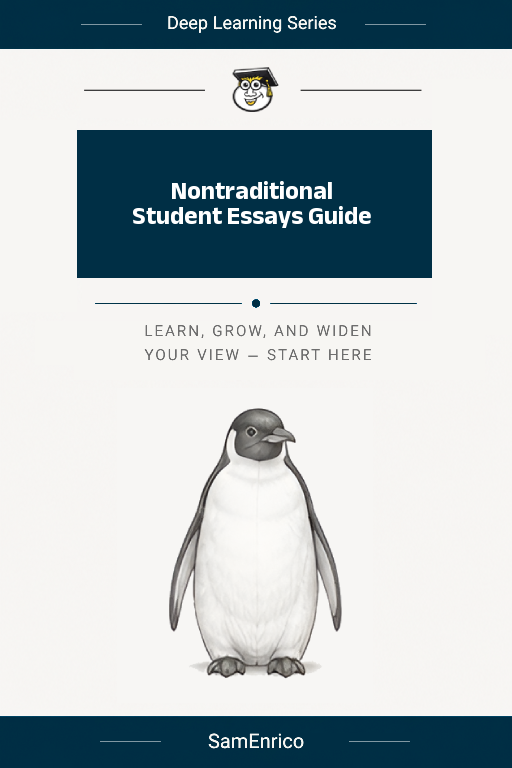
essaysStudent's ShortcutNontraditional
Nontraditional Student Essays Guide eBook
Frame gap years, work experience, or military serv
by Locke Cleo
Frame gap years, work experience, or military service as strengths in your application.
Formats
Free sample
Chapter 1: The Pivot Paradox...--You feel late. Let me stop you right there.That feeling—the one that sits in your chest when you see high school classmates posting graduation photos while you’re still scrubbing dishes, packing boxes, or changing oil—is the single biggest obstacle between you and a winning application essay. Not your age. Not your transcript. Not the three years you spent as a night manager at a gas station instead of sitting in a lecture hall.
The feeling of being behind.Here is the paradox that this entire chapter exists to sear into your memory: The very thing that makes you feel late is the thing that makes you interesting.Admissions officers are not looking for more eighteen-year-olds who followed the script perfectly. They are drowning in those applications. What they are starving for—what they will remember during hours of deliberation—is the student who walked through the world for a while before walking into their classroom. You are not behind. You are ahead in ways that have nothing to do with a calendar.This chapter will rewire how you see every month, year, or decade you spent away from traditional education.
By the time you finish, you will never again describe your gap as a “break” or “time off.” You will call it what it is: evidence.The Myth of the Linear Student Let me tell you a story about a lie we have all been told.Somewhere around middle school, most American students absorb an unspoken curriculum: good students graduate high school at eighteen, go straight to college, graduate at twenty-two, and start a career. This is called the “linear path.” It is presented as normal, optimal, and—for many families—morally superior to any deviation.Here is what no one tells you: the linear student was never the majority.According to data from the National Center for Education Statistics, fewer than forty percent of college students fit the traditional mold of attending a four-year institution full-time immediately after high school. The rest are commuting, working, parenting, serving in the military, or returning after years away. The linear path is a myth—a cultural artifact from a postwar economy that no longer exists. But myths have power, and the power of this myth is that it makes everyone who deviates feel defective.You are not defective.The admissions offices you are applying to know the data.
They know that students who arrive with work experience, military service, caregiving responsibilities, or even just a few years of life under their belts tend to have higher graduation rates. They ask questions in class. They go to office hours. They do not call their parents to complain about a B-minus. They treat college like the expensive, time-sensitive investment it is.A study published in the journal Educational Evaluation and Policy Analysis followed students who entered college after age twenty and found that they were significantly more likely to graduate within six years than their eighteen-year-old peers.
The reason is not that older students are smarter. It is that they have something that cannot be taught in an AP class: skin in the game.Every time you paid rent, you learned about consequences. Every time you showed up for a shift you hated because the alternative was eviction, you learned about discipline. Every time you navigated a difficult coworker, a demanding boss, or a bureaucratic nightmare, you learned about systems. These are not consolation prizes.
These are the raw materials of a compelling application.The Feeling of Being "Behind" (And Why It Is Wrong)Let me give you a specific exercise. I want you to take out your phone or a piece of paper and write down every reason you feel behind. Be honest. No one will see this but you.I graduated at twenty-three instead of eighteen.I worked retail for four years while my friends earned degrees.I had a child.I took care of a sick parent.I joined the military and deferred everything.I tried college once and failed.I had no idea what I wanted to study, so I did nothing.Write it all down.Now look at that list. Every item on it represents something you did—or something that happened to you—that required resilience, problem-solving, or plain old survival.
None of it is empty space. Even the years you spent “doing nothing” were likely years you spent wrestling with confusion, fear, or circumstances beyond your control. That wrestling is not nothing.Here is the reframe: Instead of “I started late,” say “I started intentionally.”Instead of “I wasted time,” say “I clarified my goals through experience.”Instead of “I have gaps in my education,” say “I built a foundation that will make my education more meaningful.”This is not toxic positivity. This is strategic repositioning. Admissions officers are not investigators trying to catch you in a lie about your past.
They are readers trying to assemble a picture of who you will be as a student. If you hand them a story about lateness and regret, that is the picture they will see. If you hand them a story about intentionality and growth, that is the picture they will see. You have the power to choose which story you tell.I want to pause here and make a distinction that will matter throughout this book. Not all gaps are created equal, and pretending they are would be dishonest.
There is a difference between a strategic pause—time spent working, serving, caregiving, or pursuing structured growth—and unstructured passive time. Unstructured passive time means months or years without engagement of any kind: no job, no education, no caregiving, no volunteering, no serious skill development. If that describes your gap, do not panic. Chapter 11 of this book is written specifically for you. But for the purposes of this chapter, we are focused on the vast majority of nontraditional students who did something with their time away from school—even if that something does not feel impressive from the outside.What Admissions Officers Actually Want Most applicants approach the admissions essay like a confession.
They believe the goal is to apologize for their flaws and convince the reader that they are not as bad as their transcript suggests. This is exactly backwards.Admissions officers are not priests. They are not therapists. They are not even, strictly speaking, evaluators of your past. They are forecasters.
Their job is to predict whether you will succeed at their institution, graduate, and make them look good in the alumni statistics. Everything in your application is data for that forecast.Here is what they know from decades of enrollment data: Students who have navigated real-world responsibilities before college tend to outperform their traditional peers on almost every metric. They have higher first-semester GPAs. They are less likely to drop out. They report higher satisfaction with their college experience.
They ask for help when they need it instead of spiraling.The nontraditional student is not a risk. The nontraditional student is a hedge.The challenge is that admissions officers read hundreds of applications per week. They are tired. They have seen the same mission trip essay fifty times. They…
This is the end of the free sample. Get the eBook to keep going. Buy now
About this book
Details
- Author
- Locke Cleo
- Publisher
- SamEnrico
- Language
- English
- Genre
- essays, Student's Shortcut, Nontraditional
- Released
- 2026-06-01
- Pages (approx.)
- 143
- Available as
- eBook, Audiobook

Read better in the ZLOADR app
Your eBooks on your phone or tablet. Sign in with your SamEnrico account and start reading.
More by Locke Cleo
 Widow Support Group FinderLocke Cleo$11.99
 Thirty Years Death Row HintonLocke Cleo$11.99
 File and Suspend Strategy GuideLocke Cleo$11.99
 Reconstruction of Hit and Run ScenesLocke Cleo$11.99
 Peg System For Travel PackingLocke Cleo$11.99
 Rate of Speech for TranceLocke Cleo$11.99
 Pomodoro for Customer ServiceLocke Cleo$11.99
 Anna Chlumsky Vada AfterLocke Cleo$11.99
 The Silk Road to Peace: How a Forgotten Trade Route Shaped Modern DiplomacyLocke Cleo$11.99
 The Poison Diaries: The Fake Doctor Who Killed for ProfitLocke Cleo$11.99
 How to Produce Dried VegetablesLocke Cleo$11.99
 Research Proposal Writing Schedule WorkbookLocke Cleo$12.99
You may also like
 YouTube Video Essay DepthLeon Lala$11.99
 TOEFL Independent Essay GuideMintz Alex$11.99
 Music Theory Essay GuideWilkinson Maisha$11.99
 Expository Essay AI PromptsApplegate Dalia$11.99
 Exam Essay MemorizationMcgovern Johna$11.99
 Compare Contrast Essay PromptsOntiveros Marx$11.99
 College Application Essay GuideSisson Aimee$11.99College Application Essay GuideSisson Aimee$11.99
 The 100 Word Essay ChallengeAli Luciana$11.99
 Journalism Essay PromptsThatcher Williemae$11.99
 Finance Essay PromptsShrader Lamont$11.99
 Cause Effect Essay GPT GuideBland Jacelyn$11.99