
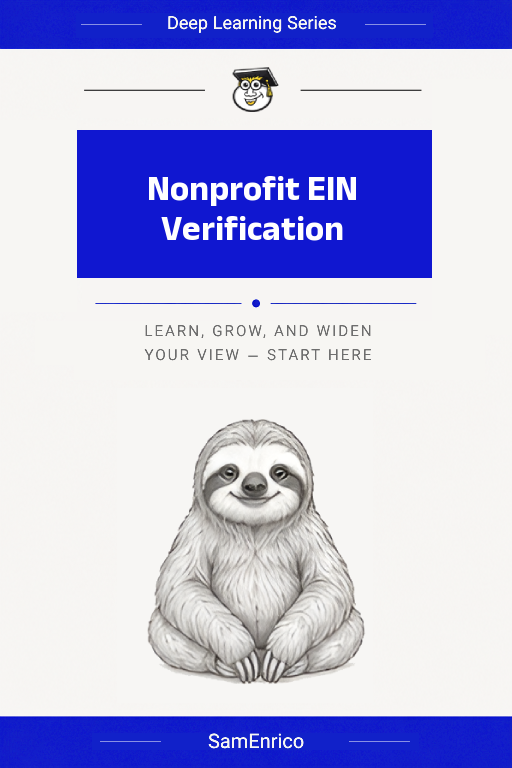
Nonprofit EIN Verification eBook
Verify employer identification number annually and
by Beasley Lou
Verify employer identification number annually and update IRS with any changes to address or responsible party.
Formats
Free sample
Chapter 1: The Verification Gap--–- Maria had been running her after-school literacy program for nearly two years. She had an Employer Identification Number. She had a bank account. She had glowing testimonials from fifteen parents. What she didn't have was a $75,000 grant from a major foundation—and she didn't know why until the program officer finally took her call."They pulled your EIN," the officer explained gently.
"You're not in the system. We can't issue a tax-deductible grant to an organization that doesn't exist in the IRS database.""But we exist," Maria protested. "We've been operating for twenty-three months. We have a determination letter. I'm looking at it right now."The program officer paused.
"Is your organization listed in Publication 78? Or the TEOS database?"Maria had no idea what either of those things were. She hung up, went to her computer, typed her EIN into the IRS Tax Exempt Organization Search tool, and stared at a message that would change the trajectory of her organization: "No matching records found."She had an EIN. She had a determination letter. But for the IRS, for donors, and for every grantmaker in America, she did not exist.The Most Dangerous Misconception in Nonprofit Management This chapter dismantles a single, devastatingly common belief: that having an Employer Identification Number (EIN) is the same as being a tax-exempt charity.
This misconception has cost well-intentioned nonprofit founders millions of dollars in lost donations, denied grants, and retroactive tax penalties. It has forced organizations to shut down after years of operation because they suddenly discovered their donors could not deduct a single contribution.The IRS issues EINs for one purpose only: identification. An EIN is to a nonprofit what a Social Security Number is to an individual. It tells the IRS who you are, not what you are. It allows you to open a bank account, file taxes, and hire employees.
But it does not—and cannot—confer tax-exempt status.501(c)(3) status requires a separate, rigorous application process via Form 1023 (or Form 1023-EZ for smaller organizations). This application can take anywhere from three months to over a year to process. During that time, you have an EIN but no tax-exempt status. You are, in the terminology this book will use throughout, caught in the Verification Gap.The Verification Gap is the period—or, for some organizations, the permanent condition—where an organization holds a valid EIN but lacks deductibility status. In this gap, donors cannot deduct contributions.
Grantmakers cannot issue tax-deductible grants. And the IRS treats every dollar received as potentially taxable income.The Two Types of Verification Gap Understanding the Verification Gap requires distinguishing between two distinct scenarios that look identical from the outside but require completely different solutions.Scenario One: The Pending Application Gap This is the most common scenario. A founder applies for an EIN online—a process that takes about fifteen minutes and produces an immediate number. They then file Form 1023 with the IRS to request 501(c)(3) status. While the application is pending—typically three to twelve months—the organization has an EIN but no official tax-exempt status.During this gap, the organization can operate.
It can raise money, hire staff, and deliver programs. But every donor who contributes during this period cannot deduct that contribution on their taxes. The organization cannot issue a valid charitable donation receipt. And major grantmakers will automatically reject any application because the organization's EIN will return "No matching records found" in the IRS database.The trap here is optimism. Founders assume that because they have applied, they are essentially approved.
They are not. The IRS rejects or requests additional information on a significant percentage of Form 1023 applications. And even for applications that will eventually be approved, the gap period creates a compliance nightmare when it comes time to file the organization's first Form 990.Scenario Two: The Never-Filed Gap The second scenario is more dangerous and more common than most advisors acknowledge. An organization receives an EIN, operates for years, and never files Form 1023. The founders mistakenly believe that the EIN itself confers tax-exempt status.
They issue donation receipts. They tell donors their gifts are tax-deductible. They may even have received a small grant from a local foundation that didn't check the IRS database.This organization does not exist for IRS purposes. Every donation receipt they have ever issued is invalid. Every donor who claimed a deduction on their taxes is potentially subject to audit and penalty.
The organization itself may owe federal income tax on all contributions received, as the IRS treats unreported revenue from a non-exempt entity as taxable income.The tragedy of this scenario is that it is entirely preventable. A single conversation with a nonprofit attorney or a competent accountant would have identified the error. But founders are busy. They are focused on programs, on clients, on impact. And the EIN application process does not include a warning that an EIN is not the same as tax-exempt status.The Three Deadly Assumptions Through hundreds of consultations with nonprofit founders, I have identified three assumptions that lead organizations directly into the Verification Gap.
Recognizing these assumptions in your own thinking is the first step toward closing the gap.Assumption One: "The IRS wouldn't give me a number if I wasn't approved."This is the most intuitive and most dangerous assumption. The IRS is the gatekeeper of tax-exempt status. Why would they issue a number to an organization that isn't approved? The answer lies in the structure of the IRS itself. The department that issues EINs (the Business Tax division) is completely separate from the department that approves 501(c)(3) applications (the Tax Exempt and Government Entities division).
The left hand does not talk to the right hand. An EIN is issued automatically to any entity that requests one, with no review of tax-exempt eligibility whatsoever.Think of it this way: The Social Security Administration will issue a Social Security Number to a newborn infant. That number does not confer the right to vote, drive a car, or purchase alcohol. It is simply an identifier. An EIN is an identifier.
501(c)(3) status is a privilege granted after a separate, substantive review.Assumption Two: "The determination letter proves we're a charity."A determination letter is a beautiful document. It bears the official IRS seal. It states in formal, authoritative language that your organization is exempt from federal income tax under Section 501(c)(3) of the Internal Revenue Code. Founders frame this letter. They include it in grant applications.
They wave it at skeptics.But the determination letter proves nothing to donors. Donors cannot deduct a contribution based on your determination letter. The IRS requires donors to verify your status in the official IRS database—historically Publication 78, now the TEOS (Tax Exempt Organization Search) tool. The determination letter is proof for you, the organization, that you are exempt. It is not proof for donors.
It is not proof for grantmakers. It is not proof for the IRS when a donor is audited.I have seen determination letters that are beautiful, official, and completely useless because the organization was never listed in the IRS database due to a clerical error. The letter said one thing; the database said another. And the database…
This is the end of the free sample. Get the eBook to keep going. Buy now
About this book
Details
- Author
- Beasley Lou
- Publisher
- SamEnrico
- Language
- English
- Genre
- Non-Fiction, Annual Checkup, EIN, Verification
- Released
- 2026-06-01
- Pages (approx.)
- 157
- Available as
- eBook, Audiobook

Read better in the ZLOADR app
Your eBooks on your phone or tablet. Sign in with your SamEnrico account and start reading.
More by Beasley Lou
 Self Hypnosis for Meal Prep HabitsBeasley Lou$11.99
 Parental Anger And Food BattlesBeasley Lou$11.99
 Priority Cheat Sheet GuideBeasley Lou$11.99
 Mindful Dating After AddictionBeasley Lou$11.99
 Beginner Mindfulness for DepressionBeasley Lou$11.99
 The Ballot Heist: How a Single County Flipped a Presidential RaceBeasley Lou$11.99
 The Code Wars: How Two Geniuses Split the Digital WorldBeasley Lou$11.99
 Isolate Reactor OperatorBeasley Lou$11.99
 Community Freemium StrategyBeasley Lou$12.99
 How to Become a Jewel Grinder IiBeasley Lou$11.99
 Understanding Decompensated PhoriaBeasley Lou$17.99