
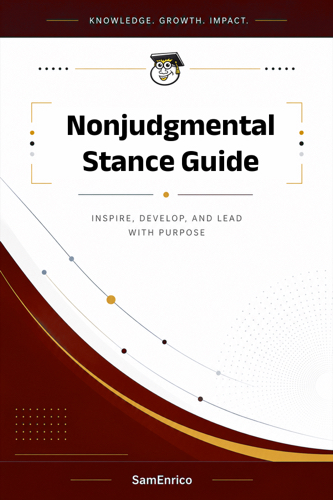
Nonjudgmental Stance Guide eBook
Describe without evaluating as good or bad.
by Pridgen Kory
Describe without evaluating as good or bad.
Formats
Free sample
Chapter 1: The Judgment Habit--–- You are about to make a judgment in the next three seconds. Not because you are a critical person, but because your brain is wired to do so. This chapter will show you why that automatic labeling happens, why it so often leads to unnecessary suffering, and how a simple shift—from evaluation to observation—can begin to rewire everything from your inner critic to your most difficult conversations.Every morning, before your feet touch the floor, your brain has already completed dozens of evaluations. The alarm is annoying. The light through the window is too bright.
The temperature of the room is either too cold or too warm. Yesterday’s text message from a friend was dismissive. The meeting you have scheduled for 10 AM will be boring. Your partner’s breathing is too loud. Your own thoughts are too slow.You are not flawed for thinking this way.
You are human.The human brain evolved over hundreds of thousands of years to prioritize one function above all others: survival. And survival depends on split-second categorization. Is that shape in the tall grass a predator or prey? Is that berry safe to eat or poisonous? Is that person from the neighboring tribe a friend or an enemy?
The brain that could answer these questions fastest—without stopping to deliberate—was the brain that lived long enough to pass on its genes.In that ancestral environment, the judgment habit was a superpower.But you do not live in the ancestral environment. You live in a world of emails, social media, deadlines, traffic, family obligations, political polarization, and an endless stream of notifications designed to trigger your brain’s threat-detection circuitry. The same mechanism that once saved your ancestors from saber-toothed tigers now misfires constantly. It labels your boss as a threat, your child’s tantrum as an injustice, your own mistake as evidence of personal failure, and a stranger’s political opinion as proof of moral inferiority.The result is not survival. The result is chronic stress, damaged relationships, narrowed thinking, and an inner life that feels like a courtroom where you are perpetually on trial.This book offers a different way.
Not by eliminating judgment—which is neither possible nor desirable—but by transforming your relationship with it. The nonjudgmental stance is not about becoming a blank, passive observer who never evaluates anything. It is about learning to notice when judgment is running on autopilot, creating a pause, and then choosing whether to describe or evaluate based on what the situation actually requires.This first chapter lays the foundation for everything that follows. You will learn why the brain defaults to judgment, how that default creates hidden costs in modern life, and the single most important distinction that will reappear in every subsequent chapter: the difference between observation and evaluation. By the end of this chapter, you will have a clear map of the book and a practical first step toward rewiring your own judgment habit.The Evolutionary Origins of Automatic Judgment To understand why judgment feels so automatic, so effortless, and so true, you have to look inside the skull.
The human brain is not a single unified organ but a collection of systems that evolved at different times. The oldest parts—sometimes called the reptilian brain or the limbic system—are responsible for basic survival functions: breathing, heart rate, fight-or-flight responses, and rapid threat detection. These systems operate below conscious awareness. They do not reason. They do not deliberate.
They react.The newer parts—the prefrontal cortex—are capable of abstract thinking, long-term planning, and impulse control. But here is the problem: the older systems are much faster. By the time your prefrontal cortex has gathered the relevant data, your limbic system has already labeled the situation as good or bad, safe or dangerous, friend or foe.This is not a design flaw. It is an elegant solution to a real problem. A gazelle that stops to analyze whether the shape on the horizon is truly a lion or just a large rock will become lunch.
A hominid that pauses to consider the nuanced personality of a stranger holding a spear will not survive to raise children. The brain’s bias toward rapid, categorical judgment is the reason you are here to read this book.The neuroscientist Antonio Damasio documented this process in patients with damage to the parts of the brain that generate emotional responses. These individuals could reason perfectly well about hypothetical situations, but they could not make even simple real-world decisions. Without the rapid, emotional, judgmental nudge from the older brain systems, they remained paralyzed by endless analysis. Judgment, in other words, is not the enemy of decision-making.
It is the engine.The trouble begins when this ancient engine runs in a modern world for which it was not designed.In the ancestral environment, threats were physical, immediate, and relatively rare. A predator attack was over quickly, and then the nervous system could return to baseline. In the modern environment, threats are often social, symbolic, and endless. A critical email does not end after two minutes; it echoes in your mind for hours. A passive-aggressive comment from a coworker triggers the same threat response as a physical attack, but there is no resolution.
The judgment loop cycles over and over, keeping your nervous system in a state of low-grade activation that psychologists call allostatic load.This chronic activation has measurable costs. High allostatic load is associated with cardiovascular disease, impaired immune function, depression, anxiety, and shortened lifespan. The judgment habit, intended to keep you alive, is slowly wearing you down.The Hidden Costs of Constant Evaluation The evolutionary perspective explains why judgment happens. But to motivate change, you have to see what constant evaluation costs you in daily life. These costs fall into four overlapping domains: internal suffering, relational conflict, cognitive narrowing, and behavioral rigidity.Internal suffering is the most obvious cost.
When you evaluate yourself as bad, wrong, lazy, stupid, or unworthy, you are not just describing your behavior. You are indicting your entire being. And because the brain cannot distinguish between a physical threat and a social or self-inflicted threat, those evaluations trigger the same stress response as a predator. The inner critic is not a harmless voice. It is a chronic stressor that elevates cortisol, disrupts sleep, and undermines motivation.
The paradox is that harsh self-judgment rarely improves performance. It triggers a threat response that narrows attention and reduces cognitive flexibility, which are the very resources you need to improve.Relational conflict is the second cost. When you evaluate another person as rude, selfish, incompetent, or dishonest, you are not just observing their behavior. You are assigning a fixed identity to them. And once you have assigned that identity, your brain seeks evidence to confirm it while filtering out evidence that contradicts it.
This is called confirmation bias. Your coworker who interrupted you once becomes, in your mind, an interrupter—a person with a flawed character. You stop noticing the nine times they listened patiently. Your resentment grows. Eventually, you treat them as if they are defective, and they respond to that treatment, creating a self-fulfilling prophecy.The same…
This is the end of the free sample. Get the eBook to keep going. Buy now
About this book
Details
- Author
- Pridgen Kory
- Publisher
- SamEnrico
- Language
- English
- Genre
- Non-Fiction, Self-Help, Judgment
- Released
- 2026-06-08
- Pages (approx.)
- 145
- Available as
- eBook, Audiobook

Read better in the ZLOADR app
Your eBooks on your phone or tablet. Sign in with your SamEnrico account and start reading.
More by Pridgen Kory
 Francis of Assisi Sermon to BirdsPridgen Kory$11.99
 Parent Priority MatrixPridgen Kory$11.99
 Panic Disorder Night PracticePridgen Kory$11.99
 Validating HopelessnessPridgen Kory$11.99
 Remote Work for FirefightersPridgen Kory$11.99
 Ghrelin Hunger GuidePridgen Kory$11.99
 Catherine Westernization BlueprintPridgen Kory$11.99
 Fafnir’s Last Breath: The Dragon’s Curse and the Doomed HeroPridgen Kory$11.99
 The Healers of Axum: The Medical Marvels of the Aksumite EmpirePridgen Kory$11.99
 How to Produce Tool Processing ServicesPridgen Kory$11.99
 A Collector's Handbook to the Hillman Minx Series IPridgen Kory$11.99
 Madrid Protocol Licensing RecordalPridgen Kory$12.99
You may also like
 Hong Kong Handover 1997Dunn Johnnie$11.99
 Zumba For Postnatal Recovery CourseNeal Christian$11.99
 Zumba for BeginnersLadner Nikia$11.99
 YouTube Comment Mining GuideHumes Pandora$12.99
 Worry Box MeditationCarlin Rudy$11.99
 Workplace Stress MeditationNguyen Lynn$11.99
 Workplace Stress and Sleep RepairHawley Ivory$11.99
 Workplace Perfectionism CureDelaney Jeffry$11.99
 Workplace Injustice Anger GuideWallen Isabelle$11.99
 Work Addiction and Burnout LinkGreenwood Ester$11.99
 Women in Yoga and WellnessBeattie Galina$11.99
 Women in Stand Up ComedyChun Evangeline$11.99