
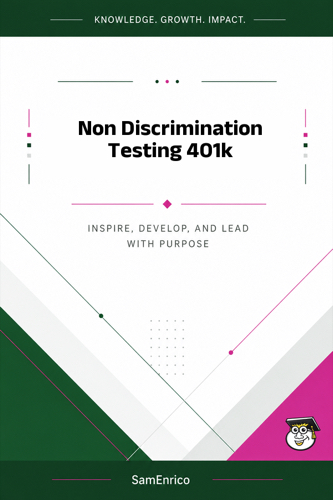
Non-FictionBusiness BriefTesting
Non Discrimination Testing 401k eBook
Ensure plan benefits rank and file employees fairl
by Jansen Joey
Ensure plan benefits rank and file employees fairly compared to owners.
Formats
Free sample
Chapter 1: The $70,000 Question--–- Most business owners have no idea they are leaving over half a million dollars on the table. Not because their business isn't profitable. Not because they aren't saving. But because they have never been shown how the 401(k) non-discrimination rules actually work—and how to make them work in their favor.Let me tell you about Dave. Dave is a dentist.
He owns a practice with twelve employees: three hygienists, four dental assistants, two front-desk staff, one office manager, and two other dentists who work for him as associates. Dave is forty-eight years old. He earns $350,000 per year. He wants to retire at sixty-five with a comfortable nest egg. He has heard that 401(k) plans are good for business owners.
So he calls his financial advisor.The advisor says, "Great idea, Dave. We'll set up a 401(k) plan. You can defer up to $69,000 in 2025 if you're over fifty, including catch-up contributions." Dave is thrilled. He imagines seventeen years of maxing out his 401(k), letting the market do its work, and retiring with over two million dollars tax-deferred.Then the advisor says, "But Dave, there's a catch. The IRS requires that your plan benefits your employees fairly.
So you'll need to contribute to their accounts as well. Based on your practice's demographics, you're looking at about $15,000 per year in contributions to your staff."Dave does the math. Fifteen thousand dollars per year times seventeen years is $255,000. That's a lot of money to give to employees, he thinks. But he also knows he needs to save for retirement.
He signs the paperwork.What Dave does not know—and what his advisor does not tell him—is that he could have achieved the same owner contribution limits for a fraction of that cost. Over the next twelve chapters, you will learn why Dave overpaid by thousands of dollars every single year. More importantly, you will learn how to avoid becoming Dave.This chapter answers one question: Why should you care about non-discrimination testing? The answer is not because the IRS says so. The answer is because getting this right puts money in your pocket.
Getting it wrong costs you money—sometimes a lot of money.The $70,000 Question Let me reframe everything you are about to read. Most books on 401(k) compliance start with the Internal Revenue Code. They cite regulations. They define terms like "Highly Compensated Employee" and "Actual Deferral Percentage" before you have any reason to care about them. That is backwards.Here is the question that actually matters to you: How much money can I put in my 401(k) this year, and what will it cost me to do it?For 2025, the maximum contribution for someone age fifty or older is approximately $69,000 (this includes the standard deferral limit of $23,500, a catch-up contribution of $7,500 for those fifty and older, plus employer profit-sharing contributions that can bring the total to the annual addition limit of $69,000).
For someone under fifty, the maximum is approximately $61,500. Let's call it $70,000 for simplicity.That is the ceiling. That is the best-case scenario. That is what you want.Now here is the reality for most business owners who do not understand non-discrimination testing: they cannot get anywhere near that number. Their actual contribution limit might be $20,000.
Or $15,000. Or zero. Not because the IRS has a separate rule limiting owners. But because the non-discrimination tests—which compare what owners save to what employees save—artificially cap owner contributions when employees do not participate at high enough rates.Let me give you a concrete example. Suppose your employees, on average, defer only 2% of their pay into the 401(k) plan.
Under the rules you will learn in Chapter 3, you as the owner might be limited to deferring only 4% of your own pay. If you earn $300,000, that is just $12,000. Compare that to the $70,000 you could have contributed. That is a $58,000 difference. In one year.
Over ten years, that is nearly $600,000 of lost retirement savings. Over a career, it is well over a million dollars.That is the $70,000 question. That is why you care about non-discrimination testing. Not because you love compliance. Not because you want to impress your third-party administrator.
But because getting this right is one of the largest untapped opportunities for tax-advantaged wealth building available to business owners today.The Four Costs of Getting It Wrong Before we dive into solutions, let me make the consequences painfully clear. There are four distinct costs associated with failing non-discrimination tests. Three of them are financial. One of them is reputational. All of them are avoidable.Cost One: The Lost Contribution Opportunity This is the largest cost and the one most owners never see because it is invisible.
When your plan fails the ADP or ACP tests, you do not write a check to the IRS. Instead, the IRS tells you that you contributed too much compared to your employees. You must take money back out of the plan—money that you had already set aside for retirement.But the real cost is not the refund itself. The real cost is that you lose the ability to contribute that money in the first place. That money could have grown tax-deferred for decades.
Instead, it comes back to you as taxable income, often with an additional 10% early withdrawal penalty if you are under fifty-nine and a half.Think of it this way: every dollar you cannot contribute today is a dollar that will not compound for your retirement. At a 7% annual return, one dollar not contributed today is worth nearly four dollars in twenty years. A $50,000 lost contribution opportunity today is $200,000 less in retirement.Cost Two: The Corrective Distribution Tax Hit When you are forced to take a corrective distribution—meaning the IRS says you put too much in and you have to take it back out—that money becomes taxable income in the year you receive it. If you are in a 37% tax bracket, a $50,000 corrective distribution means an unexpected $18,500 tax bill.But it gets worse. If you are under age fifty-nine and a half, that corrective distribution is also subject to a 10% early withdrawal penalty.
That is another $5,000. So your $50,000 contribution, which you thought was growing tax-free for retirement, becomes $50,000 of taxable income costing you $23,500 in taxes and penalties. And you no longer have the money in your retirement account.Cost Three: The Excise Tax on Employers When a plan fails its tests and the employer does not correct the failure within the 2.5-month window (March 15 for calendar-year plans), the employer owes a 10% excise tax on the excess contributions. This tax is paid by the business, not by the owner personally. It is a penalty for late correction.
It is entirely avoidable, yet the IRS collects millions of dollars of this tax every year from business owners who simply missed the deadline.Cost Four: Plan Disqualification and Audit Risk This is the nuclear option. If a plan repeatedly fails its tests or fails to correct failures in a timely manner, the IRS can revoke the plan's qualified status. A disqualified plan loses all tax benefits. Employer contributions become taxable to employees. Employee deferrals lose their pre-tax status.
The business loses its deduction for contributions. Everyone's account becomes taxable immediately. This almost never happens to owners who are…
This is the end of the free sample. Get the eBook to keep going. Buy now
About this book
Details
- Author
- Jansen Joey
- Publisher
- SamEnrico
- Language
- English
- Genre
- Non-Fiction, Business Brief, Testing
- Released
- 2026-06-07
- Pages (approx.)
- 126
- Available as
- eBook, Audiobook

Read better in the ZLOADR app
Your eBooks on your phone or tablet. Sign in with your SamEnrico account and start reading.
More by Jansen Joey
 Every Character is MeJansen Joey$11.99
 Attempt Survivor Disability StoryJansen Joey$11.99
 Metta for Radiation TherapyJansen Joey$11.99
 Adoption Disruption Loss SupportJansen Joey$11.99
 The Silk Road’s Last Emperor: The Untold Story of a Trade DynastyJansen Joey$11.99
 Head of PR and CommunicationsJansen Joey$11.99
 Five Below SWOT GuideJansen Joey$12.99
 Excel for Environmental Economics ExamsJansen Joey$12.99
 Understanding Nephropathy, Familial With GoutJansen Joey$17.99
 A Beginners Guide to Game of the Generals (Volume 1)Jansen Joey$11.99
You may also like
 Hong Kong Handover 1997Dunn Johnnie$11.99
 Zumba For Postnatal Recovery CourseNeal Christian$11.99
 Zumba for BeginnersLadner Nikia$11.99
 YouTube Comment Mining GuideHumes Pandora$12.99
 Worry Box MeditationCarlin Rudy$11.99
 Workplace Stress MeditationNguyen Lynn$11.99
 Workplace Stress and Sleep RepairHawley Ivory$11.99
 Workplace Perfectionism CureDelaney Jeffry$11.99
 Workplace Injustice Anger GuideWallen Isabelle$11.99
 Work Addiction and Burnout LinkGreenwood Ester$11.99
 Women in Yoga and WellnessBeattie Galina$11.99
 Women in Stand Up ComedyChun Evangeline$11.99