
Non-FictionSelf-HelpNoiseInterruptions
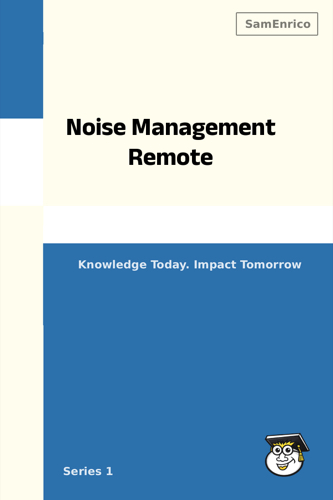
Noise Management Remote eBook
Handle household noise, construction, and family i
Handle household noise, construction, and family interruptions.
Formats
Free sample
Chapter 1: The Broken Promise--–- Sarah had spent $347 on the best noise-canceling headphones on the market. She knew this because she had checked her credit card statement three times, trying to justify the purchase to her husband, to her budget, and most of all, to herself. The Sony WH-1000XM5s were supposed to be miraculous. The reviews said they could turn a roaring airplane cabin into a whisper. You Tubers had filmed themselves standing next to jackhammers, smiling serenely while the camera captured nothing but their voice.
Sarah had watched those videos at midnight, alone in her living room, while her toddler slept upstairs and her husband worked the night shift. She had clicked "buy now" with the desperate hope of a person who believes that the right piece of technology might finally solve a problem that feels like it is slowly breaking her.The headphones arrived on a Tuesday. She unboxed them during her lunch break, carefully pairing them with her laptop, adjusting the fit, downloading the companion app. She activated the active noise cancellation, or ANC, and stood in her kitchen. The refrigerator hum disappeared.
The distant traffic outside became a faint memory. She almost cried with relief.Then her two-year-old dropped a sippy cup on the hardwood floor.Sarah flinched. Not a small flinch, either. Her shoulders went up to her ears. Her jaw clenched.
Her heart, which had been beating at a calm seventy-two beats per minute, jumped to one hundred and eight. She felt the cortisol flood her system the way you feel hot water in a shower that has suddenly been turned too high. She was not scared. She knew it was just a cup. But her body did not care what she knew.
Her body was doing what bodies have done for millions of years when a sudden, unexpected sound occurs inside a space that is supposed to be safe.She took off the headphones, set them on the counter, and stared at them. Three hundred and forty-seven dollars. And she still flinched.The Headphone Lie Sarah is not the problem. You are not the problem. The problem is a fundamental misunderstanding that has been sold to remote workers for the past decade: that noise is just sound, and sound can be canceled.Noise-canceling headphones are remarkable pieces of engineering.
They work through a process called destructive interference. A tiny microphone on the outside of the earcup listens to the ambient sound around you. A chip inside the headphone generates an inverted waveform of that sound—essentially, the exact opposite pressure wave. When the original sound wave and the inverted wave meet inside your ear, they cancel each other out. Silence.
Or at least, something very close to it.This works beautifully for what engineers call stationary or periodic noise. The hum of an airplane engine is a steady, predictable sound wave. A train rolling down tracks is periodic. The drone of a highway is monotonous. These sounds have repeating patterns that the ANC chip can learn and invert in real time.
The result is a profound sense of quiet.But here is what the marketing materials do not tell you. Here is what the You Tubers do not demonstrate when they stand next to their jackhammers (which, by the way, are usually producing a steady, predictable rumble, not the chaotic burst of a child's cry). Active noise cancellation is nearly useless against sudden, unpredictable, non-stationary sounds.A dog barking. A door slamming. A toddler shouting "MAMA" from two rooms away.
A delivery driver ringing the doorbell. A dish clattering in the sink. A saw starting and stopping as a construction worker cuts lumber. These sounds are not periodic. They do not have a repeating waveform that a chip can predict and invert.
By the time the ANC chip has identified the sound, analyzed its waveform, and generated an inverted signal, the sound is already over. Your brain has already heard it. Your amygdala has already fired. Your cortisol has already spiked.The headphone companies know this. If you read their fine print, they will tell you that ANC is most effective for "low-frequency, steady-state sounds." But they do not put that on the box.
They put a picture of a serene person on an airplane, eyes closed, completely at peace. They imply that peace is a product you can buy.It is not.The Science of the Flinch To understand why Sarah flinched at a falling sippy cup, we have to leave engineering and enter the strange, ancient world of psychoacoustics. This is the study of how the brain interprets sound, and its findings upend almost everything we think we know about noise.The first thing psychoacoustics teaches us is that loudness is not the same as disruptiveness. A sound can be objectively quiet but subjectively devastating. The sound of a mosquito buzzing near your ear at two in the morning is only about thirty decibels—softer than a whisper.
But it can prevent sleep entirely. Meanwhile, a rock concert at one hundred and ten decibels can be experienced as joyful, even energizing, by the same person who would throw a pillow at a mosquito.The difference is not volume. It is meaning.Your brain does not hear sounds neutrally. It hears them through a filter of survival. Every sound that enters your ears is processed by the amygdala, a tiny almond-shaped cluster of neurons deep in your brain that is responsible for threat detection.
The amygdala is ancient. It evolved long before the parts of your brain that handle language, logic, or self-control. It does not think. It reacts.Here is what the amygdala is asking, in every moment, about every sound: Is this a threat? Is it inside my safe zone?
Do I need to prepare my body for danger?When you are in an office, your amygdala has learned that the sounds around you—keyboards clicking, chairs rolling, coworkers chatting in the next cubicle—are not threats. They are "background." The amygdala habituates to them, which is a fancy way of saying it learns to ignore them. This is why you can work in a busy coffee shop or an open-plan office and still get things done. Not perfectly, but adequately.When you are at home, your amygdala operates under a different set of assumptions. Home is supposed to be safe.
It is supposed to be under your control. When an unexpected sound occurs in your home—a cry, a crash, a bark, a knock—your amygdala does not know whether it is a threat or not. So it defaults to threat. It floods your system with cortisol and adrenaline. Your heart rate increases.
Your muscles tense. Your attention snaps away from whatever you were doing and locks onto the sound.This is the orienting response. It is an evolutionary survival mechanism that has been with us since we lived in caves and every unexpected sound might have been a predator or an enemy tribesman. In that context, the orienting response kept us alive. In the context of a Zoom call with your boss, it is a disaster.The orienting response has three stages: detection, orientation, and habituation.
Detection happens in milliseconds. Your brain notices a sound that does not match the predicted environment. Orientation is the shift…
This is the end of the free sample. Get the eBook to keep going. Buy now
About this book
Details
- Author
- Waggoner Manie
- Publisher
- SamEnrico
- Language
- English
- Genre
- Non-Fiction, Self-Help, Noise, Interruptions
- Released
- 2026-06-09
- Pages (approx.)
- 131
- Available as
- eBook, Audiobook

Read better in the ZLOADR app
Your eBooks on your phone or tablet. Sign in with your SamEnrico account and start reading.
More by Waggoner Manie
 Beginner Mind MeditationWaggoner Manie$11.99
 Teresa's Feast Day LegacyWaggoner Manie$11.99
 Loneliness And Self WorthWaggoner Manie$11.99
 The Self Recording Hypnosis GuideWaggoner Manie$11.99
 The Klondike Gold Rush: The Great Canadian HeistWaggoner Manie$11.99
 Learn to Play the Cajun AccordionWaggoner Manie$11.99
 Email Newsletter Pre LaunchWaggoner Manie$12.99
 Leadership MOOC Hiring GuideWaggoner Manie$12.99
 Application Support ManagerWaggoner Manie$11.99
 How to Start a Fiscal Service (public Sector) Business (Beginners Guide)Waggoner Manie$11.99
You may also like
 Hong Kong Handover 1997Dunn Johnnie$11.99
 Zumba For Postnatal Recovery CourseNeal Christian$11.99
 Zumba for BeginnersLadner Nikia$11.99
 YouTube Comment Mining GuideHumes Pandora$12.99
 Worry Box MeditationCarlin Rudy$11.99
 Workplace Stress MeditationNguyen Lynn$11.99
 Workplace Stress and Sleep RepairHawley Ivory$11.99
 Workplace Perfectionism CureDelaney Jeffry$11.99
 Workplace Injustice Anger GuideWallen Isabelle$11.99
 Work Addiction and Burnout LinkGreenwood Ester$11.99
 Women in Yoga and WellnessBeattie Galina$11.99
 Women in Stand Up ComedyChun Evangeline$11.99