
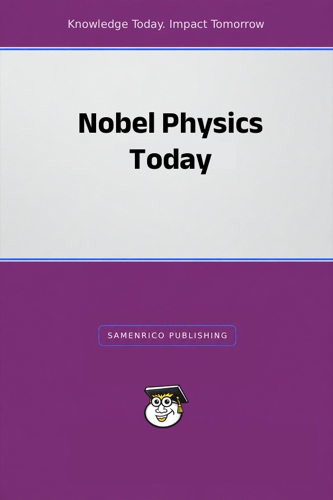
Non-FictionBiographyModern Physics
Nobel Physics Today eBook
Recent prize winners explaining their cutting edge
Recent prize winners explaining their cutting edge discoveries in accessible language.
Formats
Free sample
Chapter 1: The Ghost in the Machine--–- Imagine, for a moment, that you are holding a billiard ball. Smooth, solid, predictable. You roll it toward a brick wall. It bounces back. Everyone knows this—matter cannot pass through matter.
Now imagine that same ball, somehow, silently, appearing on the other side of the wall without breaking it, without cracking it, without even leaving a mark. You would call it magic. A physicist would call it tunneling. And in the strange, ultra-cold world of the quantum computer, this magic is not only possible—it is the engine that will power the twenty-first century.This is a book about the living edges of physics. Not the physics of Newton’s apple or Einstein’s light beam, though those stories are magnificent in their own right.
This is the physics of the Nobel Prize winners you could still meet at a conference today—the men and women who are building quantum computers out of superconducting circuits, who are listening to the ripples of colliding black holes, who are peeling single-atom-thick sheets of carbon off a piece of pencil lead with Scotch tape. This is Nobel Physics Today.And we begin, appropriately enough, with a ghost.The Quantum Heresy The year is 2024. In a laboratory at Google in Santa Barbara, California, a chip sits at the bottom of a dilution refrigerator the size of a small car, chilled to 0.015 Kelvin—colder than interstellar space. This chip contains a handful of superconducting qubits, each one a tiny circuit that behaves according to the laws of quantum mechanics. And in those circuits, something astonishing happens: an electric current, representing a bit of quantum information, can tunnel through an insulating barrier that should, by all classical laws of physics, be impenetrable.If this sounds like science fiction, you are in good company.
When physicists first proposed macroscopic quantum tunneling in the 1980s, many dismissed it as a mathematical curiosity—something that might happen in theory but could never be observed in a real, human-made device. Tunneling, after all, was supposed to be the domain of individual electrons, not of circuits containing billions of atoms acting in unison.They were wrong.The story of macroscopic quantum tunneling begins with a paradox. In the everyday world, objects have definite positions and definite energies. A ball on a hill has gravitational potential energy; if it doesn't have enough energy to reach the top, it rolls back down. A current in a wire has electrical energy; if it encounters an insulator, it stops.
These are not just observations—they are the bedrock of classical physics, the physics of trains and planets and baseballs.But at the scale of the very small—the scale of atoms and electrons—the rules change. In the quantum world, particles do not have definite positions. They exist as waves of probability, smeared out across space. And a wave, unlike a ball, can leak through a barrier. This is quantum tunneling: the probability wave extends to the other side of the wall, and sometimes, when you look, the particle is simply there, on the other side, without ever having climbed over.For decades, physicists observed tunneling only in individual particles—electrons escaping from metal surfaces, alpha particles leaking out of radioactive nuclei.
But in the 1980s, a small group of theorists and experimentalists began to ask a heretical question: What if we could make an entire collection of particles—billions upon billions of them—tunnel together, as a single quantum object?The Three Architects Three names stand out in this story: John Clarke, Michel Devoret, and John Martinis. These are not fictional characters dreamed up for a textbook; they are real scientists, and as of this writing, they are widely considered to be among the leading candidates for a future Nobel Prize in Physics for their work on macroscopic quantum tunneling and superconducting qubits.John Clarke, a British-born physicist at the University of California, Berkeley, was the theorist who first clearly articulated how macroscopic quantum tunneling could be observed in a superconducting circuit. In the early 1980s, Clarke and his collaborators predicted that a Josephson junction—a tiny sandwich of two superconductors separated by an insulating layer—could exhibit quantized energy states, and that a current trapped in the lower energy state could tunnel to the higher state through a barrier that classical physics said was impossible to cross.Michel Devoret, a French physicist who moved to Yale University, was the experimentalist who built the first clean, controllable superconducting circuit to test Clarke's predictions. Working with his colleague Daniel Esteve, Devoret spent years perfecting the art of fabricating Josephson junctions with extremely low noise. Their breakthrough came in the mid-1980s, when they observed clear signatures of macroscopic quantum tunneling in a device known as a "current-biased Josephson junction." The current, representing billions of Cooper pairs (the paired electrons that carry current in a superconductor), would sometimes switch suddenly from zero voltage to a finite voltage—a signature that it had tunneled through the barrier.John Martinis, an American physicist who spent most of his career at the University of Colorado before joining Google, was the engineer who scaled these ideas into working qubits.
Martinis realized that if you could control the tunneling rate precisely, you could use the two energy states of the circuit—the "zero" state and the "one" state—as the basis for a quantum bit. His group at Google built the first superconducting qubits that could be reliably manufactured, controlled, and read out, paving the way for the quantum computers that companies like IBM, Google, and Rigetti are racing to build today.The Experiment: Watching a Ghost Pass Through a Wall Let us walk through the key experiment that demonstrated macroscopic quantum tunneling. Imagine a superconducting loop interrupted by a Josephson junction—a thin insulating barrier. Because the loop is superconducting, a current can flow around it forever without resistance. But here is the trick: the current can only take on certain discrete values.
These are the quantized energy states of the circuit.To understand quantization, imagine a ladder. In classical physics, you can stand on any rung, or anywhere between the rungs. But in quantum physics, you can only stand exactly on the rungs. The space between is forbidden. This is quantization: only specific energies are allowed.In the superconducting circuit, the lowest energy state corresponds to a current flowing in one direction (call it clockwise, representing the "0" state).
The next higher energy state corresponds to a current flowing in the opposite direction (counterclockwise, representing the "1" state). Between these two states, there is an energy barrier—a peak that the current would have to climb over to switch directions. In classical physics, if the current does not have enough energy, it stays put. Forever.But in quantum physics, the current is not a point particle. It is a wave.
And that wave extends, however faintly, into the forbidden region beyond the barrier. If the barrier is thin enough and low enough, the wave has a small but non-zero probability of appearing on the other side. This is tunneling.In the experiment, the researchers cool the circuit to near absolute zero so that no…
This is the end of the free sample. Get the eBook to keep going. Buy now
About this book
Details
- Author
- Boudreaux Virgil
- Publisher
- SamEnrico
- Language
- English
- Genre
- Non-Fiction, Biography, Modern Physics
- Released
- 2026-06-09
- Pages (approx.)
- 140
- Available as
- eBook, Audiobook

Read better in the ZLOADR app
Your eBooks on your phone or tablet. Sign in with your SamEnrico account and start reading.
More by Boudreaux Virgil
 The Paper Planner Time BlockingBoudreaux Virgil$11.99
 Blame Shifting Anger Management HandbookBoudreaux Virgil$11.99
 Financial Stress Survival GuideBoudreaux Virgil$11.99
 Jonathan Ross Big Beard JourneyBoudreaux Virgil$11.99
 The Architects of the Sky: The Nubian Pyramids of MeroëBoudreaux Virgil$11.99
 How to Start a Pens (retail) Business (Beginners Guide)Boudreaux Virgil$11.99
 Epic Games GuideBoudreaux Virgil$12.99
 Ethereum for African ExportersBoudreaux Virgil$12.99
 Understanding PyropoikilocytosisBoudreaux Virgil$17.99
 Fund AccountantBoudreaux Virgil$11.99
You may also like
 Hong Kong Handover 1997Dunn Johnnie$11.99
 Zumba For Postnatal Recovery CourseNeal Christian$11.99
 Zumba for BeginnersLadner Nikia$11.99
 YouTube Comment Mining GuideHumes Pandora$12.99
 Worry Box MeditationCarlin Rudy$11.99
 Workplace Stress MeditationNguyen Lynn$11.99
 Workplace Stress and Sleep RepairHawley Ivory$11.99
 Workplace Perfectionism CureDelaney Jeffry$11.99
 Workplace Injustice Anger GuideWallen Isabelle$11.99
 Work Addiction and Burnout LinkGreenwood Ester$11.99
 Women in Yoga and WellnessBeattie Galina$11.99
 Women in Stand Up ComedyChun Evangeline$11.99