
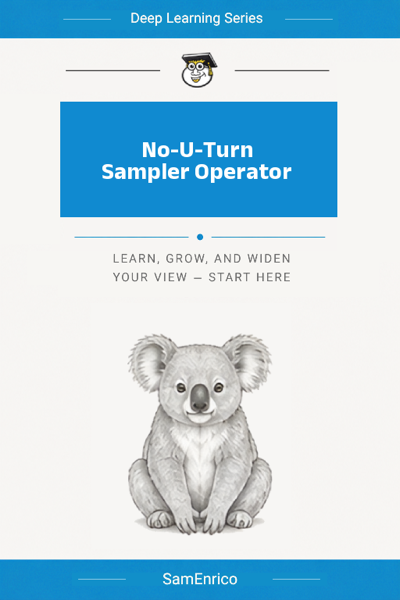
No-U-Turn Sampler Operator Audiobook
A Coursebook on No-U-Turn Sampler Operator
by Falcon Idell
A Coursebook on No-U-Turn Sampler Operator
Formats
Free sample
Chapter 1: The Certainty Mirage...---- In the winter of 2015, a well-funded startup launched an AI system designed to predict which first-year college students would drop out before completing their degrees. The system analyzed high school grades, standardized test scores, financial aid data, and social media activity. On their validation dataset of 50,000 students, the system achieved 89% accuracy. The founders raised $15 million in Series A funding.Six months after deployment, the system was quietly shut down. The problem was not that it made wrong predictions.
The problem was that no one knew when to trust it. For some students, the system predicted a 78% dropout probability. Some of those students indeed dropped out. Others graduated with honors. The 78% number was identical in both cases.
The system could not distinguish between confident predictions and uncertain ones. It output the same number regardless.This is not a story about a bad startup. This is a story about the fundamental limitation of almost every machine learning model used today: the inability to quantify uncertainty. A point estimate tells you a single number, but it conceals the crucial information of how much you should trust that number.This book is about solving that problem. It is about learning to compute not just what you know, but the shape of your ignorance.
And at the heart of this journey lies an algorithm so elegantly named that it sounds like gentle driving advice: the No-U-Turn Sampler.But before we can understand this algorithm, we must first understand why uncertainty quantification is so hard. We must walk to the edge of what traditional methods can do and gaze into the abyss where they fail.Why Your Model Is Probably Overconfident Let me ask you a question. Suppose you build a linear regression to predict housing prices. Your model estimates a coefficient of $12,500 for the number of bathrooms. What does this number mean?Most practitioners would say: "Holding all else constant, an additional bathroom is associated with a $12,500 increase in predicted price."But this is dangerously incomplete.
A complete answer would be: "Based on my data and my modeling assumptions, 12,500isthemostplausiblevalueforthebathroomcoefficient.Valuesnear12,500 is the most plausible value for the bathroom coefficient. Values near 12,500isthemostplausiblevalueforthebathroomcoefficient.Valuesnear12,500 are also plausible. Values far from $12,500 are less plausible. Here is the full distribution of plausibility."The difference between these two answers is the difference between a point estimate and a posterior distribution. The first answer is a…
This is the end of the free sample. Get the Audiobook to keep going. Buy now
About this book
Details
- Author
- Falcon Idell
- Publisher
- SamEnrico
- Language
- English
- Genre
- Non-Fiction, Informative, Educational
- Released
- 2026-05-18
- Pages (approx.)
- 129
- Available as
- eBook, Audiobook

Listen in the VoxFlicks app
Audiobooks and audio dramas wherever you go. Sign in with your SamEnrico account and press play.
More by Falcon Idell
 French Resistance Railway WorkersFalcon Idell$11.99
 Multiple Choice Distractor AIFalcon Idell$11.99
 Toilet Phobia Public Restroom CBTFalcon Idell$11.99
 Psychosis Suicide Attempt Recovery WorkbookFalcon Idell$11.99
 Stress and Frequent Urination GuideFalcon Idell$11.99
 The Whispering Witch of the Black Forest: Baba Yaga’s Forgotten PactFalcon Idell$11.99
 Understanding Maroteaux–le Merrer–bensahel SyndromeFalcon Idell$17.99
 How to Become a Newspaper CarrierFalcon Idell$11.99
 EV Charging Infrastructure GuideFalcon Idell$12.99
 Remote Review Common MistakesFalcon Idell$12.99