
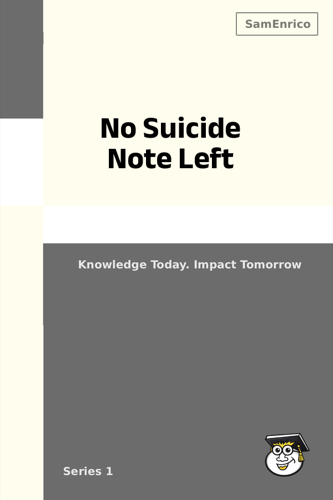
No Suicide Note Left eBook
Coping without explanation or goodbye.
Coping without explanation or goodbye.
Formats
Free sample
Chapter 1: The Knock That Changes Everything...--The sound arrives without warning. It is not a gentle tap or a doorbell’s cheerful chime. It is a knock—deliberate, firm, and somehow already apologetic. You know, in the space between the second and third knock, that nothing will ever be the same. You do not know why you know this.
You simply do. Perhaps it is the hour—too late for neighbors, too early for packages. Perhaps it is the quality of silence that follows the first knock, as if the world itself is holding its breath. Or perhaps it is something older and more primitive: an animal recognition that the social world has ended and the survival world has begun.This chapter is not about processing grief. It is not about finding meaning, writing a tolerable narrative, or beginning the long work of reconstruction.
Those chapters will come, and they will be essential. But they will also be useless if you do not first survive the next seventy-two hours. Right now, your only job is to breathe, to not make things worse, and to let one person—and only one person—help you. Everything else can wait. The funeral can wait.
The phone calls can wait. The decision about what to do with their belongings can wait. The guilt, the rage, the desperate need to understand—all of it can wait. First, you must survive the knock.The Anatomy of Sudden News When the person on your doorstep—police officer, chaplain, family member, or stranger—speaks the words you have already guessed, your brain will not process them like normal information. This is not sadness.
This is not even grief yet. This is trauma, and trauma has its own physiology.Within seconds of hearing “I’m so sorry to inform you” or “There has been an incident” or the unbearable directness of “They died by suicide,” your body will begin a cascade of reactions that are entirely automatic and entirely outside your control. Your heart rate will spike. Your breathing will become shallow or stop entirely for a moment. Your field of vision may narrow to a tunnel, or you may see the room as if from the ceiling—a phenomenon called dissociation, which is your brain’s desperate attempt to make this not real.
Time may slow down so dramatically that you can count the dust motes floating in the air, or it may accelerate so that you find yourself sitting on the floor an hour later with no memory of how you got there.Some people scream. Most do not. Many go silent, their faces frozen, their mouths open but producing no sound. Some laugh—a single, involuntary bark of disbelief—and then immediately feel guilty for laughing. Some vomit.
Some collapse. Some begin pacing, walking in circles, opening and closing drawers as if searching for something they cannot name. Some reach for their phone and begin scrolling, not because they are looking for anything specific but because the phone is a ritual object, a comfort blanket, a way to pretend that the world still operates according to normal rules.None of these reactions is wrong. None of them is a sign of weakness, madness, or lack of love. They are the human nervous system responding to an impossible event.
The person who screams is not weaker than the person who goes silent. The person who collapses is not weaker than the person who stands rigid. Your body is doing exactly what millions of years of evolution have trained it to do in the presence of an existential threat. The fact that the threat is psychological rather than physical does not matter to your amygdala. It only knows that something has gone terribly wrong, and it is flooding your system with cortisol and adrenaline to help you survive.The first thing you need to know—the thing no one will tell you in the coming days—is that this physiological storm will last between twenty minutes and several hours.
You do not need to fight it. You do not need to control it. You only need to not hurt yourself or anyone else while it passes. If you feel like running into traffic, sit down. If you feel like punching a wall, put your hands under your thighs.
If you feel like screaming, scream into a pillow or a coat or your own hands. The feeling will pass. Not the grief—that will stay. But the acute, chemical, fight-or-flight terror will eventually subside, and when it does, you will be exhausted but capable of taking the next single step.The Emergency Anchor: Your Single Most Important Decision In the first hour after the knock, you will be asked to do things. The person who delivered the news will ask if you want to see the body, if you want to call the funeral home, if you have a pastor, if there is someone they should contact.
Your phone will begin buzzing with texts from people who have heard something—social media is fast, and suicide news travels even faster. Your family will call. Your friends will call. Their friends will call. Everyone will want information.
Everyone will want to help. Everyone will have an opinion about what you should do next.You cannot handle this alone. Not because you are weak, but because your brain is currently operating at the cognitive capacity of someone who has just been hit in the head. Executive function—the part of your brain that prioritizes tasks, makes decisions, and filters information—is offline. It will come back online gradually over the next several days, but right now, you are incapable of distinguishing between an urgent need and a trivial demand.
Everything will feel urgent. Nothing is urgent except your physical safety.This is why you need an Emergency Anchor.An Emergency Anchor is one person—singular, not a committee, not a rotating cast of well-meaning friends—whose job is to handle logistics for the next seventy-two hours. This person does not need to be your closest emotional confidant. In fact, it is often better if they are not. Your closest confidant may be as traumatized as you are, especially if they also loved the person who died.
Your Emergency Anchor needs to be someone who can function under pressure, who is not currently in the middle of their own crisis, and who can say no to people on your behalf.This person’s job description is very specific. They will make phone calls to your employer, your children’s school, and any other obligations that require notification. They will filter information from authorities, writing down details that you will need later (case numbers, coroner contact information, property release forms) because you will not remember any of it. They will answer your phone when you cannot, using a script you have approved: “Thank you for reaching out. They are not able to talk right now.
I will pass along your message.” They will order food—not because you will eat it, but because you might need to eat something in six hours. They will handle the first round of social media, if you want…
This is the end of the free sample. Get the eBook to keep going. Buy now
About this book
Details
- Author
- Cummins Billie
- Publisher
- SamEnrico
- Language
- English
- Genre
- Non-Fiction, Self-Help, No Note
- Released
- 2026-06-11
- Pages (approx.)
- 130
- Available as
- eBook, Audiobook

Read better in the ZLOADR app
Your eBooks on your phone or tablet. Sign in with your SamEnrico account and start reading.
More by Cummins Billie
 Step Three Decision To Turn Will Over GuideCummins Billie$11.99
 Recording Future PacingCummins Billie$11.99
 Forgiving Without ReconciliationCummins Billie$11.99
 Brian Greene BioCummins Billie$11.99
 Goal Setting for WritingCummins Billie$11.99
 Parent Loss and Anxiety GuideCummins Billie$11.99
 Equifax Web Portal Credential LeakCummins Billie$11.99
 The Maid of Orléans: Joan’s Fire Ignites France (1429)Cummins Billie$11.99
 Anansi the Spider: Weaver of Wisdom and MischiefCummins Billie$11.99
 How to Produce Writing and Drawing Instrument AccessoriesCummins Billie$11.99
 How to Produce Microscope AccessoriesCummins Billie$11.99
 Bill.com AI Document ExtractionCummins Billie$12.99
You may also like
 Hong Kong Handover 1997Dunn Johnnie$11.99
 Zumba For Postnatal Recovery CourseNeal Christian$11.99
 Zumba for BeginnersLadner Nikia$11.99
 YouTube Comment Mining GuideHumes Pandora$12.99
 Worry Box MeditationCarlin Rudy$11.99
 Workplace Stress MeditationNguyen Lynn$11.99
 Workplace Stress and Sleep RepairHawley Ivory$11.99
 Workplace Perfectionism CureDelaney Jeffry$11.99
 Workplace Injustice Anger GuideWallen Isabelle$11.99
 Work Addiction and Burnout LinkGreenwood Ester$11.99
 Women in Yoga and WellnessBeattie Galina$11.99
 Women in Stand Up ComedyChun Evangeline$11.99