
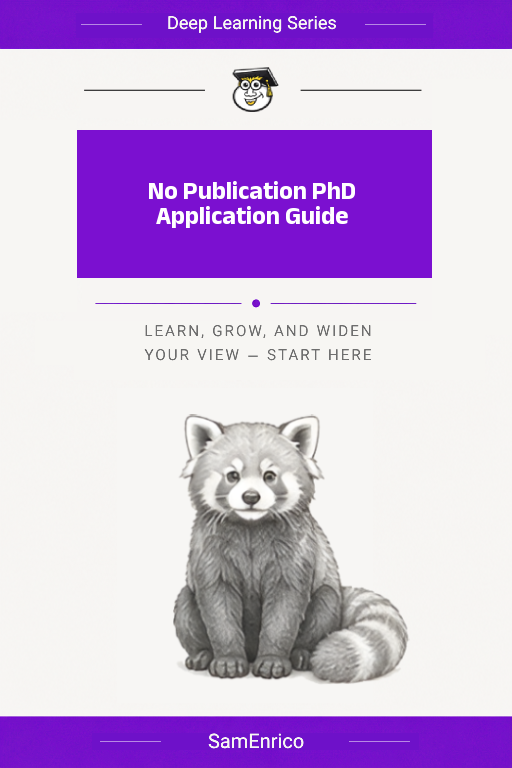
Non-FictionStudent's ShortcutResearch PathApplication Strategy
No Publication PhD Application Guide eBook
Highlight research potential through writing sampl
Highlight research potential through writing samples, conference posters, and strong reference letters. Includes strategies for explaining zero publications in statements of purpose.
Formats
Free sample
Chapter 1: The Hidden Myth...--When I ask audiences of prospective Ph D applicants, "How many of you believe you need a publication to get into a top-tier program?" nearly every hand goes up. When I ask the same question to tenured faculty who actually serve on admissions committees, nearly every hand stays down. This gap between applicant belief and admissions reality is not merely a misunderstanding—it is a costly myth that has derailed countless promising academic careers before they ever began.Let me state the central argument of this chapter—and, in many ways, of this entire book—as clearly as possible: Admissions committees do not admit publications. They admit people. They admit curiosity, resilience, analytical rigor, and the capacity to grow.
A published paper is merely one piece of evidence for those qualities, and often not the most revealing one. For every successful applicant who walked into a Ph D program with a first-author paper, there is another—often more creative, more persistent, more intellectually hungry—who walked in with nothing but a messy undergraduate thesis, a conference poster presented to seven people in a hotel ballroom, and a letter writer who described how they debugged a faulty protocol for three months without quitting.This book exists because the market is saturated with advice for the already-published and almost entirely silent for the rest. The standard guides assume you have a curriculum vitae dotted with citations. The popular forums amplify the anxieties of the hyper-productive few. The result is a silent majority of talented, hardworking students who believe they are uncompetitive simply because they have not yet crossed an arbitrary finish line that many faculty members, privately, do not even trust.This chapter dismantles the most damaging myth in graduate admissions: the supposed necessity of a first-author paper.
We will examine where this myth comes from, why it persists, and—most importantly—why it is demonstrably false. We will then replace it with a more accurate, more useful framework for understanding what admissions committees actually seek: four measurable qualities that have nothing to do with publication counts. By the end of this chapter, you will not only feel less anxious about your lack of papers; you will understand why, in many cases, zero publications can be framed as a positive signal rather than a deficiency.The Origin Story of a Dangerous Myth Every myth has a creation story, and the myth of the required publication is no exception. It emerges from the collision of three forces: selection bias, credential inflation, and the echo chamber of online advice forums.Selection bias operates silently but powerfully. The students who post their profiles on forums like The Grad Cafe, Reddit's r/gradadmissions, or academic Twitter are not a representative sample.
They are disproportionately the overachievers, the anxious, and the already-successful. A student who just received a Ph D offer from MIT with three first-author papers is far more likely to announce it publicly than a student who was admitted with zero papers. The latter often feels like an imposter, worries their admission was a fluke, and stays quiet. The result is a visible dataset that makes publications appear far more common and more necessary than they actually are.Credential inflation has worsened the problem over the past two decades. As undergraduate research opportunities have expanded, more students have access to labs and projects.
This is, on balance, a good thing. But it has also shifted the baseline of expectation. Twenty years ago, completing an undergraduate thesis was exceptional. Today, in many competitive fields, it is nearly expected. The goalposts have moved—but they have not moved as far as the forums suggest.
A published paper remains rare among undergraduate applicants, even at top programs. What has increased is the discussion of publications, not their actual prevalence.The echo chamber effect is the most pernicious force. Anxious students seek reassurance online, find other anxious students, and collectively amplify each other's fears. One student posts, "Do I need a publication for Stanford?" Another responds, "My friend got in with two." A third says, "I have three and I'm still worried." No one posts, "I got in with zero," because that feels like bragging about a secret or admitting a fluke. The signal-to-noise ratio collapses.
Within weeks, a casual observer would believe that a first-author paper is the minimum acceptable entry ticket to any respectable Ph D program. This is not true. It has never been true. And yet, the myth persists because it serves a psychological function: it gives anxious students something concrete to chase.What the Data Actually Shows Let us move from anecdote to evidence. Career development centers at several major research universities have quietly tracked admissions outcomes for decades.
Their internal data—some of which is summarized in reports from Harvard's Mignone Center for Career Success, Stanford's BEAM, and the University of Michigan's Rackham Graduate School—reveals a more nuanced picture than the forums suggest.In a typical year at a competitive R1 university, approximately 15 to 25 percent of admitted Ph D applicants in the social sciences and humanities have a peer-reviewed publication at the time of application. In the STEM fields, that number rises to roughly 30 to 40 percent—but the majority of those publications are not first-author. They are middle-author positions on large collaborative papers, conference proceedings, or undergraduate research journals with limited circulation. Genuine first-author papers in high-impact journals are rare enough that they often become a talking point in admissions meetings precisely because they are unusual, not because they are expected.More tellingly, the same data shows that publication status is a weak predictor of first-year Ph D performance, qualifying exam success, or ultimate degree completion. Students admitted with publications are not more likely to finish their doctorates.
They are not more likely to publish during graduate school. They are not more likely to secure academic positions after graduation. What does predict success? The very qualities that this book will teach you to demonstrate: the ability to formulate a novel research question, the persistence to troubleshoot methodological failures, the intellectual honesty to acknowledge limitations, and the communication skills to explain complex ideas to different audiences.The data also reveals a darker pattern. Students who arrive with multiple publications—especially from high-volume "publication mills" or predatory journals—are often flagged by admissions committees as potential risks.
Why? Because faculty members know that legitimate research takes time. An undergraduate who has produced three first-author papers likely did so in one of two ways: either they received an extraordinary level of support (raising questions about independence), or they published in venues with low standards (raising questions about judgment). Neither scenario is appealing. A well-published applicant can actually be less attractive than an unpublished one if the publications signal haste, superficiality, or poor decision-making.The Professor's Secret Fear To understand why zero publications can be an advantage, you must understand what professors actually worry about when they read applications.
And what they worry about is not an empty publications section. It is the candidate who cannot think for themselves.I have sat in admissions meetings—dozens of them—where faculty members debate applicants for hours. The conversation almost never centers on publication counts. Instead, it…
This is the end of the free sample. Get the eBook to keep going. Buy now
About this book
Details
- Author
- Pomeroy Tabatha
- Publisher
- SamEnrico
- Language
- English
- Genre
- Non-Fiction, Student's Shortcut, Research Path, Application Strategy
- Released
- 2026-05-29
- Pages (approx.)
- 148
- Available as
- eBook, Audiobook

Read better in the ZLOADR app
Your eBooks on your phone or tablet. Sign in with your SamEnrico account and start reading.
More by Pomeroy Tabatha
 Self Esteem And Breakup GuiltPomeroy Tabatha$11.99
 Multiplayer Online Game AddictionPomeroy Tabatha$11.99
 Purpose HandbookPomeroy Tabatha$11.99
 Dreams After Pandemic TraumaPomeroy Tabatha$11.99
 The Bone Hunters of the Gobi: Roy Chapman Andrews and the Lost World of DinosaursPomeroy Tabatha$11.99
 The Hollow Hill: Where the Tuatha Dé Danann SleepPomeroy Tabatha$11.99
 How to Become a ClarifierPomeroy Tabatha$11.99
 E-Commerce Southeast Asia OutlookPomeroy Tabatha$12.99
 Sailing (Commercial)Pomeroy Tabatha$11.99
 Understanding Hennekam SyndromePomeroy Tabatha$17.99
You may also like
 Hong Kong Handover 1997Dunn Johnnie$11.99
 Zumba For Postnatal Recovery CourseNeal Christian$11.99
 Zumba for BeginnersLadner Nikia$11.99
 YouTube Comment Mining GuideHumes Pandora$12.99
 Worry Box MeditationCarlin Rudy$11.99
 Workplace Stress MeditationNguyen Lynn$11.99
 Workplace Stress and Sleep RepairHawley Ivory$11.99
 Workplace Perfectionism CureDelaney Jeffry$11.99
 Workplace Injustice Anger GuideWallen Isabelle$11.99
 Work Addiction and Burnout LinkGreenwood Ester$11.99
 Women in Yoga and WellnessBeattie Galina$11.99
 Women in Stand Up ComedyChun Evangeline$11.99