
Non-FictionInformativeEducational
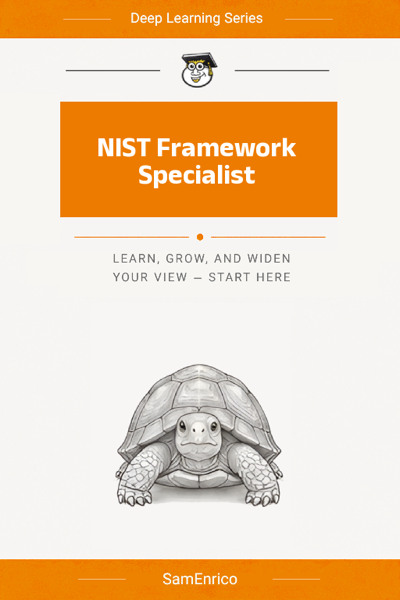
NIST Framework Specialist eBook
A Coursebook on NIST Framework Specialist
A Coursebook on NIST Framework Specialist
Formats
Free sample
Chapter 1: The Breach That Changed Everything--The alarm sounded at 2:14 AM on a Tuesday. Not the kind of alarm that wakes a security guard from a nap—this was the kind that makes seasoned cybersecurity professionals feel their blood turn cold. Within ninety seconds, the on-call analyst at a mid-sized healthcare system saw it: encrypted files spreading across the network like wildfire. Patient records, billing systems, even the backup servers—all locked. A ransom note appeared on every screen.
Your data is gone. Pay 4.2 million in Bitcoin.What happened next was not a failure of technology. It was a failure of framework.The organization had firewalls, antivirus, intrusion detection, and a team of well-meaning IT staff. What they lacked was a coherent, repeatable, documented approach to managing cybersecurity risk. They had no common language to describe what was happening.
They had no pre-defined roles for who made decisions. They had no baseline against which to measure whether their security controls were actually working. And they had certainly never heard of the NIST Cybersecurity Framework—at least, not in a way that anyone had operationalized.Over the next seventy-two hours, the company made every mistake in the book. They argued about whether to pay the ransom while the clock ticked. They discovered that their "backups" had been connected to the live network and were also encrypted.
They learned—too late—that a single compromised vendor account had been sitting undetected for eleven months. By the time the FBI arrived, the attackers had already exfiltrated 1.2 million patient records. The eventual cost: over $18 million in fines, legal fees, lost revenue, and reputational damage. The Chief Information Security Officer resigned. Two board members followed.This is not a hypothetical story.
It is a composite drawn from dozens of real breaches—Target, Equifax, Colonial Pipeline, Solar Winds, and countless smaller organizations whose names never make the news. In every case, the root cause was not a missing patch or a weak password. The root cause was a missing framework.This book is the antidote. It is designed to transform you from someone who knows about cybersecurity into someone who can operationalize a NIST-based risk management program. By the time you finish these twelve chapters, you will not only understand the NIST Cybersecurity Framework (CSF) and the Risk Management Framework (RMF)—you will be able to implement them, assess them, and defend them to executives, auditors, and regulators.
You will become a NIST Framework Specialist.But before we dive into controls, tiers, and profiles, we must first answer three foundational questions: Why do frameworks exist? What distinguishes a framework from a standard or a law? And most importantly, why should any organization—especially yours—invest time and money in a NIST-based approach?The Evolution of Cyber Threats: From Pranksters to Nation-States To understand why frameworks matter, we must understand what they are fighting against. The threat landscape of 1995 bears almost no resemblance to the threat landscape of today. In the early days of the internet, most cyberattacks were the digital equivalent of graffiti.
A teenager in a basement might deface a website or launch a denial-of-service attack to prove a point. The motivation was ego, not profit. The impact was embarrassment, not bankruptcy.That world is gone.Today, cybercriminals operate like Fortune 500 companies. They have human resources departments, research and development budgets, and customer support teams—yes, ransomware gangs now have help desks to assist victims in paying ransoms. The ransomware-as-a-service (Raa S) model means that a would-be attacker with no technical skills can rent malware, infrastructure, and even negotiation services for a percentage of the payout.
Entry-level cybercrime has never been easier.State-sponsored actors have raised the stakes even further. The Solar Winds compromise of 2020 demonstrated that a sophisticated nation-state could embed malicious code into a software update used by 18,000 organizations, including multiple U.S. government agencies. The attackers did not need to "break in" to each target—they simply waited for the victims to install the backdoor themselves. That is not a failure of perimeter security.
That is a failure of supply chain risk management.Supply chain compromises represent the newest and most terrifying frontier. Instead of attacking a well-defended target directly, attackers compromise a vendor, a contractor, or an open-source library that the target trusts. The Target breach of 2013 began with a compromised HVAC vendor. The Not Petya attack spread through a single Ukrainian accounting software update. When you cannot trust the software you install, traditional defenses become nearly irrelevant.Ransomware has evolved from an annoyance into an existential threat.
Modern ransomware attacks do not merely encrypt data—they exfiltrate it first, then threaten to publish it if the ransom is not paid. This "double extortion" model means that even organizations with perfect backups cannot simply restore and move on. The data is already in the attacker's hands. Hospitals have diverted ambulances. Schools have closed for weeks.
Pipelines have shut down. All because of ransomware.What do all these threats have in common? They are not prevented by any single control, product, or checklist. They are systemic problems that require systemic solutions. And that is precisely what a cybersecurity framework provides.The Reactive Trap: Why Point-in-Time Security Fails Before frameworks became standard practice, most organizations relied on what we call point-in-time security.
The pattern looked like this:An annual penetration test, performed by an external firm over two weeks A compliance audit (PCI DSS, HIPAA, SOX) once per year Vulnerability scans run quarterly, or worse, annually A risk assessment performed whenever a regulator demanded it Security awareness training delivered as a thirty-minute video once per year This approach creates the illusion of security without the reality. Consider the timeline: a vulnerability discovered the day after the annual penetration test will go undetected for 364 days. An employee who falls for a phishing simulation six months after training has already forgotten the lesson. A configuration change made during a maintenance window—one that accidentally opens a firewall port—might never be reviewed until the next audit.Attackers know this. They deliberately strike during holidays, weekends, and the gap between audit cycles.
They move laterally through networks for months before triggering the final payload, precisely because they understand that most organizations only look for threats during specific windows.The reactive trap is seductive because it feels like action. Buying a new firewall feels productive. Running a vulnerability scan feels thorough. But these activities, in isolation, do not constitute a security program. A security program requires continuous, structured, risk-informed decision-making.
It requires a framework.Defining the Terms: Frameworks, Standards, and Laws Before we go further, we must establish a shared vocabulary. In the world of cybersecurity governance, three types of documents are often confused: frameworks, standards, and laws. Each serves a different purpose, and a NIST Framework Specialist must understand the distinctions.Frameworks: The Strategic Structure A framework is a high-level, flexible structure for managing risk. It does not prescribe specific products or configurations. Instead, it provides a common language, a set of categories, and a process for continuous improvement.
Think of a framework as the architectural blueprint for a house—it shows where the rooms go, how they connect, and what basic features each room needs (electrical, plumbing…
This is the end of the free sample. Get the eBook to keep going. Buy now
About this book
Details
- Author
- Duff Cathrine
- Publisher
- SamEnrico
- Language
- English
- Genre
- Non-Fiction, Informative, Educational
- Released
- 2026-06-02
- Pages (approx.)
- 159
- Available as
- eBook, Audiobook

Read better in the ZLOADR app
Your eBooks on your phone or tablet. Sign in with your SamEnrico account and start reading.
More by Duff Cathrine
 Shift Work Shift Trading GuideDuff Cathrine$11.99
 The Flaky Contact HandlerDuff Cathrine$11.99
 Self Esteem After Prison HandbookDuff Cathrine$11.99
 Cesium In Alternative Cancer CareDuff Cathrine$11.99
 Self Esteem Interracial RelationshipDuff Cathrine$11.99
 Silk & Shadows: The Secret Life of a Victorian CouturierDuff Cathrine$11.99
 The Last Message of the Karluk: A Ghost Ship’s Final BroadcastDuff Cathrine$11.99
 Understanding Exfoliative DermatitisDuff Cathrine$17.99
 ToS for Blockchain AppsDuff Cathrine$12.99
 Executive Summary Formula That WorksDuff Cathrine$12.99
 How to Become a Molder-machine TenderDuff Cathrine$11.99
You may also like
 Hong Kong Handover 1997Dunn Johnnie$11.99
 Zumba For Postnatal Recovery CourseNeal Christian$11.99
 Zumba for BeginnersLadner Nikia$11.99
 YouTube Comment Mining GuideHumes Pandora$12.99
 Worry Box MeditationCarlin Rudy$11.99
 Workplace Stress MeditationNguyen Lynn$11.99
 Workplace Stress and Sleep RepairHawley Ivory$11.99
 Workplace Perfectionism CureDelaney Jeffry$11.99
 Workplace Injustice Anger GuideWallen Isabelle$11.99
 Work Addiction and Burnout LinkGreenwood Ester$11.99
 Women in Yoga and WellnessBeattie Galina$11.99
 Women in Stand Up ComedyChun Evangeline$11.99