
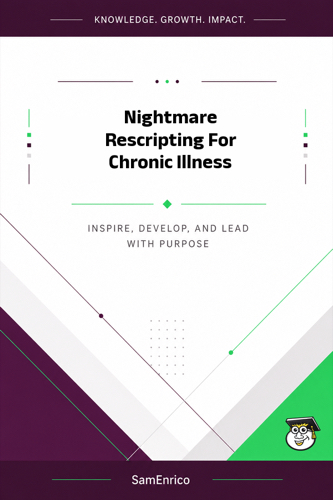
Non-FictionSelf-HelpChronic Illness
Nightmare Rescripting For Chronic Illness eBook
Process dreams about disease progression and treat
Process dreams about disease progression and treatment.
Formats
Free sample
Chapter 1: The 3 AM Funeral...–- You wake up because you stopped breathing. Not in real life—your chest is rising and falling just fine, the pulse oximeter on your nightstand reads 97%, and your body, for all its betrayals, is still quietly doing the work of keeping you alive. But in the dream—the one you were just torn out of—you were dead. Not metaphorically. Not “a part of you died.” Actually, concretely, unmistakably dead.
You watched people you love stand over a casket that somehow contained you and also somehow left you standing outside your own body, invisible, trying to scream that you were still here. No sound came out. You woke up gasping, and now it’s 3:17 AM, and your sheets are soaked, and your heart is hammering against your ribs like a prisoner demanding release, and you have to be up for a doctor’s appointment in four hours, and you cannot fall back asleep because every time you close your eyes you see the casket again.This is not a bad dream. This is not a stress dream about showing up to an exam unprepared or missing a flight. This is an illness nightmare, and if you are reading this book, you likely know the difference in your bones.
Ordinary nightmares have plots you can explain to someone the next morning: There was a monster, I was running, I woke up. Illness nightmares have a different texture. They are more vivid, more somatic, more repetitive, and more convincing. They do not feel like metaphors. They feel like previews.
And the terror they leave behind is not the generalized anxiety of “that was scary”—it is the specific, bone-deep dread of is my body telling me something my doctors haven’t found yet?Here is the truth that this entire book rests upon, and I need you to hear it before we go any further: Your nightmares are not prophecies. But they are not nothing, either. And understanding what they are—and what they are not—is the first step toward rewriting them.What Makes an Illness Nightmare Different Let us start with a clear definition. An illness nightmare is a repeated, highly distressing dream whose central content involves disease progression, treatment failure, bodily deterioration, medical settings, or the social consequences of being sick. It differs from ordinary nightmares in four specific ways.First, somatic intensity.
Illness nightmares often include physical sensations that persist after waking: the phantom burn of an infusion that never happened, the echo of paralysis that wasn’t real, the memory of pain that your body, now awake and alert, cannot locate but cannot forget. Readers with postural orthostatic tachycardia syndrome (POTS), for example, frequently report dreams of falling that feel indistinguishable from their waking pre-syncope episodes. Readers with multiple sclerosis report dreams of losing the ability to walk that leave them checking, upon waking, whether their legs still work. The dream feels like a test drive of the body’s worst-case scenario.Second, repetitive precision. Ordinary nightmares tend to change over time—the monster shifts shape, the chase takes a different route, the ending varies.
Illness nightmares often play out with terrifying fidelity to a template. The same chemotherapy pump beeps the same alarm at the same moment. The same doctor delivers the same bad news in the same flat voice. The same clock ticks down to the same zero. This repetition is not a sign that the dream is “stuck” because you are failing to process it; it is a sign that your brain’s fear circuitry has learned a maladaptive pattern and keeps hitting the same exit ramp, which we will explore in Chapter 2.Third, low narrative weirdness.
Ordinary dreams are bizarre. You are in your childhood home but also on a spaceship, and your third-grade teacher is there for some reason, and the laws of physics keep changing. Illness nightmares are often mundane in their settings. A hospital room that looks exactly like the one you were in last week. A CT machine that sounds exactly like the one you heard yesterday.
A conversation with your rheumatologist that uses the exact words she used at your last appointment. This lack of weirdness is what makes them so convincing—they feel like memories of the future, not dreams of the impossible.Fourth, anticipatory spillover. The distress from an illness nightmare does not end when you open your eyes. It follows you into the next day as a specific, targeted anxiety: My dream showed my cancer spreading. Does my back hurt, or am I imagining it?
My dream showed my infusion going badly. Should I cancel tomorrow’s appointment? This is not mere catastrophizing; it is the brain’s normal threat-detection system operating on contaminated data.If you recognize yourself in these four features, you are in the right place.The Prodromal Question: Can Dreams Detect Illness Before We Can?Before we go any further, I need to address the question that every chronically ill reader brings to this topic. You have probably wondered it yourself, probably in the dark, probably at an hour when you could not look up the answer. Here it is, laid bare: My nightmare showed my disease getting worse.
Is it possible that my sleeping brain knows something my waking brain hasn’t figured out yet?The answer is complicated, and giving you anything less than the full truth would be a betrayal of trust.There is a real phenomenon in sleep medicine called the prodromal dream. The word “prodromal” comes from “prodrome”—the early signs and symptoms that precede the full onset of a medical condition. For decades, clinicians have observed that some patients report unusual dreams in the months or even years before a neurological diagnosis. This is most well-documented in Parkinson’s disease, where patients frequently report vivid, action-filled, often frightening dreams (including dreams of being attacked or chased) years before their motor symptoms appear. Similar patterns have been observed in certain autoimmune conditions and in migraines, where patients report specific visual or sensory dreams before the headache phase begins.How could this happen?
The leading theory involves the sleeping brain’s access to interoceptive data—information from inside the body that never reaches conscious awareness during wakefulness. When you are awake, your brain is bombarded with external sensory input: what you see, hear, smell, and touch. Internal signals from your organs, your immune system, your autonomic nervous system—these are often processed below the level of conscious perception. But during sleep, especially during REM sleep when the brain is highly active but cut off from external input, those internal signals can rise to the surface and be woven into dream narratives. Your sleeping brain might detect a subtle rise in inflammatory cytokines, or a shift in autonomic regulation, or a change in gut motility, and translate that physical data into a story.
Pain becomes a monster. Inflammation becomes a fire. A drop in blood sugar becomes a fall.So yes. Your sleeping brain can detect some physiological changes before your waking brain consciously registers them.But—and this is the most important “but” in this entire chapter—detecting what is already happening inside your body is…
This is the end of the free sample. Get the eBook to keep going. Buy now
About this book
Details
- Author
- Penny Eleonora
- Publisher
- SamEnrico
- Language
- English
- Genre
- Non-Fiction, Self-Help, Chronic Illness
- Released
- 2026-06-07
- Pages (approx.)
- 157
- Available as
- eBook, Audiobook

Read better in the ZLOADR app
Your eBooks on your phone or tablet. Sign in with your SamEnrico account and start reading.
More by Penny Eleonora
 Self Worth After Conditional LovePenny Eleonora$11.99
 Political Campaign PersuasionPenny Eleonora$11.99
 Paleo Organ Meats IntroductionPenny Eleonora$11.99
 Berries and Boulders PatternPenny Eleonora$11.99
 Saying No With ConfidencePenny Eleonora$11.99
 Eyewitness Confidence MismatchPenny Eleonora$11.99
 English Language Support DubaiPenny Eleonora$11.99
 Stefan Batory: The Last Lion of the CommonwealthPenny Eleonora$11.99
 The Cosmic Botanists: Black Naturalists Who Charted the UniversePenny Eleonora$11.99
 A Collector's Handbook to the Daimler Conquest Century Drophead CoupePenny Eleonora$11.99
 How to Produce Specialty Electrical Switches and RelaysPenny Eleonora$11.99
 How to Become a Prisoner-classification InterviewerPenny Eleonora$11.99
You may also like
 Hong Kong Handover 1997Dunn Johnnie$11.99
 Zumba For Postnatal Recovery CourseNeal Christian$11.99
 Zumba for BeginnersLadner Nikia$11.99
 YouTube Comment Mining GuideHumes Pandora$12.99
 Worry Box MeditationCarlin Rudy$11.99
 Workplace Stress MeditationNguyen Lynn$11.99
 Workplace Stress and Sleep RepairHawley Ivory$11.99
 Workplace Perfectionism CureDelaney Jeffry$11.99
 Workplace Injustice Anger GuideWallen Isabelle$11.99
 Work Addiction and Burnout LinkGreenwood Ester$11.99
 Women in Yoga and WellnessBeattie Galina$11.99
 Women in Stand Up ComedyChun Evangeline$11.99