
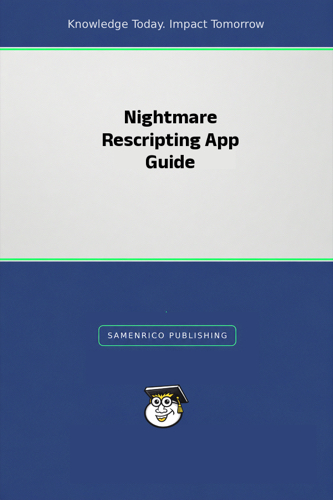
Nightmare Rescripting App Guide eBook
Use digital tools to support dream processing.
by Wolf Glayds
Use digital tools to support dream processing.
Formats
Free sample
Chapter 1: The Broken Bridge--You are reading this because something has been stealing from you in the dark.Not your wallet. Not your keys. Something deeper. Every night, while you lie motionless in bed, your own mind produces a horror show that leaves you gasping, sweating, and afraid to close your eyes again. By morning, the details blur, but the dread remains—a low-grade fever of exhaustion that follows you through coffee, commutes, and conversations.
You have learned to function around it. You have learned to smile while running on four hours of fractured sleep. But you know, in the quiet moments when no one is watching, that you are not okay.This is not a failure of will. It is not a character flaw. And despite what well-meaning friends have suggested, it is not something you can “just get over” by thinking positive thoughts before bed.Nightmares are not random noise.
They are a specific, predictable, and—most importantly—treatable malfunction of the brain’s fear-processing system. For decades, the standard advice was either pharmacological (medications that suppress REM sleep but leave you chemically hungover) or primitive (keep a journal by your bed and hope for the best). Neither solution works reliably because neither addresses the actual mechanism. Pills mask the symptom. Paper journals capture the aftermath.
What you need is a bridge between what happens in your sleeping brain and what you can change while awake.That bridge is data.And data, applied correctly, is the difference between being haunted by your nightmares and rewriting them.The Arithmetic of Terror Let me ask you a question that sounds simple but is actually revolutionary: How many nightmares did you have last month?Most people cannot answer this with any accuracy. They remember the really bad ones—the ones that launched them out of bed at 3:00 AM with a racing heart and a certainty that something was in the room. But the moderate ones? The ones that woke them briefly before they fell back asleep? The ones that didn't fully wake them but left behind a residue of anxiety that poisoned the next morning?
Those vanish into the fog of recall bias.This is not your fault. Human memory was not designed for accurate frequency tracking of unpleasant events. We remember the peak of the pain and the end of the experience, a phenomenon psychologists call the “peak-end rule.” Everything else gets compressed, distorted, or discarded. When you try to remember how often nightmares have disrupted your sleep, your brain gives you an average—a vague impression—rather than actual numbers.Here is what that means in practical terms: you have been trying to solve a problem you cannot accurately measure.Imagine trying to manage your finances if your bank statement only showed a fuzzy impression of your spending. Imagine trying to lose weight if your scale displayed not a number but a feeling (“seems a bit heavier than last week”).
That is the situation you are in right now with your nightmares. You have a problem. You have motivation. You have suffering. What you do not have is objective data.And without data, you are guessing.Why Paper Fails The traditional solution—keeping a dream journal by your bed—has been recommended for centuries.
And it is better than nothing. But “better than nothing” is a low bar, and paper journals fail in four specific ways that matter profoundly.First, recall decay. When you wake from a nightmare, the memory of it is vivid but fragile. Within minutes, details begin to erode. Within an hour, the emotional core remains but the narrative structure crumbles.
By the time you finish your morning routine, you have lost critical information: exactly when the nightmare occurred, what the transitional moments were, and—most importantly—what specific sensory details triggered the peak terror. Paper requires you to write by hand in the dark, which most people will not do consistently. So you tell yourself you will remember it in the morning. You never do.Second, subjective bias. When you write about a nightmare after the fact, you do not record what happened.
You record what you remember happening, filtered through your morning mood, your level of exhaustion, and your existing beliefs about why you have nightmares. If you believe your nightmares are caused by work stress, you will unconsciously emphasize work-related elements in your description. If you believe they are meaningless, you will write shorter, less detailed entries. Your beliefs shape your data, which then reinforces your beliefs. This is a closed loop, and paper cannot break it.Third, inconsistent timing.
A paper journal has no timestamp. When you write “3:00 AM” in a notebook, you are guessing—and your guess is often wrong. Sleep science has shown that people consistently misjudge when they woke up, especially when disoriented by a nightmare. A 3:15 awakening feels like 2:45; a 4:30 awakening feels like 5:00. These errors matter because nightmare timing is clinically meaningful.
Nightmares that occur early in the night are different from those that occur during the final REM cycle. Paper cannot tell you the difference because paper cannot enforce accurate timing.Fourth, no pattern recognition. A stack of handwritten journal entries is a mass of undigested text. To find patterns, you would need to read through every entry, tag each element manually, and perform your own frequency analysis. No one does this.
It is too much work, and the human brain is not good at it anyway. You might notice that you wrote “spiders” several times, but you will miss the correlation between spider nightmares and the nights you ate chocolate before bed. You will miss the subtle shift in emotional valence that preceded a major nightmare by three days. Paper buries these signals in noise.Why Pills Fail (And What They Actually Do)If paper is inadequate, what about medication? The most common pharmaceutical approach to nightmares—particularly those associated with PTSD—involves medications that suppress REM sleep.
Prazosin, for example, is often prescribed to reduce nightmare frequency by blocking certain adrenaline receptors. Other medications, including certain antidepressants, also suppress REM activity.These medications work for some people. They reduce the number of nightmares. But they do so by reducing the amount of REM sleep itself—and REM sleep is not optional. It is during REM that your brain processes emotional memories, consolidates learning, and performs what neuroscientists call “fear extinction.” When you suppress REM, you may have fewer nightmares, but you also impair your brain’s ability to resolve the underlying fear that caused the nightmares in the first place.Think of it this way: nightmares are the smoke alarm going off because there is a fire.
Medications that suppress REM sleep do not put out the fire. They disable the smoke alarm. The fire continues to burn—the unresolved fear, the unprocessed memory, the unexamined stress—but you no longer get the signal. Meanwhile, the medication may cause side effects: morning drowsiness, dizziness, low blood pressure, and a growing dependency that requires increasing doses over time.None of this is to say that medication is never appropriate. For severe, treatment-resistant nightmares, especially in the context of PTSD, medication can be a valuable part of a broader treatment plan.…
This is the end of the free sample. Get the eBook to keep going. Buy now
About this book
Details
- Author
- Wolf Glayds
- Publisher
- SamEnrico
- Language
- English
- Genre
- Non-Fiction, Self-Help, Apps
- Released
- 2026-06-08
- Pages (approx.)
- 142
- Available as
- eBook, Audiobook

Read better in the ZLOADR app
Your eBooks on your phone or tablet. Sign in with your SamEnrico account and start reading.
More by Wolf Glayds
 Networking Small Talk MasteryWolf Glayds$11.99
 Assertiveness Role PlaysWolf Glayds$11.99
 Driving Safety Memory AgingWolf Glayds$11.99
 Sibling Rivalry Self WorthWolf Glayds$11.99
 Search and Rescue FailuresWolf Glayds$11.99
 Research Skills For StudentsWolf Glayds$11.99
 Child Neglect and GamblingWolf Glayds$11.99
 The Golden Fleets: Portugal’s Renaissance of the SeasWolf Glayds$11.99
 The Ballad of the Lost Love Letters: A Reunion Across TimeWolf Glayds$11.99
 Understanding Von Hippel-lindau Disease (Vhl)Wolf Glayds$11.99
 How to Start a Anaesthetic Equipment Business (Beginners Guide)Wolf Glayds$11.99
 How to Produce GPS AccessoriesWolf Glayds$11.99
You may also like
 Morning Routine App GuideHowerton Iraida$11.99
 App Usage ReviewButterfield Lesha$11.99
 The TM App Usage GuideKinney Dodie$11.99
 The Sober App GuideBurnside Prince$11.99
 The Beginner's App GuideAshmore Morgan$11.99
 Anger Management Apps GuideThomson Lucina$11.99
 Sex Addiction App Blockers GuideWoodward Lenora$11.99
 Anger App RecommendationsRivas Yesenia$11.99
 Self Hypnosis Smartphone AppsBunn Missy$11.99
 Anger Thought Record App GuideSimons Ardath$11.99
 Teen Self Esteem App GuidePetty Vanda$11.99
 Mindfulness for TechnologyDickerson Clelia$11.99