
Non-FictionSelf-HelpNightmaresPTSD
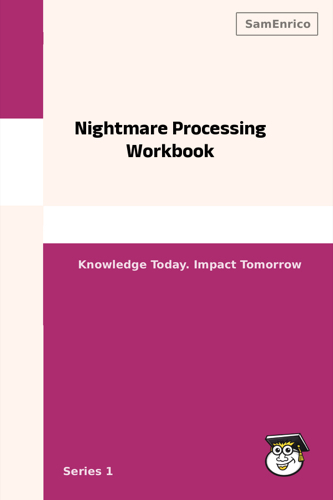
Nightmare Processing Workbook eBook
Reduce nightmare frequency and intensity using exp
by Ruff Cyndi
Reduce nightmare frequency and intensity using exposure, rescripting, and relaxation.
Formats
Free sample
Chapter 1: The Nightmare Trap--You are not afraid of monsters under the bed. You are afraid of the ones that live inside your own mind, the ones that visit you when you are most vulnerable, when your guard is down, when your eyes are closed and the world is quiet. You are afraid of falling asleep because you know what is waiting for you there. And that fear is not irrational. It is not weakness.
It is a perfectly logical response to a brain that has learned to turn rest into a battlefield.Let me say something that might surprise you: your nightmares are not random. They are not punishments. They are not signs that you are broken or crazy or beyond help. They are, in a strange and frustrating way, your brain trying to protect you. The problem is that your brain is using an outdated operating system, one that confuses memory with prediction, past danger with present safety.
This chapter will show you exactly how that happens, why the nightmare trap is so effective at keeping you stuck, and most importantly, why you have already taken the most difficult step simply by opening this book.Before we go any further, I want you to take a slow breath. Not because breathing fixes everything, but because you have probably been holding your breath for longer than you realize. The anticipation of a nightmare, the dread that creeps in as the sun goes down, the way your heart rate increases when you turn off the light — all of these are physiological responses that keep your nervous system locked in a state of high alert. You cannot learn new skills when your body believes it is under attack. So breathe.
Just for a moment. You are safe in this room, reading this page, and nothing in this book will ask you to do anything you are not ready for.Now let us talk about what nightmares actually are, why they keep happening, and how the trap works.The Difference Between Bad Dreams and Nightmare Disorder Everyone has bad dreams. A bad dream is unpleasant but forgettable. You wake up thinking, "That was weird," roll over, and go back to sleep without much disruption. A nightmare is different.
A nightmare wakes you up. It leaves your heart pounding, your sheets soaked with sweat, your mind racing with images that feel more real than the room around you. And crucially, a nightmare creates what clinicians call "clinically significant distress" — meaning it affects your life during the daytime, not just in the dark.The diagnostic criteria for nightmare disorder are straightforward. You have nightmares. They wake you up.
You remember them clearly. And they cause problems in your daily functioning — problems like avoiding sleep, feeling exhausted during the day, struggling with concentration, or experiencing anxiety that starts hours before bedtime. If you are reading this book, there is a high probability that you meet these criteria. But even if you do not meet the full definition of a disorder, the techniques in this workbook will still help you. Nightmares exist on a spectrum, and everyone deserves relief.Here is something that might surprise you: nightmares are surprisingly common.
Approximately four percent of adults experience clinically significant nightmare disorder, but the number of people who have occasional disruptive nightmares is much higher. Among people with post-traumatic stress disorder, the rate of nightmares jumps to nearly sixty percent. Among people with borderline personality disorder, the rate is similar. Among people who have experienced childhood trauma, nightmares are so common that they are considered a hallmark symptom. You are not alone.
You are not strange. You are part of a very large group of people whose brains have learned to send danger signals at the wrong time.The Two Types of Nightmares Not all nightmares are created equal, and understanding which type you experience will help you apply the right tools. The first type is called idiopathic nightmares. "Idiopathic" is a medical term that means "arising spontaneously or from an unknown cause." Idiopathic nightmares have no clear trauma trigger. They may run in families.
They may be linked to stress, sleep deprivation, medication changes, or alcohol withdrawal. They often feature universal themes like falling, being chased, losing a loved one, or showing up unprepared for an exam. If you have idiopathic nightmares, you might not have a clear memory of when they started. They have simply always been there, like a dark passenger who shows up without invitation.The second type is trauma-related nightmares. These are different.
Trauma-related nightmares are direct or symbolic replays of a traumatic event. A combat veteran might dream of explosions. A survivor of assault might dream of being trapped. A car accident survivor might dream of crashing over and over again, each time with slightly different details but the same core terror. Trauma-related nightmares are considered a core symptom of PTSD, and they tend to be more intense, more frequent, and more resistant to simple interventions than idiopathic nightmares.
The good news is that the techniques in this workbook — particularly Imagery Rehearsal Therapy, which you will learn in Chapter 7 — are specifically designed for trauma-related nightmares and have strong scientific support.You may have both types. You may have nightmares that started after trauma but now include themes completely unrelated to that trauma. You may have no idea which category fits you. That is fine. The protocols in this book work for both, with only minor adjustments that will be clearly marked.The Nightmare Loop: Why One Nightmare Leads to Another Now we arrive at the most important concept in this entire chapter: the Nightmare Loop.
Understanding this loop is the single most important step you will take because it explains why your nightmares are not random misfortunes but a predictable, self-perpetuating cycle. Once you see the loop, you will stop blaming yourself for being stuck. You will stop feeling like a failure because you cannot simply "get over it." You will understand that you are caught in a neurological and psychological trap that has nothing to do with willpower.Here is how the loop works, step by step.Step one: You have a nightmare. It wakes you up. Your heart is racing.
Your body is flooded with cortisol and adrenaline. You lie in the dark, trying to convince yourself that it was just a dream, but your body does not know the difference between a dream threat and a real threat. Your sympathetic nervous system — the "fight or flight" system — is fully activated.Step two: You begin to fear falling asleep. This is not a conscious choice. It is a conditioned response.
Your brain is an incredible pattern-matching machine, and it has just learned a powerful association: darkness + bed + drowsiness = terror. The next night, as you approach bedtime, you feel a knot in your stomach. You find yourself delaying sleep. You turn on the TV. You scroll through your phone.
You tell yourself you are just not tired yet, but really, you are afraid.Step three: You experience sleep deprivation. Because you are avoiding sleep or waking up frequently, you are not getting enough total sleep. Your body is exhausted. Your brain is foggy.…
This is the end of the free sample. Get the eBook to keep going. Buy now
About this book
Details
- Author
- Ruff Cyndi
- Publisher
- SamEnrico
- Language
- English
- Genre
- Non-Fiction, Self-Help, Nightmares, PTSD
- Released
- 2026-06-08
- Pages (approx.)
- 139
- Available as
- eBook, Audiobook

Read better in the ZLOADR app
Your eBooks on your phone or tablet. Sign in with your SamEnrico account and start reading.
More by Ruff Cyndi
 The Foster Parent Stress Survival GuideRuff Cyndi$11.99
 Behavioral Addiction in NursingRuff Cyndi$11.99
 Ultradian Rhythm Work GuideRuff Cyndi$11.99
 The Icebound Gene Hunters: A Scientist’s Fight for Survival in the ArcticRuff Cyndi$11.99
 The Tower of Ten Thousand Mirrors: The Yokai’s IllusionRuff Cyndi$11.99
 Understanding Hepatocellular CarcinomaRuff Cyndi$17.99
 LLC Operating Agreement PrimerRuff Cyndi$12.99
 E-Commerce Circular Economy OutlookRuff Cyndi$12.99
 Air Quality TechnicianRuff Cyndi$11.99
 How to Start a Pressure Die Casting of Non-ferrous Base Metal Business (Beginners Guide)Ruff Cyndi$11.99
You may also like
 Hong Kong Handover 1997Dunn Johnnie$11.99
 Zumba For Postnatal Recovery CourseNeal Christian$11.99
 Zumba for BeginnersLadner Nikia$11.99
 YouTube Comment Mining GuideHumes Pandora$12.99
 Worry Box MeditationCarlin Rudy$11.99
 Workplace Stress MeditationNguyen Lynn$11.99
 Workplace Stress and Sleep RepairHawley Ivory$11.99
 Workplace Perfectionism CureDelaney Jeffry$11.99
 Workplace Injustice Anger GuideWallen Isabelle$11.99
 Work Addiction and Burnout LinkGreenwood Ester$11.99
 Women in Yoga and WellnessBeattie Galina$11.99
 Women in Stand Up ComedyChun Evangeline$11.99