
Non-FictionSelf-HelpSocial Anxiety
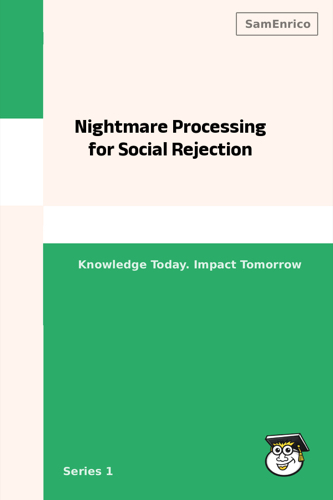
Nightmare Processing for Social Rejection eBook
Changes exclusion dreams into inclusion and belong
Changes exclusion dreams into inclusion and belonging.
Formats
Free sample
Chapter 1: The Architecture of Pain...--–- You wake up gasping, but not from a monster under the bed. There was no chase scene, no falling from a great height, no teeth at your throat. Instead, the terror came from something far quieter and, in its own way, far more devastating: a group chat you were left out of. A party you arrived at only to find everyone already paired off. A text message you sent that was met with three dots that never became words.
A dinner table where conversations flowed around you as if you were made of glass. Your heart pounds not from adrenaline of escape, but from the slow, suffocating certainty that you have been seen, judged, and found wanting. This, more than any nightmare monster, is the architecture of social pain.For most of human history, we have misunderstood the weight of these dreams. We dismiss them with a shrug— "It was just a dream" —and pour coffee, scroll through our phones, and try to shake off the residue of shame. But the residue does not shake off.
It clings. It follows you into the shower, onto the commute, into the first meeting of the day where you find yourself speaking a little too quickly, laughing a little too loudly, checking your phone a little too often for a message that has not arrived. What you experienced at 3:00 AM was not merely a bad dream. It was a neurological event. And to understand why it hurt so much, you must first understand a shocking truth: your brain does not know the difference between a broken bone and a broken heart.The Anterior Cingulate Cortex: Where Physical and Social Pain Meet Let us travel inside your skull for a moment.
Deep within the brain, tucked behind the frontal lobe and straddling the corpus callosum, lies a small but ferociously active region called the anterior cingulate cortex, or ACC. For decades, neuroscientists believed the ACC was primarily involved in processing physical pain—the sharp sting of a paper cut, the dull ache of a sprained ankle, the searing burn of a hot stove. And they were right. When you stub your toe, your ACC lights up like a Christmas tree. But then something strange happened in the research labs.
In the early 2000s, a team of psychologists at UCLA led by Naomi Eisenberger placed volunteers into functional magnetic resonance imaging (f MRI) machines and played a cruel but revealing game called "Cyberball." In this game, participants tossed a virtual ball with two other players. At first, everyone played nicely. Then, midway through the game, the other two players began throwing the ball only to each other, excluding the participant entirely. The participant was left sitting alone, watching the ball arc back and forth between two digital strangers who had decided, for no reason at all, that the participant no longer mattered.The results were astonishing. The same region of the brain—the ACC—that flared up during physical pain also flared up during social exclusion.
The participants were not being burned, cut, or struck. They were simply being ignored. And yet their brains responded as if they had been physically injured. Eisenberger and her colleagues had discovered what they called the "neural overlap" between social and physical pain. The brain, it turns out, evolved using the same ancient circuitry to process both threats to the body and threats to social connection.
Why? Because for our ancestors, being cast out from the tribe was a death sentence. No tribe meant no protection from predators, no shared food, no shelter, no mate, no offspring. The brain learned, over millions of years, to treat social exclusion as a survival threat. Your heart races, your cortisol spikes, and your ACC screams—not because you are dramatic, but because your brain is trying to save your life.This is not metaphor.
This is biology. When you dream of being excluded, your ACC activates just as it would if you were actually being rejected while awake. Your brain does not know that the laughing crowd is a hallucination. Your brain knows only that the ancient alarm system has been triggered, and it responds accordingly. You wake up with a racing heart, shallow breath, and a feeling of dread because your body has just completed a full stress response to an event that never happened.
This is the first great revelation of this book: your rejection nightmares are not signs of weakness or emotional fragility. They are signs that your brain's survival circuitry is working exactly as designed. The problem is not that the alarm is broken. The problem is that the alarm is ringing in a world where there are no predators, no tribes, and no life-or-death stakes for being left out of a group chat.Sleep Architecture: Why REM Sleep Betrays You To understand why rejection nightmares feel so real and recur so stubbornly, you must understand how your brain sleeps. Sleep is not a single state but a cycling series of stages, each with a distinct purpose.
Stage 1 is light sleep, the drifting-off phase where you might jerk awake feeling like you are falling. Stage 2 is deeper, with slower brain waves and brief bursts of activity called sleep spindles that help with memory consolidation. Stage 3 is deep sleep or slow-wave sleep, where your body repairs tissue, strengthens your immune system, and clears metabolic waste from your brain. And then there is Stage 4: REM sleep, named for the rapid eye movements that flicker beneath your closed lids. REM is where dreams happen.
Most of your vivid, narrative, emotionally charged dreams—including your rejection nightmares—occur during REM sleep.REM sleep is not a bug. It is a feature. During REM, your brain performs a critical function: it processes emotional memories from the day, stripping them of their intense emotional charge and filing them into long-term storage. Think of REM sleep as your brain's overnight filing system. The raw, painful data of the day—the awkward conversation, the missed invitation, the harsh word—comes in hot, drenched in cortisol and adrenaline.
During healthy REM sleep, your brain gradually reduces that emotional intensity, allowing you to remember what happened without reliving the visceral pain. This is why, after a good night's sleep, an argument that felt catastrophic at 10:00 PM seems manageable at 8:00 AM. Your brain did its job. It filed the memory away, neutralized the charge, and cleared space for a new day.But here is where the system breaks down for people with rejection nightmares. When social rejection is fresh, repeated, or tied to old wounds, your brain cannot file it properly.
The emotional charge is too high. The memory is too tangled with past rejections. The cortisol levels are too elevated. So instead of being filed, the rejection memory stays in a kind of neural limbo, replaying during REM sleep not as a memory but as a fresh experience. You do not dream about the rejection.
You dream of the rejection, as if it is happening again in real time. This is the second great revelation: a rejection nightmare is not a replay. It is a failure of the filing system. The…
This is the end of the free sample. Get the eBook to keep going. Buy now
About this book
Details
- Author
- Dent Chiquita
- Publisher
- SamEnrico
- Language
- English
- Genre
- Non-Fiction, Self-Help, Social Anxiety
- Released
- 2026-06-07
- Pages (approx.)
- 139
- Available as
- eBook, Audiobook

Read better in the ZLOADR app
Your eBooks on your phone or tablet. Sign in with your SamEnrico account and start reading.
More by Dent Chiquita
 The Caregiver Nature Therapy GuideDent Chiquita$11.99
 Being Interrupted Anger GuideDent Chiquita$11.99
 Walking Meditation for AnxietyDent Chiquita$11.99
 Fertility and Immunological IssuesDent Chiquita$11.99
 The Unseen Strike: How Ghost Workers Shut Down the Roman EmpireDent Chiquita$11.99
 Understanding Oligomeganephronic Renal HypoplasiaDent Chiquita$17.99
 Uber Remote Internship HandbookDent Chiquita$12.99
 Centene SWOT LibraryDent Chiquita$12.99
 Digital Analytics ConsultantDent Chiquita$11.99
 How to Start a Pest Control In Connection With Agriculture Business (Beginners Guide)Dent Chiquita$11.99
You may also like
 Hong Kong Handover 1997Dunn Johnnie$11.99
 Zumba For Postnatal Recovery CourseNeal Christian$11.99
 Zumba for BeginnersLadner Nikia$11.99
 YouTube Comment Mining GuideHumes Pandora$12.99
 Worry Box MeditationCarlin Rudy$11.99
 Workplace Stress MeditationNguyen Lynn$11.99
 Workplace Stress and Sleep RepairHawley Ivory$11.99
 Workplace Perfectionism CureDelaney Jeffry$11.99
 Workplace Injustice Anger GuideWallen Isabelle$11.99
 Work Addiction and Burnout LinkGreenwood Ester$11.99
 Women in Yoga and WellnessBeattie Galina$11.99
 Women in Stand Up ComedyChun Evangeline$11.99