
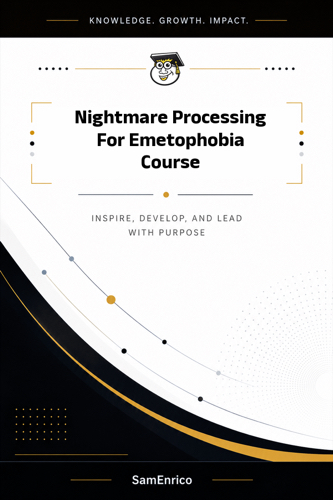
Non-FictionSelf-HelpEmetophobia
Nightmare Processing For Emetophobia Course eBook
Rescripts vomiting and nausea nightmares into sett
by Higdon Nelia
Rescripts vomiting and nausea nightmares into settled stomach images.
Formats
Free sample
Chapter 1: The Midnight Betrayal...--–- You wake up with a start. Your heart is hammering against your ribs like a trapped animal. Your mouth tastes like metal and bile. Your stomach lurches, and for one terrible, crystalline second, you are absolutely certain: this is it. You are going to be sick.
Right here, right now, in your own bed, at three in the morning, with no warning and no escape.You lie frozen, waiting for the inevitable. Your hand drifts to your throat. You swallow hard. Nothing happens. The nausea recedes slightly, but the terror does not.
You glance at the clock. 3:14 AM. Again. It is always between 3:00 and 3:30 AM when these nightmares strike. You are not alone in this.
Every single person reading this book knows exactly what that moment feels like: the split second between dreaming and waking when your brain has not yet decided whether the nightmare was real.You check the bathroom. You turn on the light. You look in the mirror. Your face is pale, your pupils dilated, your hair damp with sweat. You press your hand to your stomach.
It feels… fine. Mostly fine. There is a flutter of something, but you cannot tell if it is genuine nausea or the aftershock of fear. You run your tongue over your teeth. Everything seems normal.
But the certainty remains: you almost vomited. The dream was so vivid, so real, that your body is still braced for impact.You climb back into bed, but sleep is impossible. Your mind races through the frames of the nightmare, replaying each detail like a film editor searching for a mistake. The sound of it. The texture.
The helplessness. You tell yourself it was just a dream. But your body does not believe you. Your stomach is still tight. Your jaw is still clenched.
You lie awake until the sun rises, exhausted, ashamed, and already dreading the next time you close your eyes.If this sounds familiar, you are not broken. You are not crazy. And you are certainly not alone. Welcome to the midnight betrayal.The Nightmare Nobody Talks About Emetophobia is one of the most poorly understood anxiety disorders in existence. Approximately one percent of the global population suffers from it, yet most doctors have never heard the word.
The average emetophobe suffers for twelve years before receiving an accurate diagnosis. Twelve years of waking up at 3:00 AM convinced you are dying. Twelve years of avoiding restaurants, airplanes, public transportation, and children’s birthday parties. Twelve years of scanning your body for signs of nausea, monitoring every gurgle and twitch of your digestive system as if you were a bomb disposal expert waiting for the wire to snap.But the nightmares are the worst part. Daytime anxiety is exhausting, but at least you can control your environment.
You can avoid triggers. You can carry ginger candies and anti-nausea medication. You can scan restaurant menus for safe foods. At night, all of that control evaporates. Your unconscious mind does not care about your safety behaviors.
It does not care that you have not vomited since 1998. It does not care that you are perfectly healthy. At night, your brain serves up the one thing you fear most, in vivid technicolor, complete with sound effects and physical sensations so real that you wake up gasping.Nightmare processing for emetophobia is not about learning to "handle" vomit. It is not exposure therapy. It is not about becoming comfortable with something that is genuinely uncomfortable.
It is about something much more specific and much more achievable: teaching your brain to recode the memory file from "DANGER" to "NEUTRAL."The Computer File in Your Head Here is the central metaphor that will guide you through every chapter of this book. Imagine that your brain is a hard drive. Every memory, every sensation, every nightmare is a file stored on that drive. When you have a traumatic experience—or even a vividly imagined experience, which your brain cannot reliably distinguish from a real one—the file gets saved with a piece of metadata, an error code, that says: THIS IS AN EMERGENCY. DANGER.
DO NOT FORGET.This error code is what makes your heart race when you think about vomiting. It is what makes you scan your body for nausea. It is what makes you wake up at 3:14 AM convinced that you are dying. Your brain is not trying to hurt you. It is trying to protect you.
But it has saved the file with the wrong label.Here is what most people do not understand about nightmares: you cannot delete the file. You cannot erase the memory. You cannot perform "exposure therapy" on yourself in your sleep and hope that the nightmares stop. That is like trying to delete a computer file by hitting the screen. It does not work, and it will only make you feel more helpless.What you can do is recode the metadata.
You can take that file labeled "DANGER: VOMIT" and change the label to "NEUTRAL: BODILY EVENT." You are not erasing the memory. You are not pretending the event never happened. You are simply teaching your brain that this particular file does not require the emergency alarm system. This is what nightmare rescripting is. This is what this entire book will teach you to do.Why Your Brain Wakes You Up To understand why these nightmares feel so real, you need to understand a little bit about what happens in your brain while you sleep.
Do not worry. This is not a neuroscience textbook. There will be no diagrams of brain stems or pop quizzes on REM cycles. But there is one distinction that is essential for you to understand: the difference between your amygdala and your hippocampus.Your amygdala is your brain's fear center. It is ancient, fast, and very stupid.
It does not think. It reacts. It is the part of your brain that pulls your hand away from a hot stove before you have even registered the word "hot." It is the part of your brain that makes you leap backward when you see something that looks like a snake, even if it is just a coiled garden hose. The amygdala is wonderful at keeping you alive in physical danger. It is terrible at distinguishing between a real threat and a memory of a threat.Your hippocampus is your brain's context center.
It is newer, slower, and very smart. It is the part of your brain that says, "That was just a garden hose, not a snake." It provides time stamps, location markers, and reality checks. It is the reason you can watch a horror movie without genuinely believing that a murderer is in your living room.Here is the problem. During REM sleep—the stage of sleep when most vivid nightmares occur—your amygdala is wide awake and working overtime. It is scanning for threats, revving up your stress hormones, ready to spring into action.
Your hippocampus, on the other hand, is largely offline. It is resting. It is not providing context or time stamps or reality checks.This means that during a nightmare, your brain is experiencing the event as if it is…
This is the end of the free sample. Get the eBook to keep going. Buy now
About this book
Details
- Author
- Higdon Nelia
- Publisher
- SamEnrico
- Language
- English
- Genre
- Non-Fiction, Self-Help, Emetophobia
- Released
- 2026-06-10
- Pages (approx.)
- 152
- Available as
- eBook, Audiobook

Read better in the ZLOADR app
Your eBooks on your phone or tablet. Sign in with your SamEnrico account and start reading.
More by Higdon Nelia
 Pesticide Exposure Reduction PlanHigdon Nelia$11.99
 Landlord Anger TriggersHigdon Nelia$11.99
 Cape Town Edtech OpportunitiesHigdon Nelia$11.99
 The Calorie Tracking for SeniorsHigdon Nelia$11.99
 The Battle of the Hydaspes: Alexander’s Last Great TriumphHigdon Nelia$11.99
 Understanding Proximal Myotonic DystrophyHigdon Nelia$17.99
 Excel Statistics for Economics ExamsHigdon Nelia$12.99
 Workplace Posters First HireHigdon Nelia$12.99
 Digital Product OwnerHigdon Nelia$11.99
 How to Start a Tradebinding and Related Work BusinessHigdon Nelia$11.99
You may also like
 Hong Kong Handover 1997Dunn Johnnie$11.99
 Zumba For Postnatal Recovery CourseNeal Christian$11.99
 Zumba for BeginnersLadner Nikia$11.99
 YouTube Comment Mining GuideHumes Pandora$12.99
 Worry Box MeditationCarlin Rudy$11.99
 Workplace Stress MeditationNguyen Lynn$11.99
 Workplace Stress and Sleep RepairHawley Ivory$11.99
 Workplace Perfectionism CureDelaney Jeffry$11.99
 Workplace Injustice Anger GuideWallen Isabelle$11.99
 Work Addiction and Burnout LinkGreenwood Ester$11.99
 Women in Yoga and WellnessBeattie Galina$11.99
 Women in Stand Up ComedyChun Evangeline$11.99