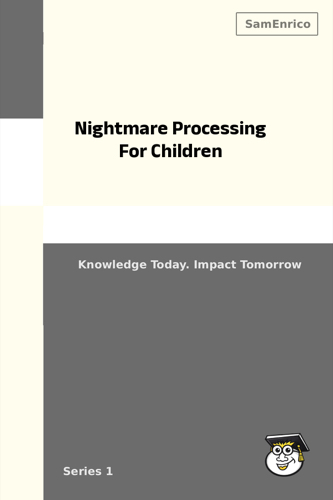
Nightmare Processing For Children Audiobook
Gentle techniques to help kids process scary dream
Gentle techniques to help kids process scary dreams.
Formats
Free sample
Chapter 1: The Nightmare Bug--–- Three-year-old Mia bolts upright in bed, screaming. Her pajamas are soaked with sweat. Her eyes are open, but for the first thirty seconds, she doesn't seem to recognize her own mother sitting beside her. When she finally does, she clutches her mother's arm with surprising strength and whispers, "The monster was under my bed. It had red eyes.
It wanted to eat me."Her mother, exhausted and overwhelmed, says the thing most parents say: "Honey, it was just a dream. There are no monsters. Go back to sleep."Mia does not go back to sleep. Neither does her mother. And tomorrow night, the bedtime battle will begin two hours earlier than usual, because Mia is already terrified of falling asleep.This scene repeats itself in millions of homes every single night.
And the most heartbreaking part? The mother's response—well-intentioned, loving, completely normal—is exactly the wrong thing to say. Not because she made a mistake, but because no one ever taught her what nightmares actually are, why they happen, and how to respond in a way that doesn't accidentally make things worse.This chapter is going to change that for you. By the time you finish reading, you will understand the science of scary dreams better than most pediatricians. More importantly, you will have a completely new framework for thinking about nightmares—not as a problem to be eliminated, but as a biological process to be understood and gently guided.But first, we need to talk about the elephant in the room.
Or rather, the monster under the bed.The Great Confusion: Night Terrors vs. Nightmares Before we can help a child process a nightmare, we have to know what we're actually dealing with. And here is where most parents—and even some doctors—get it wrong.Nightmares and night terrors are not the same thing. They look similar from the outside. Both involve a child crying out in the night.
Both disrupt sleep. But they are biologically distinct events that require completely different responses. Using a nightmare protocol on a night terror is like using an umbrella in a hurricane. It won't work, and you'll both end up soaked.Night Terrors (Sleep Terrors)Night terrors occur during non-REM sleep, usually in the first third of the night. The child is not actually awake.
Their eyes may be open, they may sit up, they may scream or thrash, but their brain is still in…
This is the end of the free sample. Get the Audiobook to keep going. Buy now
About this book
Details
- Author
- Archuleta Exie
- Publisher
- SamEnrico
- Language
- English
- Genre
- Non-Fiction, Self-Help, Child Therapy
- Released
- 2026-06-06
- Pages (approx.)
- 137
- Available as
- eBook, Audiobook

Listen in the VoxFlicks app
Audiobooks and audio dramas wherever you go. Sign in with your SamEnrico account and press play.
More by Archuleta Exie
 Zero Based Peg System GuideArchuleta Exie$11.99
 Anger De escalation for Train StaffArchuleta Exie$11.99
 Ectopic Fertility AfterArchuleta Exie$11.99
 Leading Question EffectArchuleta Exie$11.99
 Social Smoking Cessation GuideArchuleta Exie$11.99
 Keto Mental Clarity FocusArchuleta Exie$11.99
 Spironolactone PCOSArchuleta Exie$11.99
 The Frost King's Gambit: Charles XII's Lost Victory at PoltavaArchuleta Exie$11.99
 The Clockwork Visionary: Jacques de Vaucanson and the Automaton RevolutionArchuleta Exie$11.99
 A Collector's Handbook to the Daihatsu CharadeArchuleta Exie$11.99
 How to Produce Speaker Bags, Covers and CasesArchuleta Exie$11.99
 How to Produce Glitter SprayArchuleta Exie$11.99