
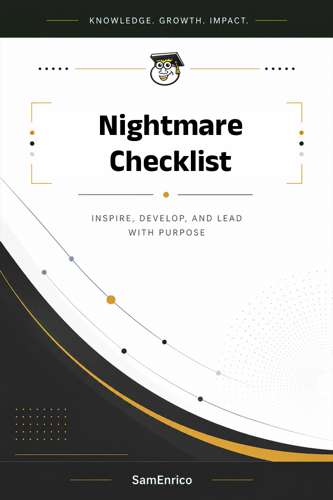
Free sample
Chapter 1: The 3 AM Inventory--–- The first time Sarah woke up certain she was going to die, it was 3:17 AM on a Tuesday in March. There was no intruder at her Chicago apartment door. No fire alarm shrieking from the hallway. No text message bearing news of a catastrophe. Her son, Leo, was asleep in the next room, his stuffed octopus tucked under one arm, breathing the slow, wet rhythm of a six-year-old in the middle of a good dream.
The radiators hissed their usual February-lingering complaint. The neighbor’s television murmured through the wall. Everything was fine. And yet Sarah’s heart was pounding so hard she could feel it in her teeth. Her palms were slick.
Her brain was feeding her a highlight reel of disaster: the front door lock that had felt loose last week, the smoke detector that needed a battery she kept forgetting to buy, the weird email from her bank’s fraud department she had marked as “read” and then ignored. In the darkness, these small failures aggregated into a single, overwhelming certainty: something terrible was about to happen, and she was not ready.She lay there for twenty minutes, running the same loop. Then she got up, checked the front door lock (still locked), checked Leo (still breathing), checked her phone (no alerts), and went back to bed. By morning, the feeling had evaporated, replaced by the ordinary exhaustion of a single mother who taught seventh grade English and had a stack of essays on symbolism in The Outsiders waiting to be graded. She forgot about the 3 AM certainty.
Until the next Tuesday. And the Tuesday after that. And then the night the smoke detector actually did go off—not because of a fire, but because the dying battery had finally surrendered to entropy, shrieking at 2 AM for no reason at all. Sarah stood under it with a broom handle, jabbing at the reset button, and thought: I am going to die because I couldn’t be bothered to buy a nine-volt battery. She was wrong, but not entirely.The Fear Audit: Naming the Ghosts Every person who has ever woken up at 3 AM convinced of an impending catastrophe is participating in an ancient, involuntary ritual.
Your brain, freed from the distractions of daylight, begins running threat simulations. Some of these are rational. Some are statistical nonsense. But your amygdala—that small, almond-shaped cluster of neurons responsible for emotional processing and threat detection—does not care about statistics. It cares about survival.
And because it cannot tell the difference between a real threat (a loose lock, a forgotten battery) and an imagined one (a shark attack in Illinois, a lightning strike through a closed window), it treats both identically. Your heart races. Your muscles tense. You prepare to fight or flee from a predator that exists only in the electrical storm of your own mind.This chapter is not about stopping that process. You cannot stop it, any more than you can stop your stomach from growling or your eyes from watering in wind.
What you can do is redirect it. The tool for that redirection is called the Fear Audit, and it is the single most important practice in this entire book. Every subsequent chapter—every checklist, every drill, every hard-won piece of advice about home invasions and blackouts and crowd surges—depends on you completing this audit honestly.The Fear Audit is simple, uncomfortable, and liberating. You are going to write down every nightmare scenario that has ever kept you awake at 3 AM. You are going to name them.
You are going to categorize them. And then you are going to learn which ones deserve your limited time, energy, and money—and which ones you are permitted to ignore.Do not skip this exercise. I have taught preparedness to thousands of people across two decades of research, and I have watched otherwise rational adults spend three hundred dollars on “zombie apocalypse” survival kits while their smoke detectors ran on dead batteries. I have watched parents install fifteen thousand dollars in home security cameras while never teaching their teenager how to escape a second-floor bedroom during a fire. I have watched people memorize active shooter response protocols while having no idea where their family’s passports or birth certificates were stored.
The Fear Audit exists to prevent that specific kind of misdirected anxiety. It will tell you what to fear first.Sarah’s First Audit Let me show you how this works. Sarah, our recurring protagonist, completed her first Fear Audit on a Sunday afternoon while Leo was at a birthday party. She sat at her kitchen table with a yellow legal pad and a pen that leaked ink onto her fingers. She wrote for forty-five minutes.
Here is what she produced, unedited:Someone breaks in through the back window while Leo and I are sleeping.Leo has a severe allergic reaction and I don’t have his Epi Pen because it expired and I forgot to refill it.I get laid off and can’t pay rent and we end up in Leo’s classroom’s homeless shelter rotation.A fire starts in the kitchen while I’m in the shower and Leo is watching TV and I don’t hear the alarm.My bank account gets hacked and I can’t access my money for weeks and I have no cash.A shooter comes to Leo’s school while I’m at my school and I can’t get to him.I fall in the shower and break my hip (I am thirty-four, this is insane, but I think about it constantly).The car’s brakes fail on the highway with Leo in the back seat.A crowd crush at the Christkindlmarket where we go every December.The power goes out for a week in winter and we freeze.I get a weird mole that turns out to be melanoma and I ignored it because no insurance.Leo gets cancer. (I cannot write this one without crying, but it’s there.)Twelve nightmares. Some rational. Some statistically absurd (she is thirty-four, with no family history of hip fractures, and she has never fallen in a shower in her life). Some so terrifying she could barely bring herself to write them.
But they were out of her head and on the page, and that was the point.The Five Categories of Nightmares Once you have written your own list—and you will, before you finish this chapter—you need to sort your nightmares into five buckets. These categories will appear throughout the book, and every subsequent chapter will address one or more of them directly. The categories are not arbitrary; they emerged from analyzing the best-selling preparedness literature of the last forty years, from Gavin de Becker’s The Gift of Fear to Amanda Ripley’s The Unthinkable to the U.S. government’s own CERT (Community Emergency Response Team) training manuals.Category One: Natural Nightmares. These are events caused by weather, geology, or biology: hurricanes, tornadoes, earthquakes, floods, wildfires, pandemics, extreme heat, extreme cold.
They are the nightmares you cannot negotiate with. You cannot reason with a hurricane. You cannot sue a wildfire. Natural…
This is the end of the free sample. Get the eBook to keep going. Buy now
About this book
Details
- Author
- Norfleet Carletta
- Publisher
- SamEnrico
- Language
- English
- Genre
- Non-Fiction, Self-Help / Reference
- Released
- 2026-06-06
- Pages (approx.)
- 148
- Available as
- eBook, Audiobook

Read better in the ZLOADR app
Your eBooks on your phone or tablet. Sign in with your SamEnrico account and start reading.
More by Norfleet Carletta
 Sales Team ExhaustionNorfleet Carletta$11.99
 A Monk in the SlumsNorfleet Carletta$11.99A Monk in the SlumsNorfleet Carletta$11.99
 The TM Group Meditation GuideNorfleet Carletta$11.99
 Student Data Leak School ScriptsNorfleet Carletta$11.99
 Acupuncture For GlaucomaNorfleet Carletta$11.99
 In Law Conflict TriggersNorfleet Carletta$11.99
 Anabaptist Munster Rebellion HandbookNorfleet Carletta$11.99
 Susan RiceNorfleet Carletta$11.99
 The Silent Empire: How a Forgotten Mogul Built the First Global News NetworkNorfleet Carletta$11.99
 The Stone Sentinels: Gothic Cathedrals and the Men Who Defied GravityNorfleet Carletta$11.99
 The Day the Music Died: The Untold Story of Buddy Holly’s Last FlightNorfleet Carletta$11.99
You may also like
 Hong Kong Handover 1997Dunn Johnnie$11.99
 Zumba For Postnatal Recovery CourseNeal Christian$11.99
 Zumba for BeginnersLadner Nikia$11.99
 YouTube Comment Mining GuideHumes Pandora$12.99
 Worry Box MeditationCarlin Rudy$11.99
 Workplace Stress MeditationNguyen Lynn$11.99
 Workplace Stress and Sleep RepairHawley Ivory$11.99
 Workplace Perfectionism CureDelaney Jeffry$11.99
 Workplace Injustice Anger GuideWallen Isabelle$11.99
 Work Addiction and Burnout LinkGreenwood Ester$11.99
 Women in Yoga and WellnessBeattie Galina$11.99
 Women in Stand Up ComedyChun Evangeline$11.99