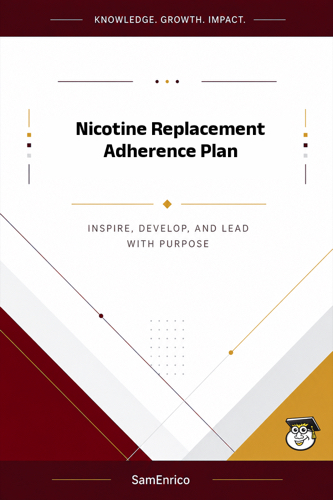
Nicotine Replacement Adherence Plan eBook
Sticking to gum, lozenge, or patch schedules to av
Sticking to gum, lozenge, or patch schedules to avoid premature discontinuation and relapse.
Formats
Free sample
Chapter 1: The 40% Lie--You have been lied to. Not maliciously, and not by any single person, but by a cultural story about quitting smoking that has been repeated so often it has hardened into事实. The lie sounds like this: If you really wanted to quit, you would just quit. The patch is a crutch. The gum is for people who lack willpower.
And if you start smoking again, it’s because you didn’t want it badly enough.That narrative is not just wrong. It is medically dangerous.Here is what the data actually says. Forty percent of people who buy nicotine patches stop using them within the first two weeks. Not because they have started smoking again—most haven’t, not yet—but because they have concluded that the medicine isn’t working or that they no longer need it. They peel off the patch, put away the gum, and announce to themselves: I’ve got this on my own now.
Then, seven to fourteen days later, the wheels come off. A stressful meeting. A fight with a partner. A flat tire on the highway. And suddenly they are standing in a convenience store buying a pack they swore they were done with.The pattern is so predictable that it has a name in clinical research: premature discontinuation.
It is the single largest predictor of relapse in smoking cessation. It is more powerful than craving severity, more powerful than smoking history, more powerful than age, gender, income, or education. And it is almost entirely preventable.This book exists because you have probably tried to quit before. Maybe you tried once. Maybe you tried twelve times.
Maybe you have a drawer full of half-used patches and a cabinet full of expired gum. And every time, you told yourself the same story: I failed because I wasn’t strong enough.That story is wrong. You failed because you stopped the medicine too soon. And you stopped the medicine too soon because no one ever explained how it actually works.The Adherence Paradox Let me introduce you to a concept that will determine whether you succeed or fail. I call it the Adherence Paradox, and it works like this:Phase 1: You start NRT.
The patch goes on. The gum goes in. Within a few days, your cravings drop. Your mood stabilizes. You feel human again.
You are proud of yourself.Phase 2: Because you feel better, you assume you are better. Your brain whispers: Maybe I don’t need this anymore. Maybe I was never really addicted. Maybe the hard part is over.Phase 3: You stop the NRT. Not because you want to smoke—you don’t, not yet—but because stopping feels like a victory.
You are proving that you are in control.Phase 4: Your nicotine levels crash. Not from the cigarettes you aren’t smoking, but from the medicine you stopped taking. The crash feels exactly like withdrawal. Because it is withdrawal. And because you don’t have NRT in your system, your brain reaches for the only source of nicotine it knows: a cigarette.Phase 5: You smoke one.
The relief is instant. You tell yourself it’s just one. By the end of the week, you are buying packs again. And you tell yourself: I guess I just don’t have the willpower.You had the willpower. You quit, didn’t you?
What you didn’t have was information. You didn’t know that the feeling of being cured was actually the medicine working. You mistook the effect of the treatment for the end of the treatment. And that mistake is not a character flaw. It is a predictable neurochemical event.Let me say that again, because it is the most important sentence in this chapter: Feeling good on Day 14 does not mean you are cured.
It means the medicine is working. Quitting the medicine means quitting the feeling good.The 90-Day Foundation Here is the number that will save your life: 90.Ninety days. That is how long your brain needs to rewire itself. Not two weeks. Not a month.
Not even eight weeks. Ninety days.The science is clear. Nicotine works by attaching to receptors in your brain called nicotinic acetylcholine receptors. When you smoke regularly, your brain grows more of these receptors to keep up with the constant flood of nicotine. It is not trying to hurt you.
It is just adapting. The problem is that when you stop smoking, you don’t suddenly have a normal number of receptors. You have an excess of receptors, all of them screaming for nicotine. That screaming is what we call cravings.Nicotine replacement therapy works by giving you a low, steady dose of nicotine—enough to quiet the screaming receptors, but not enough to give you a high. Over time, your brain realizes it doesn’t need all those extra receptors, so it starts pruning them back.
This process takes time. Specifically, it takes about ninety days for your receptor density to return to that of a never-smoker.If you stop NRT at Day 14, your receptor density is still sky-high. You are not healed. You are not even close. You are just a few days into a three-month process.
Stopping the medicine at Day 14 is like stopping antibiotics at Day 3 of a 10-day course. The infection isn’t gone. It’s just hiding.This is why clinical trials consistently show that adherence for 12 weeks—approximately 90 days—is the statistical tipping point for long-term remission. People who complete 12 weeks of NRT are three times more likely to still be smoke-free at one year compared to those who stop at 4 weeks. Three times.
That is not a small difference. That is the difference between a temporary quit and a permanent one.Why 40% Quit the Patch in Two Weeks Let’s go back to that 40% statistic. Why do so many people stop the patch within the first fourteen days? The answer is not what you think.If you ask people why they stopped, they will tell you things like: It wasn’t working. Or: I didn’t feel any different.
Or: I forgot to put it on one day, and then I just never put it back on.But here is what the clinical data shows. When researchers track people who stop NRT early, the majority are not experiencing severe side effects. They are not experiencing uncontrolled cravings. They are not reporting that the NRT made them sick. Instead, they are reporting a feeling of disappointment.
The patch didn’t eliminate all cravings. The gum didn’t taste good. The lozenge didn’t feel like a cigarette. And so they concluded: This isn’t working.This is the hidden trap. NRT is not designed to feel good.
It is not designed to eliminate cravings completely. It is designed to reduce cravings by about 50 to 70 percent. That is enough to make quitting possible. But it is not enough to make quitting easy. And when people expect easy and get manageable, they mistake manageable for failure.Let me be brutally honest with you.
You will still have cravings on NRT. You will still think about cigarettes. You will still have moments when your hand reaches for…
This is the end of the free sample. Get the eBook to keep going. Buy now
About this book
Details
- Author
- Mosher Fidelia
- Publisher
- SamEnrico
- Language
- English
- Genre
- Non-Fiction, Health & Wellness, Treatment Adherence
- Released
- 2026-06-07
- Pages (approx.)
- 136
- Available as
- eBook, Audiobook

Read better in the ZLOADR app
Your eBooks on your phone or tablet. Sign in with your SamEnrico account and start reading.
More by Mosher Fidelia
 Minimum Viable Product TestingMosher Fidelia$11.99
 Legal Professional Stress GuideMosher Fidelia$11.99
 Intermittent Fasting Success StoriesMosher Fidelia$11.99
 The Bully Proof TeenMosher Fidelia$11.99
 Mitch McConnell GridlockMosher Fidelia$11.99
 Collaborative Observation MethodMosher Fidelia$11.99
 TM for TradersMosher Fidelia$11.99
 HGH And BodybuildingMosher Fidelia$11.99
 The Silk Road in the Sky: The Forgotten Flight of the Kashgari AviatorsMosher Fidelia$11.99
 The Manchurian Candidate: The Untold CIA ExperimentsMosher Fidelia$11.99
 Orpheus and the Lyre That Moved the GodsMosher Fidelia$11.99
 Chain-of-Thought Prompt StrategiesMosher Fidelia$11.99