
Non-FictionHealth & WellnessMental Health
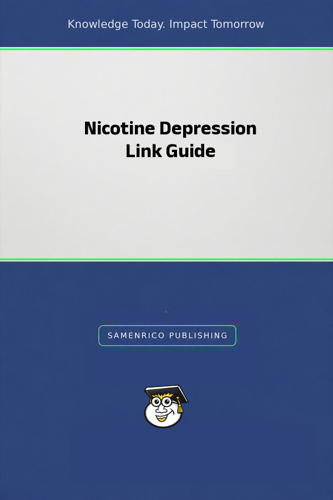
Nicotine Depression Link Guide Audiobook
Managing mood swings and depressive episodes trigg
Managing mood swings and depressive episodes triggered by nicotine withdrawal after quitting.
Formats
Free sample
Chapter 1: The Dopamine Crash--–- On a Tuesday morning in Denver, a 34-year-old graphic designer named Sarah crushed out her last cigarette. She had smoked for 18 years, a pack a day, and had tried to quit seven times before. Each attempt followed the same brutal pattern: the first two days were hard but manageable—cravings, irritability, the usual suspects. Then, around day four, something darker emerged. She stopped laughing at her daughter’s jokes.
She stopped wanting to see her friends. The music she loved sounded like noise. Her work, once a source of pride, became an exhausting slog. She was not just uncomfortable. She was hollow.
By day nine, she was back at the gas station, buying another pack, convinced that she was too weak to quit.Sarah was not weak. Sarah was experiencing a dopamine crash.This chapter will explain what happened inside Sarah’s brain—and what happens inside yours when you stop smoking. You will learn why nicotine withdrawal feels so devastatingly emotional, why some people sink into depression while others only feel irritable, and why this has nothing to do with willpower and everything to do with neurochemistry. By the end of this chapter, you will understand that you are not broken. Your brain is simply healing from an addiction that hijacked its most fundamental reward system.
And that understanding is the first step toward quitting for good.The Brain's Reward Currency: Understanding Dopamine To understand why quitting smoking makes you feel miserable, you must first understand dopamine. Dopamine is often called the "feel-good" neurotransmitter, but that is a simplification. Dopamine is not about pleasure. It is about motivation, anticipation, and reward prediction. It is the chemical that says, "Do that again.
That was good for you."Every time you eat when you are hungry, drink when you are thirsty, or connect with someone you love, your brain releases a small pulse of dopamine. This pulse reinforces the behavior, making you more likely to repeat it. This system evolved over millions of years to keep you alive. It is why you bother to get out of bed, why you work for a paycheck, why you seek out social connection. Dopamine is the fuel of human ambition.Nicotine hijacks this system with brutal efficiency.
When you inhale cigarette smoke or vape aerosol, nicotine travels to your brain within 7 to 10 seconds—faster than an intravenous injection.…
This is the end of the free sample. Get the Audiobook to keep going. Buy now
About this book
Details
- Author
- Mccullough Yetta
- Publisher
- SamEnrico
- Language
- English
- Genre
- Non-Fiction, Health & Wellness, Mental Health
- Released
- 2026-06-07
- Pages (approx.)
- 122
- Available as
- eBook, Audiobook

Listen in the VoxFlicks app
Audiobooks and audio dramas wherever you go. Sign in with your SamEnrico account and press play.
More by Mccullough Yetta
 Diamond Vault Legend HistoryMccullough Yetta$11.99
 Imposter Syndrome for Product ManagersMccullough Yetta$11.99
 Contingent Beneficiary GuideMccullough Yetta$11.99
 Sustainable Therapy Training Supervisors GuideMccullough Yetta$11.99
 Learner Driver Patience GuideMccullough Yetta$11.99
 Peg System Memory WorkbookMccullough Yetta$11.99
 Period Flu Remedies GuideMccullough Yetta$11.99
 Vitamin D Deficiency RLSMccullough Yetta$11.99
 The Last Telegram: The Untold Story of the Titanic’s Final HoursMccullough Yetta$11.99
 The Hermit King's Gambit: Yi Sun-sin and the Turtle Ships of MyeongnyangMccullough Yetta$11.99
 The Stone Spies: Gothic Architects of the DivineMccullough Yetta$11.99
 Sentiment Driven Response GuideMccullough Yetta$12.99
You may also like
 Hong Kong Handover 1997Dunn Johnnie$11.99
 Zumba For Postnatal Recovery CourseNeal Christian$11.99
 Zumba for BeginnersLadner Nikia$11.99
 YouTube Comment Mining GuideHumes Pandora$12.99
 Worry Box MeditationCarlin Rudy$11.99
 Workplace Stress MeditationNguyen Lynn$11.99
 Workplace Stress and Sleep RepairHawley Ivory$11.99
 Workplace Perfectionism CureDelaney Jeffry$11.99
 Workplace Injustice Anger GuideWallen Isabelle$11.99
 Work Addiction and Burnout LinkGreenwood Ester$11.99
 Women in Yoga and WellnessBeattie Galina$11.99
 Women in Stand Up ComedyChun Evangeline$11.99