
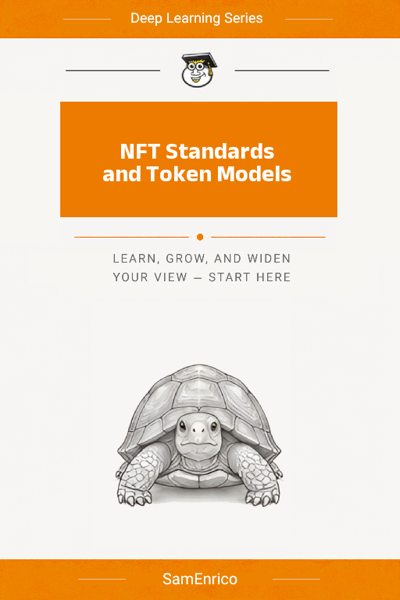
NFT Standards and Token Models eBook
A Coursebook on NFT Standards and Token Models
A Coursebook on NFT Standards and Token Models
Formats
Free sample
Chapter 1: The Illusion of Ownership...--The first time I watched someone lose an NFT, it wasn't because they were hacked, or scammed, or even particularly careless. It was because they assumed that owning a token meant the same thing as owning the thing the token pointed to. That assumption cost them twelve thousand dollars.Let me tell you about Alex. Alex had bought a piece from a hyped generative art collection—beautiful algorithms, scarcity enforced by code, a verified contract on Ethereum. He displayed it proudly on his profile.
He showed friends the swirling colors and the provenance hash that proved his was the first mint. Then the artist's server went offline. The image disappeared. The metadata resolved to a 404 error. Alex still owned the token.
The blockchain still said so. But what, exactly, did he own?This book exists because that question—"What do you actually own when you own an NFT?"—has no simple answer. And the answer changes depending on which standard you use, how you implement it, and what assumptions you bake into your smart contracts.The Asset That Isn't There Non-fungibility sounds straightforward. One token, unique, cannot be replicated, cannot be divided. But dig deeper and the concept unravels.
What makes a thing non-fungible? Is it the code? The metadata? The social consensus that one Crypto Punk with a cigarette is worth more than one without?Here is the foundational truth that most NFT books get wrong: non-fungibility is not a technical property. It is a social and cryptographic construct enforced by standards.
The blockchain does not inherently know that Token ID 42 cannot be swapped for Token ID 43. The blockchain knows only that they are different entries in a mapping. The standard—ERC-721, ERC-1155, LSP8, CIP-68—tells the world how to interpret those entries.Think of it this way. A dollar bill is fungible. Swap one for another and nothing changes.
A concert ticket starts as fungible—Row G, Seat 12 is identical to Row G, Seat 13 until the moment someone sits down. After the show, that stub becomes non-fungible. It held your experience. It has your memory attached. The paper is identical.
The meaning is not.NFTs invert this logic. The token is always identical at the protocol level. The meaning is attached through metadata, through history, through the standards that govern how wallets and marketplaces read that token. This inversion is the source of nearly every confusion, every hack, and every failed project in the space.The Three Pillars of Digital Scarcity To understand what you own, you must understand three concepts that appear in every standard, every implementation, and every dispute. I call them the three pillars of digital scarcity: indivisibility, uniqueness, and provenance.Indivisibility sounds obvious.
You cannot send half an NFT. But the boundary between fungible and non-fungible blurs in standards like ERC-1155, which allow the same contract to manage both. A game might mint 1000 "sword shards" that act as fungible currency, then let you combine five shards into one unique sword. The shards are divisible. The sword is not.
The standard handles both.Uniqueness is not the same as rarity. Every Crypto Punk is unique by token ID. But some are rare because of traits. Some are rare because of who owned them. The blockchain records the ID.
The market decides the value. No standard can encode cultural significance.Provenance is where blockchains shine. Every transfer, every approval, every mint is recorded forever. When Beeple's "Everydays" sold for sixty-nine million dollars, the buyer wasn't paying for a JPEG. They were paying for the history: the first major NFT sold at Christie's, the moment the art world acknowledged digital ownership as real.
That history is immutably recorded. No standard can create it. But every standard preserves it.Understanding these pillars matters because later chapters will show you how different standards prioritize them differently. ERC-721 emphasizes uniqueness and provenance at the cost of gas efficiency. ERC-1155 trades some uniqueness guarantees for batch operations.
LSP8 adds provenance hooks that ERC-721 lacks. CIP-68 separates provenance from metadata mutability.From Colored Coins to Crypto Punks The story of NFT standards begins not with Ethereum but with Bitcoin. In 2012, developers realized they could "color" satoshis—mark specific units of Bitcoin to represent external assets like shares in a company or a deed to property. Colored Coins never gained traction. Bitcoin's scripting language was too limited.
But the idea took root.In 2017, a team called Larva Labs released Crypto Punks. Ten thousand unique characters, each with different attributes, claimable for free by anyone with an Ethereum wallet. The contract was simple: a mapping from token ID to owner, a transfer function, and an offer function for selling. It was not standard. It did not implement ERC-721 because ERC-721 did not exist yet.
But Crypto Punks proved demand.Later that year, the ERC-721 standard was proposed. The authors—William Entriken, Dieter Shirley, Jacob Evans, and Nastassia Sachs—formalized what Crypto Punks had hacked together: an interface for non-fungible tokens that any wallet, any marketplace, any exchange could trust. The standard passed in 2018. By 2021, ERC-721 had powered hundreds of millions of dollars in volume.Understanding this history matters because every standard you will learn in this book is a response to limitations in the previous ones. ERC-1155 fixed ERC-721's inefficiency.
ERC-6551 fixed its lack of account abstraction. LSP8 fixed its metadata rigidity. Progress is measured in standards.Fungible, Semi-Fungible, Non-Fungible Before we go deeper, you need to place NFTs on a spectrum. Most people think in binary: fungible or not. The truth is more nuanced.Fungible tokens (ERC-20) are like water.
One drop is indistinguishable from another. Your wallet balance tracks quantity, not identity. Transfer a hundred tokens, and the sender loses a hundred while the receiver gains a hundred. No history attaches to individual units.Semi-fungible assets blur the line. Consider a concert ticket.
Before the show, every ticket to Row G, Seat 12 is identical to every other. They are fungible. After the show, that ticket becomes unique. It held your seat for that performance on that night. The standard that best handles this transition is ERC-1155, which treats semi-fungibility as a first-class concept rather than an edge case.Non-fungible tokens are the extreme end of the spectrum.
Each is unique, indivisible, and carries its own provenance. ERC-721, LSP8, and CIP-68 all operate in this regime, though with different trade-offs.Why does this spectrum matter? Because when you design an NFT project, you must decide where on this spectrum each asset lives. A game might have thousands of common potions (fungible), hundreds of uncommon weapons (semi-fungible), and a handful of legendary artifacts (non-fungible). Mixing standards—using ERC-1155 for the first two and ERC-721 for the last—is common.
So is using ERC-1155 for everything. The choice affects gas costs, user experience, and composability with other contracts.The Value Accrual Puzzle Why do some NFTs sell for millions while others never find a bid? The answer lies in how value accrues to the token. There are three channels, and every successful project masters all three.The first channel is metadata persistence. An NFT is only as valuable as its metadata is accessible.
When an artist uses centralized servers for images, and those servers go offline, the NFT becomes a pointer to nothing.…
This is the end of the free sample. Get the eBook to keep going. Buy now
About this book
Details
- Author
- Geary Kimberli
- Publisher
- SamEnrico
- Language
- English
- Genre
- Non-Fiction, Informative, Educational
- Released
- 2026-06-02
- Pages (approx.)
- 115
- Available as
- eBook, Audiobook

Read better in the ZLOADR app
Your eBooks on your phone or tablet. Sign in with your SamEnrico account and start reading.
More by Geary Kimberli
 Natural Disaster Trauma GuideGeary Kimberli$11.99
 Industrial Pollution Home GuideGeary Kimberli$11.99
 The Persuasive PresentationGeary Kimberli$11.99
 Fintech Capital StrategiesGeary Kimberli$11.99
 Anxiety Relief Hypnosis ScriptGeary Kimberli$11.99
 Alcohol Recovery Financial RecoveryGeary Kimberli$11.99
 Sarcopenia Metabolic Rate GuideGeary Kimberli$11.99
 Dreaming for Trauma ProcessingGeary Kimberli$11.99
 DesignOps Team AlignmentGeary Kimberli$11.99
 The Caspian's Hidden Energy: How a 19th-Century Russian Scientist Unlocked the Secrets of ThermodynamicsGeary Kimberli$11.99
 The Hammer of the North: Ragnar Lothbrok and the Siege of Paris (885-886 AD)Geary Kimberli$11.99
 Growing TrichosanthesGeary Kimberli$11.99