
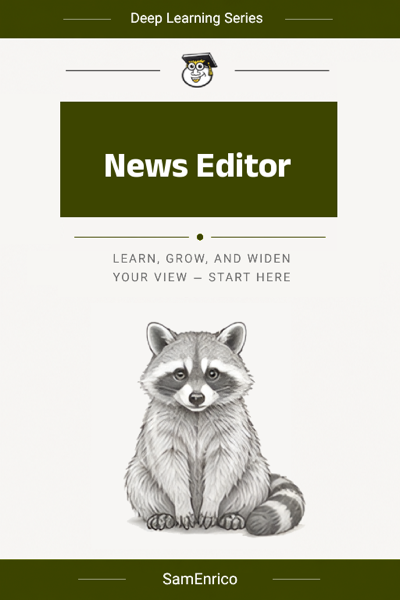
Non-FictionInformativeEducational
News Editor eBook
A Coursebook on News Editor
by Metzler Man
A Coursebook on News Editor
Formats
Free sample
Chapter 1: The Gatekeeper’s Gun--–- The first thing they don’t tell you in journalism school is that editing is not about commas. It is about power. The second thing they don’t tell you is that power feels nothing like you expect. It does not arrive with a fanfare or a corner office. It arrives at 11:47 on a Tuesday night, when a junior reporter sends you a story with a single line in the body that could end a career—yours, theirs, or someone else’s.
And in that moment, with your cursor hovering over the publish button, you discover what kind of editor you truly are.This chapter is not about grammar. It is not about AP Style or the Oxford comma or whether to capitalize “internet.” Those things matter, but they are tools, not the trade. This chapter is about the fundamental redefinition of the news editor for the 2020s and beyond. It is about moving from a copy cutter—a janitor of prose—to a content strategist, a legal gatekeeper, and the first line of defense for a publication’s credibility. If you do not understand this shift, no amount of stylistic precision will save you or your newsroom.The 1990s Newsroom vs.
The 2020s Newsroom To understand where the editor stands today, you must first understand where the editor came from. The newsroom of the 1990s was a cathedral. It was print-first, with rigid deadlines that structured the entire day like a liturgical calendar. Morning editors planned. Afternoon editors wrote.
Evening editors edited. Night editors laid out pages. And the copy desk—a phalanx of chain-smoking, coffee-swilling grammarians—sat in a horseshoe, wielding red pens like scalpels.In that world, the editor’s job was linear. A story flowed from reporter to city editor to copy editor to slot editor to proofreader to page designer. Each handoff was discrete.
Each person had a single function. The copy editor checked spelling, grammar, and libel. The slot editor checked the copy editor. The proofreader checked the page proofs. And then the presses rolled, and nothing could be changed until tomorrow’s edition.That world is dead.
It has been dead for at least a decade, though some newsrooms are still performing the autopsy.The 2020s newsroom is a bazaar. It is digital-first, meaning the homepage is never finished and the deadline is always “now.” It is 24/7, meaning your audience is spread across time zones and expects updates while they sleep. It is multi-platform, meaning the same story must survive as a push alert, a web article, a newsletter excerpt, a Tik Tok script, a podcast segment, and—if you still have one—a print column.In this world, the editor’s job is simultaneous. You do not hand off a story. You orbit it.
You check facts while the reporter files. You write headlines while the visual editor crops photos. You consult legal while the social media manager drafts threads. You publish a first version, then update it, then correct it, then update it again. The story is never finished.
It is only abandoned when the news cycle moves on.This shift from linear to simultaneous editing is the single most important structural change in modern journalism. It is also the source of most editor burnout, which we will address in Chapter 12. But for now, understand this: you cannot edit like it is 1995. The cathedral is gone. You work in the bazaar.The Four Pillars of Editorial Authority If the old editor’s job was to enforce rules, the new editor’s job is to exercise judgment.
Rules are simple. Judgment is hard. To help you develop judgment, this book introduces the Four Pillars of Editorial Authority: Accuracy, Clarity, Fit, and Fairness. Every decision you make—every cut, every rewrite, every kill, every publish—should rest on these four foundations.Pillar One: Accuracy Accuracy is not the same as fact-checking, though fact-checking is part of it. Accuracy is a posture.
It is the assumption that every claim in every story might be wrong until you have personally verified it from a primary source. Not a secondary source. Not “another outlet reported.” Not “a spokesperson said.” A primary source: the document, the data, the recording, the eyewitness you can name and contact.The accurate editor is paranoid. They do not trust memory. They do not trust “everyone knows.” They do not trust the reporter’s assurances, no matter how senior.
They verify. And when they cannot verify, they either demand the claim be removed or flag it explicitly for the reader: “The Associated Press reported, but The Times could not independently confirm...”In Chapter 3, we will spend considerable time on the specific tools of verification—reverse image search, geolocation, metadata analysis, deepfake detection. For now, adopt the mindset. Accuracy is not a step. It is the water you swim in.Pillar Two: Clarity Clarity is the art of making complex things simple without making them wrong.
It is the most underrated editorial skill because when it works, no one notices. When it fails, everyone blames the reporter.The clear editor reads every sentence twice: once for meaning, once for confusion. They cut jargon. They break up long paragraphs. They replace passive voice with active voice unless there is a good reason not to.
They ask themselves: “If a reader has never heard of this topic before, will they understand this sentence on the first pass?” If the answer is no, they rewrite.Clarity is not dumbing down. It is not removing nuance. It is removing unnecessary obstacles between the reader and the information. The reader is not the enemy. The reader is the reason you have a job.
Treat their attention as sacred.Pillar Three: Fit Fit is the most pragmatic pillar and the most frequently ignored. It asks: does this story belong in this publication, at this length, in this format, for this audience?A brilliant investigation into municipal bond fraud does not fit in a lifestyle magazine. A touching human-interest feature does not fit on a breaking-news homepage. A 5,000-word narrative does not fit in a morning newsletter designed for three-minute commutes. None of these are bad stories.
They are simply misfits. And a misfit story, no matter how well reported, is a disservice to the reader.The fit editor knows their publication’s mission statement by heart. They know the audience demographics. They know the typical reading time. They know the platform constraints.
And they shape—or kill—stories accordingly. Fit is also the pillar that connects editorial judgment to business reality, a theme we will explore in Chapter 11. A story that fits perfectly serves the reader and the bottom line.Pillar Four: Fairness Fairness is the most emotionally demanding pillar because it requires you to balance competing interests: the source’s right to privacy, the public’s right to know, the subject’s right to reply, the reporter’s right to pursue the truth, and the publication’s right to protect itself from liability.The fair editor asks a series of uncomfortable questions before publication: Have we given the subject meaningful opportunity to respond? (Not just a voicemail at 11 PM.) Have we included context that might absolve or explain? Have…
This is the end of the free sample. Get the eBook to keep going. Buy now
About this book
Details
- Author
- Metzler Man
- Publisher
- SamEnrico
- Language
- English
- Genre
- Non-Fiction, Informative, Educational
- Released
- 2026-06-03
- Pages (approx.)
- 145
- Available as
- eBook, Audiobook

Read better in the ZLOADR app
Your eBooks on your phone or tablet. Sign in with your SamEnrico account and start reading.
More by Metzler Man
 Long Pomodoro for Deep WorkMetzler Man$11.99
 Teresa's Intellectual FormationMetzler Man$11.99
 Reddit Thread Spiral GuideMetzler Man$11.99
 Prednisone Taper PlanMetzler Man$11.99
 The Outback Visionaries: How Australia Built a NationMetzler Man$11.99
 How to Produce Cat TreatsMetzler Man$11.99
 Hurricane Property Coverage HandbookMetzler Man$12.99
 How to Start a Loose Leaf Binder Business (Beginners Guide)Metzler Man$11.99
You may also like
 Hong Kong Handover 1997Dunn Johnnie$11.99
 Zumba For Postnatal Recovery CourseNeal Christian$11.99
 Zumba for BeginnersLadner Nikia$11.99
 YouTube Comment Mining GuideHumes Pandora$12.99
 Worry Box MeditationCarlin Rudy$11.99
 Workplace Stress MeditationNguyen Lynn$11.99
 Workplace Stress and Sleep RepairHawley Ivory$11.99
 Workplace Perfectionism CureDelaney Jeffry$11.99
 Workplace Injustice Anger GuideWallen Isabelle$11.99
 Work Addiction and Burnout LinkGreenwood Ester$11.99
 Women in Yoga and WellnessBeattie Galina$11.99
 Women in Stand Up ComedyChun Evangeline$11.99