
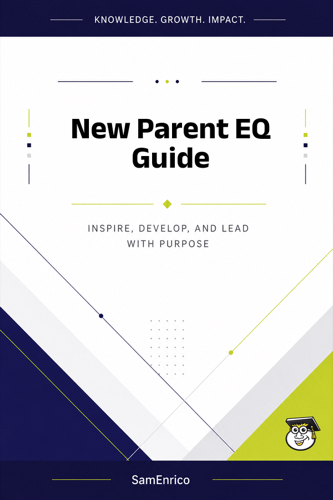
Non-FictionSelf-HelpPostpartum
New Parent EQ Guide eBook
Manage postpartum emotions and partner communicati
by Bell Hugh
Manage postpartum emotions and partner communication.
Formats
Free sample
Chapter 1: The Emotional Hangover--–- You are thirty-seven minutes into what was supposed to be a peaceful afternoon nap. The baby has been asleep for exactly nine of those minutes. You have not slept more than three consecutive hours in eleven days. Your partner just asked, "What's wrong?" and you felt your entire body turn into a clenched fist. You want to scream.
You want to cry. You want to go back in time and shake the person you used to be, the one who thought parenthood would be soft light and matching pajamas and a baby who smelled like vanilla and slept on your chest while you read novels.Instead, you are standing in the kitchen, staring at a counter full of half-washed bottles, wearing a shirt that has spit-up on the shoulder you forgot to change, trying to remember the last time you ate something that wasn't eaten standing up. And underneath all of it, underneath the exhaustion and the frustration and the noise, there is a thought you would never say out loud. A thought that makes you feel like a monster. A thought that whispers: What have I done?Here is the first thing this book needs to tell you: that thought does not make you a monster.
It makes you a normal human being who is going through one of the most profound, disorienting, and emotionally violent transformations a person can experience. The fact that you are having that thought and still showing up, still feeding the baby, still trying to figure out how to talk to your partner without losing your mind—that is not failure. That is evidence that you are doing something incredibly hard and you are still standing.This chapter is going to give you permission to feel all of it. The grief, the rage, the numbness, the boredom, the love that sometimes feels buried under logistics. It is going to teach you how to tell the difference between normal postpartum emotional chaos and something that needs professional help.
And it is going to give you a simple, four-step tool that will change how you respond to your own feelings—not by making them go away, but by making them something you can work with instead of against.Welcome to the emotional hangover. It does not last forever. But pretending it isn't happening definitely makes it worse.The Silence Around What Actually Hurts Let us be honest about something most parenting books dance around. There is a massive gap between what we expect parenthood to feel like and what it actually feels like. The expectation comes from everywhere—social media feeds full of golden-hour photos, movies where the baby sleeps through the night by week two, well-meaning relatives who say "just you wait" with a smile that suggests they have forgotten everything.
The expectation is that you will feel a tidal wave of instant, overwhelming love the second you see your baby. That you will intuitively know what to do. That your partner will read your mind and bring you tea and rub your feet without being asked. That you will be tired but happy, the way people are tired after a good workout.The reality, for most people, is much messier.The reality is that love for a newborn often feels less like a tidal wave and more like a slow, complicated attachment that grows in fits and starts. The reality is that many parents look at their baby and feel mostly terror and responsibility for the first few weeks, with occasional flashes of something warmer.
The reality is that you might find yourself missing your old life so acutely that it takes your breath away, and then feel guilty about missing it because you are supposed to be grateful. The reality is that you might feel rage so intense it scares you—rage at the baby for crying, at your partner for breathing wrong, at the dog for needing to go out, at the universe for making this so hard.And here is the thing no one tells you: all of that is within the range of normal.Not all of it is fine. Some of it needs help. But the presence of these feelings does not mean you are broken, or that you made a mistake, or that you are a bad parent. It means you are a person who just went through a seismic life event while operating on a level of sleep deprivation that is literally used as an interrogation technique because it breaks down human resistance.Matrescence and Patrescence: You Are Becoming Someone New There is a word for what you are going through, and it should be as common as "adolescence" but it is not.
The word is matrescence—the process of becoming a mother. Coined by anthropologist Dana Raphael in the 1970s and popularized by psychiatrist Alexandra Sacks, matrescence describes the physical, emotional, hormonal, and identity transformation that happens when a person becomes a mother. It is not an event. It is a developmental process, like puberty. And like puberty, it is messy, disorienting, and full of mood swings that make absolutely no sense at the time.For non-birthing parents—fathers, partners, adoptive parents—a parallel process exists, sometimes called patrescence.
The hormonal shifts may be less dramatic, but the identity transformation is just as real. You are not the same person you were before the baby arrived. Your relationship is not the same relationship it was before. Your understanding of yourself—as a partner, as a professional, as a friend, as a person with hobbies and spontaneity—is being rebuilt from the ground up.Here is what this means in practical terms: you are not supposed to feel like yourself right now. You are not supposed to have it figured out.
You are not supposed to be the same partner you were before the baby, because you are not the same person. The goal is not to "get back to normal." The goal is to become the person you are becoming, without hating yourself or your partner along the way.Think about what we expect from adolescents. We expect mood swings. We expect identity confusion. We expect them to try on different versions of themselves and reject the ones that do not fit.
We expect them to be messy and uncertain and occasionally insufferable. And we give them years to figure it out.Now look at what we expect from new parents. We expect them to have it together in weeks. We expect them to be emotionally stable while sleeping in ninety-minute increments. We expect them to maintain their relationship, keep the house clean, and document every adorable moment for social media.That gap between what is developmentally normal and what we are told to expect is the source of so much unnecessary suffering.
This chapter is giving you permission to close that gap. You are allowed to be a mess right now. You are allowed to not know who you are. You are allowed to grieve the person you used to be while you figure out who you are becoming.Sleep Deprivation: The Emotional Truth Serum Before we go any further, we…
This is the end of the free sample. Get the eBook to keep going. Buy now
About this book
Details
- Author
- Bell Hugh
- Publisher
- SamEnrico
- Language
- English
- Genre
- Non-Fiction, Self-Help, Postpartum
- Released
- 2026-06-10
- Pages (approx.)
- 135
- Available as
- eBook, Audiobook

Read better in the ZLOADR app
Your eBooks on your phone or tablet. Sign in with your SamEnrico account and start reading.
More by Bell Hugh
 Hospital Resident Nap GuideBell Hugh$11.99
 OKR For Saving GoalsBell Hugh$11.99
 Group Creativity Assessment WorkbookBell Hugh$11.99
 Student Safety in DubaiBell Hugh$11.99
 Price to Sales Multiples GuideBell Hugh$11.99
 Massage For Neck TensionBell Hugh$11.99
 Self Hypnosis for Performance AnxietyBell Hugh$11.99
 The Troll King's GambitBell Hugh$11.99
 The Bamboo Cutter’s Daughter: A Moonlit LamentBell Hugh$11.99
 How to Start a Hobby in CurlingBell Hugh$11.99
 Sabre-toothed Tigers: SmilodonBell Hugh$11.99
 How to Produce Decorative PlaquesBell Hugh$11.99
You may also like
 Hong Kong Handover 1997Dunn Johnnie$11.99
 Zumba For Postnatal Recovery CourseNeal Christian$11.99
 Zumba for BeginnersLadner Nikia$11.99
 YouTube Comment Mining GuideHumes Pandora$12.99
 Worry Box MeditationCarlin Rudy$11.99
 Workplace Stress MeditationNguyen Lynn$11.99
 Workplace Stress and Sleep RepairHawley Ivory$11.99
 Workplace Perfectionism CureDelaney Jeffry$11.99
 Workplace Injustice Anger GuideWallen Isabelle$11.99
 Work Addiction and Burnout LinkGreenwood Ester$11.99
 Women in Yoga and WellnessBeattie Galina$11.99
 Women in Stand Up ComedyChun Evangeline$11.99