
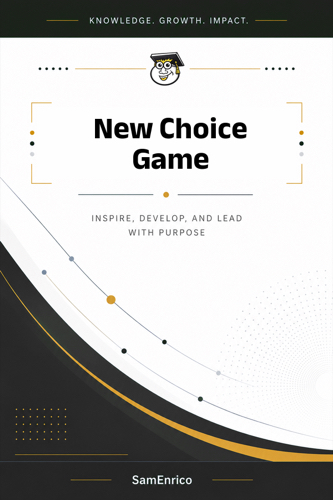
New Choice Game eBook
Repeat scenes with changed lines to explore possib
by Robson Lauri
Repeat scenes with changed lines to explore possibilities.
Formats
Free sample
Chapter 1: The Tyranny of Never--–- Every writer has felt it. That quiet, suffocating pressure about halfway through a first draft when you realize your protagonist has become a puppet. They speak the lines you assigned them. They make the choices you plotted out on your index cards. They move from Scene A to Scene B to Scene C with the mechanical obedience of a train on a track.
And somewhere around page 147, you look up from the keyboard and think: This character isn't a person. This character is a delivery system for a plot I already decided on six months ago.The problem is not that you lack talent. The problem is not that your idea is flawed. The problem is a hidden assumption so deeply embedded in Western storytelling that most writers never even notice it, let alone question it. The assumption is this: a story must move forward in a straight line, and a character must make one irreversible choice after another, and by the end of the story, there is a single, correct version of who that character turned out to be.This chapter calls that assumption what it is: the tyranny of the arc.And then it offers a way out.The Quiet Lie of Rising Action Every aspiring writer has memorized the diagram.
It appears in every craft book, every creative writing syllabus, every You Tube video about story structure. The diagram shows a line rising from left to right. It begins with exposition, climbs through rising action, peaks at the climax, and descends through falling action to the resolution. The line is smooth. The line is inevitable.
The line is, according to everything we have been taught, the shape of a story worth telling.But here is what that diagram does not show you. It does not show you the moment in Groundhog Day when Phil Connors, after trying kindness, cruelty, hedonism, despair, and suicidal recklessness, finally settles into something like wisdom. The diagram shows a single line. Phil Connors lived a thousand lines. The diagram shows us the ending.
The movie shows us the multiverse of possibilities that existed inside the same character before he chose which version of himself to become.The tyranny of the arc tells you that a character must change. It tells you that change must be linear. It tells you that every scene should push the character further along that line toward a predetermined destination. And these instructions are not wrong, exactly. They are just incomplete.
They omit the most important question a writer can ask: What were the other possibilities?Consider a different diagram. Instead of a rising line, imagine a point in the center of a blank page. That point is a single moment—a dinner table, a hospital room, a car idling at a red light, a doorstep at midnight. From that point, lines radiate outward in every direction. Each line represents a different choice the character could make in that moment.
Some lines are short, leading to dead ends. Some lines are long, leading to entirely different versions of the rest of the story. Some lines loop back to the center, returning to the same moment but with different knowledge. Some lines spiral outward, never returning at all.This is the radial narrative, a concept borrowed from Jane Alison's extraordinary craft book Meander, Spiral, Explode. A radial narrative does not ask "what happens next?" in the linear sense.
It asks "what else could happen here?" It treats a single moment not as a stepping stone to the next moment, but as a hub from which many possible futures branch.The New Choice Game, which this book will teach you in its entirety, is a practical method for writing radial narratives within the commercial constraints of linear storytelling. You will not abandon plot. You will not write experimental fiction that alienates readers. Instead, you will learn to write repeat scenes—the same setting, the same stakes, the same two characters facing each other across the same table—with a single line of dialogue changed. And in that changed line, you will discover versions of your character you never knew existed.What This Book Means by "New Choice Game"Let me define the term precisely before we go any further.
The New Choice Game (capitalized throughout this book as a proper noun) is a structured writing practice in which the writer returns to a previously written scene and alters exactly one variable—usually a single line of dialogue or a single action—while holding all other elements constant. The writer then observes how that single change ripples through the rest of the scene, the following scenes, and ultimately the entire narrative.The word game is chosen deliberately. This is not a rigid methodology or a dogmatic theory. It is a game you play with your own draft. Like any good game, it has rules (which we will establish in Chapter 2 and refine throughout Part II).
Like any good game, it has goals (to discover hidden character truth, to break out of plot ruts, to generate material you would never have found through linear writing). And like any good game, it is meant to be enjoyable. If the New Choice Game feels like homework, you are playing it wrong.The word choice is equally important. The game is not about random variation. It is not about changing a line just to see what happens, though that can be a useful starting exercise.
The game is about identifying the moments in a scene where a character genuinely could choose differently—where the line you wrote is not the only true line, but one of several true lines that exist in parallel inside the character's contradictory humanity.Consider a character you know well. Perhaps a character from your own work, or perhaps a character from a novel you love. Think of a moment of pressure. A moment of decision. In Pride and Prejudice, think of the moment Mr.
Darcy first proposes to Elizabeth Bennet. He says, "In vain I have struggled. It will not do. My feelings will not be repressed. You must allow me to tell you how ardently I admire and love you."That is the line Austen wrote.
It is a magnificent line. It is also, if we are honest, only one of the lines Darcy could have spoken in that moment. What if he had said, "I have tried to forget you, and I cannot"? What if he had said, "Your family is beneath me, and yet I find I do not care"? What if he had said nothing at all and simply stood there, trembling, waiting for her to speak first?
Each of these is a different New Choice. Each leads to a different Elizabeth. Each reveals a different Darcy—the proud Darcy, the vulnerable Darcy, the inarticulate Darcy, the Darcy who is still learning to be human.Austen chose one Darcy. She chose correctly. But the fact that she could have chosen differently, that multiple true Darcys existed in her imagination before she settled on the final version, is precisely what makes the character feel alive.
A character with only one possible line is a puppet. A character with many possible lines is a person.The Case…
This is the end of the free sample. Get the eBook to keep going. Buy now
About this book
Details
- Author
- Robson Lauri
- Publisher
- SamEnrico
- Language
- English
- Genre
- Non-Fiction, Self-Help, Replay
- Released
- 2026-06-10
- Pages (approx.)
- 143
- Available as
- eBook, Audiobook

Read better in the ZLOADR app
Your eBooks on your phone or tablet. Sign in with your SamEnrico account and start reading.
More by Robson Lauri
 Morning Routine for PoliceRobson Lauri$11.99
 SR 71 Blackbird ReconRobson Lauri$11.99
 Sam Sheppard Burial LocationRobson Lauri$11.99
 The Retirement Housing Dual Agency RiskRobson Lauri$11.99
 Crucial Conversations SummaryRobson Lauri$11.99
 Tom Kenny SpongeBob LifeRobson Lauri$11.99
 Thyroid And Menopause OverlapRobson Lauri$11.99
 Tipu Sultan's Last Stand: The Siege of Seringapatam (1799)Robson Lauri$11.99
 The 1996 Unabomber Manifesto: How a 23,000-Word Essay Almost Ended a Decade of TerrorRobson Lauri$11.99
 Service Providers Guide to Beauty ConsultantsRobson Lauri$11.99
 How to Produce Vehicle Door Lock KnobsRobson Lauri$11.99
 A Collector's Handbook to the Lea-francis 14Robson Lauri$11.99
You may also like
 Hong Kong Handover 1997Dunn Johnnie$11.99
 Zumba For Postnatal Recovery CourseNeal Christian$11.99
 Zumba for BeginnersLadner Nikia$11.99
 YouTube Comment Mining GuideHumes Pandora$12.99
 Worry Box MeditationCarlin Rudy$11.99
 Workplace Stress MeditationNguyen Lynn$11.99
 Workplace Stress and Sleep RepairHawley Ivory$11.99
 Workplace Perfectionism CureDelaney Jeffry$11.99
 Workplace Injustice Anger GuideWallen Isabelle$11.99
 Work Addiction and Burnout LinkGreenwood Ester$11.99
 Women in Yoga and WellnessBeattie Galina$11.99
 Women in Stand Up ComedyChun Evangeline$11.99