
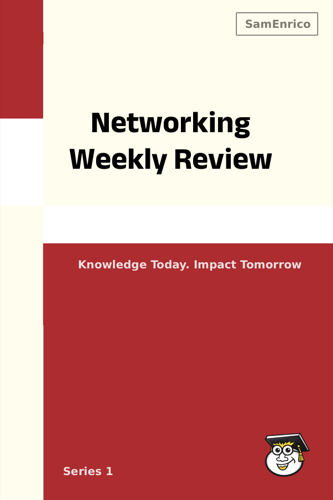
Non-FictionSelf-HelpNetworking
Networking Weekly Review eBook
Follows up on new contacts.
by Hartley Dean
Follows up on new contacts.
Formats
Free sample
Chapter 1: The 48-Hour Countdown--–- The business card sits on your desk. You told yourself you would follow up. That was nine days ago. Now you cannot remember if the person you met was named Jennifer or Jessica, whether they worked in marketing or product, or why you were so excited to talk to them in the first place. You have lost them.
Not because you are lazy, not because you are bad at networking, but because you trusted a feeling instead of a system.This is the most expensive illusion in professional life. Almost every working adult has experienced it: the electric jolt of a great conversation at a conference, a coffee shop, or a dinner party, followed by the slow, quiet decay of that connection into nothing. You meant well. You genuinely liked the person. You promised yourself—and maybe even them—that you would “stay in touch.” But staying in touch is not a strategy.
It is a wish. And wishes do not build careers.The Forgotten 80 Percent Let us begin with a number that should frighten you. According to relationship science and decades of networking research aggregated from sources including the Federal Reserve Bank of Philadelphia’s studies on social capital, approximately 80 percent of the value generated by a new professional connection is lost within 72 hours of the first meeting if no structured follow-up occurs. Eighty percent. You meet someone brilliant.
You share ideas, laughter, and possibility. Then you go back to your real life—emails, meetings, deadlines, children, traffic, exhaustion—and within three days, that brilliant person has faded into the background noise of your memory.The remaining 20 percent lingers for a few weeks, then decays further. Within six months, without intentional contact, the statistical probability that you will ever do business with, receive a referral from, or exchange meaningful value with that person drops below 5 percent. You have, in effect, never met them at all.Here is the painful irony. Most people who fail at follow-up are not selfish or incompetent.
They are overwhelmed. They attend networking events, collect business cards, return home with good intentions, and then watch those cards migrate from a stack on the desk to a drawer to a recycling bin. The author of this book has done it hundreds of times. The executives interviewed for this research admitted to doing it thousands of times. Even Keith Ferrazzi, the author of Never Eat Alone and one of the most connected people in the world, has confessed to losing valuable contacts because he waited too long to reach out.The difference between Ferrazzi and the rest of us is not that he never drops the ball.
It is that he has a system to pick it back up. You are about to build that system.The Myth of the Unforgettable First Impression Here is a belief that feels true but is demonstrably false: if you make a strong enough first impression, the other person will remember you and reach out. This is the fantasy of the charismatic networker. It allows you to offload responsibility onto your own charm. If they forget you, the logic goes, you simply were not memorable enough.
Work harder on your elevator pitch. Wear a brighter suit. Tell a funnier story.The research says otherwise. A 2014 study published in the Journal of Experimental Social Psychology examined how accurately people remember their first impressions of others after a delay of one week. The results were humbling.
Participants consistently overestimated how vivid and durable their memories were. After seven days, specific details about the other person—their name, their industry, the unique thing they said—decayed by nearly 70 percent. The researchers called this the “durability bias” of social memory. You think you will remember. You will not.Dale Carnegie understood this problem nearly a century before the study was published.
In How to Win Friends and Influence People, he devoted multiple chapters to the simple, radical act of remembering and using people’s names. Carnegie’s insight was not merely about politeness. It was about the brutal reality of human memory. People forget. The person who actively counteracts that forgetting becomes, almost by default, the person who is remembered.Carnegie told the story of Jim Farley, who became Postmaster General under Franklin Roosevelt.
Farley claimed to remember 50,000 names. When asked how, he said he had a system. He repeated every new name aloud during the introduction. He wrote it down immediately afterward. He visualized the person’s face while saying the name.
And crucially, he followed up within two days with a handwritten note or a phone call. Farley did not have a photographic memory. He had a protocol.The 48-Hour Activation Rule This brings us to the foundational law of this book, the rule from which every other system and strategy will flow. It is simple enough to fit on a sticky note. It is difficult enough that almost no one follows it consistently.The 48-Hour Activation Rule: Every new professional contact must receive a personalized Micro-Touch within 48 hours of your first meaningful interaction.
No exceptions. No excuses. No “I’ll do it when things calm down.”Let us define our terms precisely because, in the chapters ahead, we will build an entire vocabulary around this work. A Micro-Touch is any low-friction, personalized communication that references a specific detail from your previous conversation and offers value without asking for anything in return. The micro part means it takes less than two minutes to send.
The touch part means it lands softly—no demands, no urgency, no “let’s schedule a call next week to discuss synergies.”Examples of a legitimate Micro-Touch include:A two-sentence email that says: “Great meeting you at the conference yesterday. I checked out that podcast you mentioned—episode four was exactly right for what I am working on. Thanks for the tip.”A Linked In message that says: “Loved your point about supply chain delays. I just saw this article on the exact issue we discussed. Thought you might find it useful.”A 15-second voice memo sent via Whats App or Signal: “Hey, it is Alex from the coffee shop.
I remembered your question about hiring remote developers. This person on my team solved the same problem last month. Want me to share their template?”A text message: “Following up on our chat about fundraising. I remembered the name of that VC I mentioned—it is Sarah at First Round. Want me to send a warm intro?”Notice what these Micro-Touches do not contain.
They do not contain requests for a meeting, a call, a coffee, a favor, or a reply. They do not contain the phrase “I hope you are well,” which research by the email productivity company Boomerang found to be one of the most ignored openings in professional correspondence. They do not contain attachments, long explanations, or emotional labor.What they do contain is specificity, value, and an exit ramp. The recipient can read, smile, and move on with their day—or they can reply if they choose. The ball is not in their court.
You are not waiting. You have already given.This last point is so important that it deserves its own paragraph. Most…
This is the end of the free sample. Get the eBook to keep going. Buy now
About this book
Details
- Author
- Hartley Dean
- Publisher
- SamEnrico
- Language
- English
- Genre
- Non-Fiction, Self-Help, Networking
- Released
- 2026-06-07
- Pages (approx.)
- 144
- Available as
- eBook, Audiobook

Read better in the ZLOADR app
Your eBooks on your phone or tablet. Sign in with your SamEnrico account and start reading.
More by Hartley Dean
 Personal OKR GuideHartley Dean$12.99
 International Trade Pandemic GuideHartley Dean$11.99
 The Foster Care Quiet ChildHartley Dean$11.99
 HGH Decline Natural PreventionHartley Dean$11.99
 Implementation IntentionsHartley Dean$11.99
 Loving Kindness for OptometristsHartley Dean$11.99
 Church Building Memory PalaceHartley Dean$11.99
 Couch To 5K PlanHartley Dean$11.99
 The Alchemists of Ale: Renaissance Brewers and the Birth of Modern BeerHartley Dean$11.99
 How to Produce Masonry MaterialsHartley Dean$11.99
 A Collector's Handbook to the Morris Six MSHartley Dean$11.99
 Agent Background Checks IndiaHartley Dean$12.99
You may also like
 Hong Kong Handover 1997Dunn Johnnie$11.99
 Zumba For Postnatal Recovery CourseNeal Christian$11.99
 Zumba for BeginnersLadner Nikia$11.99
 YouTube Comment Mining GuideHumes Pandora$12.99
 Worry Box MeditationCarlin Rudy$11.99
 Workplace Stress MeditationNguyen Lynn$11.99
 Workplace Stress and Sleep RepairHawley Ivory$11.99
 Workplace Perfectionism CureDelaney Jeffry$11.99
 Workplace Injustice Anger GuideWallen Isabelle$11.99
 Work Addiction and Burnout LinkGreenwood Ester$11.99
 Women in Yoga and WellnessBeattie Galina$11.99
 Women in Stand Up ComedyChun Evangeline$11.99