
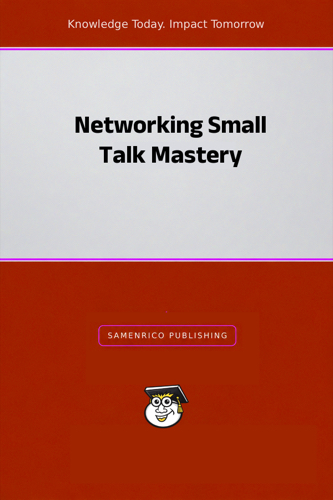
Non-FictionSelf-HelpBusiness Networking
Networking Small Talk Mastery eBook
Turn brief professional exchanges into memorable c
by Wolf Glayds
Turn brief professional exchanges into memorable connections using targeted conversation frameworks.
Formats
Free sample
Chapter 1: The Invisible Professional--–- The fluorescent lights hummed overhead. Twenty-three people in name badges. Two hundred and fourteen minutes of smiling, nodding, and saying “Nice to meet you.” One drink spilled on her sleeve. Zero follow-ups. Zero opportunities.
Zero memory that she had ever been there.This is the moment Maya Chen decided she was done with networking.She had done everything right. She had researched the attendee list beforehand. She had prepared three questions about industry trends. She had practiced her elevator pitch in the bathroom mirror until it sounded “natural.” She had smiled until her cheeks ached. She had collected eleven business cards and handed out fourteen of her own.Three days later, she opened her CRM—a simple spreadsheet she maintained religiously—and tried to match faces to names.
The conference website had photos. She scrolled. And scrolled. And scrolled.Of the eleven people she had spoken with for more than three minutes each, she could remember exactly two. One was the woman who had spilled wine on her.
The other was a man who had told a genuinely funny story about a warehouse fire. Everyone else? Gone. Erased. As if the conversations had never happened.Worse, she realized with a sinking stomach, they had forgotten her too.
Not a single email landed in her inbox. Not one Linked In connection request. She had spent nearly four hours of her life in a room full of people, and the professional equivalent of nothing had occurred.Maya was not bad at her job. She was a senior product manager with a track record of successful launches. She was not socially awkward.
Her team liked her. She had friends outside work. She was not unintelligent. She had graduated near the top of her class.But she was, for all practical purposes, professionally invisible.And she had no idea why.The Myth of “Just Be Yourself”If you are reading this book, there is a high probability that you have experienced some version of Maya’s story. You have left a networking event, a conference, a happy hour, or even a one-on-one coffee chat with the vague sense that you did something—you showed up, you talked, you listened—but nothing happened.
No doors opened. No opportunities emerged. No one remembered your name.The conventional advice you have received is almost certainly wrong.“Just be yourself,” they say. “Let the conversation flow naturally.” “Don’t overthink it.”This advice is not merely unhelpful. It is actively destructive.Here is the truth that no one tells you: Natural conversation is a myth.
What we call “natural” is actually a set of deeply ingrained habits—habits that most people never examine, never optimize, and never question. And for the vast majority of professionals, those default habits are designed to make you forgettable.Think about the last five conversations you had with someone you did not know well. What did you talk about? Be honest.The weather. The commute.
How busy you both are. Where you grew up. How long you have been at your company. Generic compliments about the venue, the food, the speaker, the lighting.This is what researchers call transient talk—conversational content so generic, so interchangeable, so devoid of distinguishing features that it might as well have been generated by an artificial intelligence trained on elevator muzak.Transient talk is the enemy of memorability. And yet, it is the default setting for almost every professional interaction.Why?Because transient talk is safe.
It requires no vulnerability. It asks no uncomfortable questions. It reveals nothing that could be used against you. It is the conversational equivalent of beige paint: inoffensive, unremarkable, and completely invisible against a crowded wall.The problem is that “safe” and “memorable” are opposites.The ROI of Rapport: Why “Just Chatting” Is a Losing Strategy Let us perform a simple calculation together.Imagine you attend four networking events per year. At each event, you have meaningful conversations (say, longer than two minutes) with an average of eight people.
That is thirty-two substantive professional conversations annually.Now imagine that each of those conversations has the potential to lead to something: a job referral, a client introduction, a partnership opportunity, a mentorship, a warning about an industry shift, or simply a positive reputation that precedes you into a room.What is the value of a single high-quality professional relationship over the course of a career?Consider this: according to data from the Federal Reserve Bank of New York, more than 50% of jobs are found through personal networks. According to Linked In’s own research, 85% of jobs are filled through networking. Every major study on career advancement—from the Harvard Business Review to the Journal of Applied Psychology—concludes that your network is the single greatest predictor of your career trajectory, often outweighing skills, education, and even performance reviews.A single connection, made at the right time, can be worth tens of thousands—or hundreds of thousands—of dollars over a career. One introduction. One sentence of recommendation.
One email forwarded to the right person.Now multiply that by thirty-two conversations per year, times the number of years you have left in your career.The potential value is staggering.And yet, most professionals treat these conversations as if they were disposable. They show up unprepared. They rely on transient talk. They leave with no follow-up plan. They treat networking as a chore rather than the high-leverage investment it actually is.This book introduces a concept called Conversational ROI (Return on Interaction).
It is a simple mental model for evaluating whether a conversation drains or gains professional value.Let me define the two categories clearly.Drain interactions consume your time, energy, and attention while producing no measurable professional return. They include:Conversations that end with no next step Exchanges where you cannot remember the other person’s name an hour later Interactions that feel pleasant but generate no follow-up action Any conversation where you talked more than you listened Gain interactions are brief exchanges that lead to future opportunities. They include:Conversations where you leave with a specific, actionable next step Exchanges where the other person remembers a unique detail about you Interactions where value is exchanged (an insight, an introduction, a resource)Any conversation where you listened more than you talked Here is the uncomfortable question: What percentage of your recent professional conversations would you classify as gain interactions?If you are like most professionals, the number is below 20%. Eighty percent of your networking time is being spent on drain interactions. You are investing hours of your life—hours you could spend with your family, on your hobbies, or simply resting—into activities that produce no return.That is not networking.
That is an expensive hobby.The Conversational Ledger: A Self-Audit Tool Before we go any further, I want you to perform a simple self-audit. I call this the Conversational Ledger.Think back to the last professional event you attended—a conference, a work happy hour, a Zoom breakout, even a single coffee chat with someone outside your immediate team. Identify the five people you spoke with for the longest period of time.For each person, answer the following four questions:Recall: Without checking…
This is the end of the free sample. Get the eBook to keep going. Buy now
About this book
Details
- Author
- Wolf Glayds
- Publisher
- SamEnrico
- Language
- English
- Genre
- Non-Fiction, Self-Help, Business Networking
- Released
- 2026-06-10
- Pages (approx.)
- 158
- Available as
- eBook, Audiobook

Read better in the ZLOADR app
Your eBooks on your phone or tablet. Sign in with your SamEnrico account and start reading.
More by Wolf Glayds
 Assertiveness Role PlaysWolf Glayds$11.99
 Driving Safety Memory AgingWolf Glayds$11.99
 Nightmare Rescripting App GuideWolf Glayds$11.99
 Sibling Rivalry Self WorthWolf Glayds$11.99
 Search and Rescue FailuresWolf Glayds$11.99
 Research Skills For StudentsWolf Glayds$11.99
 Child Neglect and GamblingWolf Glayds$11.99
 The Golden Fleets: Portugal’s Renaissance of the SeasWolf Glayds$11.99
 The Ballad of the Lost Love Letters: A Reunion Across TimeWolf Glayds$11.99
 Understanding Von Hippel-lindau Disease (Vhl)Wolf Glayds$11.99
 How to Start a Anaesthetic Equipment Business (Beginners Guide)Wolf Glayds$11.99
 How to Produce GPS AccessoriesWolf Glayds$11.99
You may also like
 Hong Kong Handover 1997Dunn Johnnie$11.99
 Zumba For Postnatal Recovery CourseNeal Christian$11.99
 Zumba for BeginnersLadner Nikia$11.99
 YouTube Comment Mining GuideHumes Pandora$12.99
 Worry Box MeditationCarlin Rudy$11.99
 Workplace Stress MeditationNguyen Lynn$11.99
 Workplace Stress and Sleep RepairHawley Ivory$11.99
 Workplace Perfectionism CureDelaney Jeffry$11.99
 Workplace Injustice Anger GuideWallen Isabelle$11.99
 Work Addiction and Burnout LinkGreenwood Ester$11.99
 Women in Yoga and WellnessBeattie Galina$11.99
 Women in Stand Up ComedyChun Evangeline$11.99