
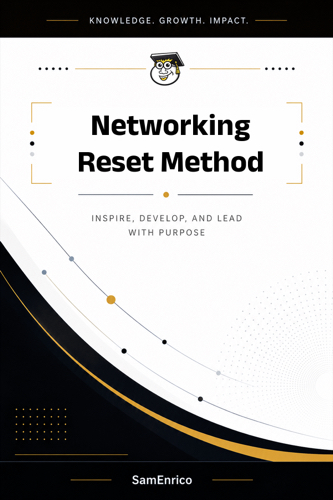
Non-FictionSelf-HelpNetwork Optimization
Networking Reset Method eBook
Revitalize stale relationships and prune networks
Revitalize stale relationships and prune networks that no longer serve you.
Formats
Free sample
Chapter 1: The Clogged Illusion--–- Margaret had 3,247 Linked In connections. She had attended 142 networking events in the past five years. She had collected business cards in three different shoeboxes, two desk drawers, and a folder on her phone labeled “Opportunities.” And she was exhausted. Not the kind of tired that coffee fixes. The kind of tired that settles into your bones when you realize that the thing you were told would open every door—your network—has become a locked room with no air.She opened her inbox one Tuesday morning to find forty-seven messages.
Three were from people she genuinely admired and wanted to help. The other forty-four fell into predictable categories: requests for “quick coffee chats” with no agenda, updates from former colleagues she hadn’t spoken to in a decade, group calendar invitations for events she had no memory of joining, and one particularly long voice note from a contact who had spent nine minutes describing a problem that Margaret could not solve and was not responsible for. She closed her laptop, walked to the kitchen, and stood staring at the refrigerator for a full minute. She was not hungry. She was hiding.This is not a story about a bad networker.
Margaret is an excellent networker by every conventional measure. She follows up. She offers introductions. She remembers birthdays, promotions, and the names of her contacts’ children. She has given far more than she has taken.
And that is precisely the problem. The conventional wisdom of networking—more contacts, more visibility, more follow-up, more generosity—has created a generation of professionals who are drowning in the very relationships that were supposed to save them.The Paradox of Abundance For the past twenty years, the dominant message in business literature has been clear: your network is your net worth. Build it wide. Build it deep. Never burn a bridge.
Collect connections like currency because you never know when a random contact might become your next client, boss, or investor. This advice is not wrong. It is incomplete. And incompleteness, when applied to human relationships, becomes a slow poison.The incomplete truth is this: networks have diminishing returns. The first two hundred connections you make—the people you actually know, trust, and interact with—provide enormous value.
The next two thousand provide noise. Each additional connection beyond your cognitive and emotional capacity does not add linearly to your opportunities. It multiplies your obligations. Every new contact is not a resource. It is a relationship that requires maintenance, attention, and energy.
And energy is finite.This is the Clogged Illusion. It is the belief that a larger network is always better, that every connection is an asset, and that the discomfort you feel—the dread before certain emails, the guilt about unanswered messages, the vague sense that you are failing at relationships you never asked for—is simply the price of success. It is not. It is the cost of a system you were never taught to audit.The Symptom Checker: Are You Clogged?Before we build anything new, we must diagnose what is broken. The following symptoms are not signs that you are bad at networking.
They are signs that your network has grown beyond your capacity to maintain it healthily.Symptom One: The Inbox Flinch You see a name in your inbox, and before you read the message, you feel a small contraction in your chest. Maybe it is a former client who always asks for favors without reciprocity. Maybe it is an old colleague who uses every interaction as a therapy session. Maybe it is someone you genuinely like, but you are so behind on replying that you have accumulated three months of guilt. The flinch is not about the message.
It is about the weight of the relationship. And if you can name five people who trigger this response, your network is clogged.Symptom Two: The Obligation Calendar You have coffee chats, calls, or meetings scheduled not because you want them, but because you said “yes” six months ago and have never found a graceful way to say “no.” These appointments sit on your calendar like small gray clouds. You attend them. You are pleasant. You leave feeling not energized but relieved that it is over.
The relationship is not serving you, and you are not serving it. You are both performing a ritual that has outlived its purpose.Symptom Three: The Sunk-Cost Stay There is a person in your network whom you have known for years. You have helped them repeatedly. They have rarely helped you. But you stay because you have invested so much time already that leaving feels like admitting failure.
This is the sunk-cost fallacy applied to human relationships. It is the same logic that keeps people watching terrible movies because they have already sat through the first hour. Past investment is not a reason for future loyalty. It is a reason to audit.Symptom Four: The Evolution Gap Think of someone you met five years ago. Now think of who they are today.
Have they grown? Have they learned new skills, pursued new interests, or matured in their thinking? Or are they having the same conversations, complaining about the same problems, and occupying the same professional space? The Evolution Gap is the distance between where a person could be and where they actually are. Networks clog when we keep people who have stopped evolving.
They are not bad people. They are stagnant people. And stagnant people, like stagnant water, eventually poison everything around them.Symptom Five: The Energy Ledger After every significant interaction—a call, a coffee, a long email exchange—ask yourself one question: Did I feel more energy or less energy after this conversation? The answer is not about whether the person is nice. Nice people can be draining.
The answer is about your nervous system. If a relationship consistently leaves you depleted, it does not matter how valuable that person appears on paper. Your body knows before your brain admits it. And your body is right.If you recognized yourself in two or more of these symptoms, you are not broken. You are carrying a network that was designed for a different era—an era when we had fewer contacts, slower communication, and clearer boundaries between professional and personal life.
That era is gone. But the tools to manage this new reality are just now being written.The Scarcity Trap versus The Abundance Mindset To understand why most networking advice fails, we must examine its hidden assumption: scarcity. Traditional networking operates on the belief that opportunities are rare, so you must collect as many potential sources of opportunity as possible. Every person is a lottery ticket. Every coffee chat is a chance.
Every introduction might be the one. This is the scarcity mindset, and it creates hoarding behavior. You keep connections you do not need. You accept meetings you do not want. You stay in relationships that drain you because you are afraid of closing a door.The Networking Reset Method operates on the opposite assumption: abundance.
Opportunities are not rare. People are not scarce. Your time and attention are the scarce resources. Therefore, the goal is…
This is the end of the free sample. Get the eBook to keep going. Buy now
About this book
Details
- Author
- Matthews Kristy
- Publisher
- SamEnrico
- Language
- English
- Genre
- Non-Fiction, Self-Help, Network Optimization
- Released
- 2026-06-08
- Pages (approx.)
- 116
- Available as
- eBook, Audiobook

Read better in the ZLOADR app
Your eBooks on your phone or tablet. Sign in with your SamEnrico account and start reading.
More by Matthews Kristy
 Parent Mental Ill Child GuideMatthews Kristy$11.99
 Miyazaki Pure ImaginationMatthews Kristy$11.99
 Tears of Kingdom Build FixMatthews Kristy$11.99
 The Senior Volunteering Confidence GuideMatthews Kristy$11.99
 Graffiti Wars: The Underground Artists Who Painted a RevolutionMatthews Kristy$11.99
 World Bank Health Nutrition Population CareersMatthews Kristy$12.99
 Promotion Business Case Email ScriptMatthews Kristy$12.99
 Ultimate Handbook Guide to Xintai : (China) Travel GuideMatthews Kristy$11.99
You may also like
 Hong Kong Handover 1997Dunn Johnnie$11.99
 Zumba For Postnatal Recovery CourseNeal Christian$11.99
 Zumba for BeginnersLadner Nikia$11.99
 YouTube Comment Mining GuideHumes Pandora$12.99
 Worry Box MeditationCarlin Rudy$11.99
 Workplace Stress MeditationNguyen Lynn$11.99
 Workplace Stress and Sleep RepairHawley Ivory$11.99
 Workplace Perfectionism CureDelaney Jeffry$11.99
 Workplace Injustice Anger GuideWallen Isabelle$11.99
 Work Addiction and Burnout LinkGreenwood Ester$11.99
 Women in Yoga and WellnessBeattie Galina$11.99
 Women in Stand Up ComedyChun Evangeline$11.99