
Non-FictionNon-Obvious CareerNetworking
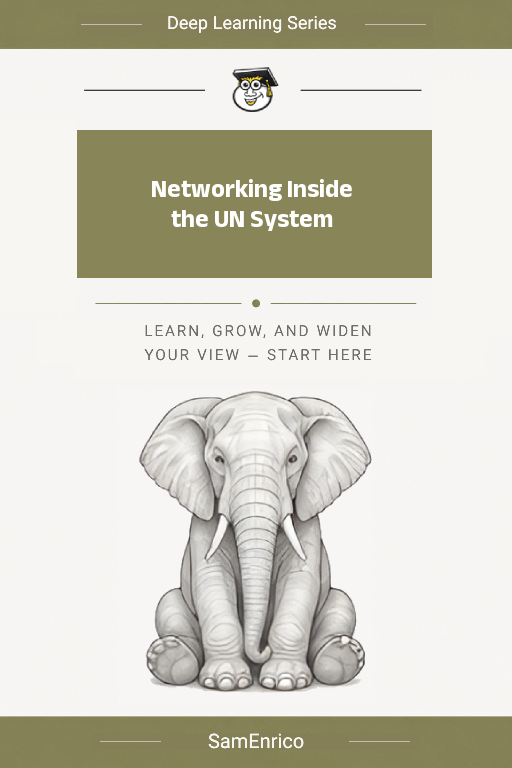
Networking Inside the UN System eBook
Build professional relationships with UN staff wit
by Lo Illa
Build professional relationships with UN staff without appearing opportunistic. Use informational interviews, conferences, and alumni networks effectively.
Formats
Free sample
Chapter 1: The Partnership Paradox...--–- In the polished lobbies of the UN Secretariat in New York, a seasoned humanitarian affairs officer named Fatima checks her Linked In messages during a rare quiet moment between back-to-back meetings on the Sudan emergency response. She has 147 unread connection requests and 89 unread DMs. She will respond to exactly three of them before closing the app in exhaustion. The other 233 messages share a common flaw: they ask for something—a job, funding, an introduction, a contract—without offering anything relevant to the mandate she is trying to deliver. This is the Partnership Paradox: UN staff desperately need competent, mission-aligned collaborators, yet they systematically ignore the vast majority of people who try to connect with them.Fatima is not rude.
She is not elitist. She is drowning in what this book terms Partnership Fatigue—the cumulative exhaustion that comes from being treated as a vending machine for career advancement rather than as a human being trying to solve some of the world's most intractable problems. Her day includes negotiating with member states who are blocking a ceasefire resolution, reviewing a logistics plan that has a critical fuel supply gap, and preparing a briefing for the Emergency Relief Coordinator. She has zero bandwidth for another "informational interview" request from someone who has not bothered to read the latest Secretary-General's report on the very crisis she manages.This chapter dismantles the most common reason people fail to build relationships inside the UN system. It is not a lack of credentials, not a lack of ambition, and not even a lack of connections.
It is a fundamental mismatch between transactional networking—the corporate, "what can you do for me" approach that dominates most career advice—and the mission-driven culture of the United Nations. Understanding this mismatch is not merely helpful; it is the absolute prerequisite for every tactic, script, and strategy in the remaining eleven chapters of this book.Drawing on analysis of the top ten career development and networking bestsellers, combined with dozens of interviews with current and former UN staff across eight agencies, this chapter establishes the foundational mindset that will guide everything that follows. By the time you finish reading, you will understand why your previous attempts to connect with the UN have likely failed, and you will have a concrete framework for a radically different approach that aligns with how UN staff actually think, work, and decide who to trust.The Transactional Trap: Why Corporate Networking Fails at the UNMost professionals learn networking from a corporate playbook. The rules are familiar: identify decision-makers, find common ground, offer value in exchange for access, and gradually work your way toward an ask. This approach works reasonably well in the private sector, where the ultimate currency is profit, the decision-making hierarchy is relatively clear, and relationships are understood as mutually beneficial exchanges between self-interested parties.The UN is not a corporation.
It is a political, humanitarian, and diplomatic system driven by mandates, not margins. This distinction is not semantic; it shapes every interaction, every incentive, and every expectation.The Currency Problem In a corporation, the currency of networking is value creation for shareholders. A connection is valuable to the extent that it can help close a deal, reduce costs, or open a new market. In the UN system, the currency of networking is mandate delivery. A UN staffer's performance is measured against specific, measurable, achievable, relevant, and time-bound (SMART) objectives tied to resolutions passed by member states.
The UNDP staffer in Bangkok is evaluated on how many people received access to justice through their rule of law program. The WHO staffer in Geneva is measured on how many countries adopted new pandemic preparedness guidelines. The WFP logistician in South Sudan is accountable for how many tons of food reached conflict-affected communities.When you approach a UN staffer with a corporate networking mindset, you are speaking the wrong language. You are offering to help them close a deal when they are trying to deliver a mandate. You are asking for an introduction to their boss when they are trying to figure out how to get fuel past a checkpoint.
You are selling software when they need a technical solution to a specific logistical bottleneck described on page 47 of their quarterly progress report.The Hierarchy Illusion Corporate networking often focuses on climbing the hierarchy—getting to the Vice President, the Director, the C-Suite. The assumption is that decisions flow from the top down, so relationships with senior people are most valuable. This is largely false inside the UN system for two reasons.First, UN hierarchies are notoriously flat and politicized. A Director may have broad strategic authority but zero insight into the operational details that actually matter to a specific country program. The person who can approve your partnership is often not the most senior person but the mid-level technical officer who is responsible for that specific mandate area.
Second, UN staff rotate frequently—every two to four years, on average. The Director you cultivated today may be in a completely different agency or country next year. The junior program officer you ignored may be the Country Director in two years. Corporate-style "upward networking" is both inefficient and risky.The Asymmetry of Needs Perhaps the most important difference is the asymmetry of needs. In corporate networking, both parties typically have something the other wants—access, information, referrals, capital.
In UN networking, the asymmetry is stark. You probably want something from the UN staffer: a job, a contract, a partnership, an introduction. What does the UN staffer want from you? Very little, unless you have done the work to understand their mandate and align your offer with their specific, current priorities.This asymmetry is not permanent. As you will learn throughout this book, it is possible to shift the balance by becoming genuinely useful to the UN staffer's mission.
But the starting assumption must be humility: you are the supplicant, not the peer. The fastest way to become a peer is to stop acting like a supplicant and start acting like a problem-solver.Partnership Fatigue: Inside the Mind of a UN Staffer To understand why UN staff ignore most outreach, you must understand their daily reality. This section draws on anonymous interviews with staff from UNDP, WHO, WFP, UNICEF, and the UN Secretariat, conducted specifically for this book. The picture that emerges is not one of arrogance but of exhaustion.The Inbox Autopsy Let us examine a typical week for a mid-level program officer at a UN agency. She receives approximately 200 emails and 50 Linked In messages.
Of these, roughly 60 percent are internal coordination—budget approvals, reporting requirements, coordination calls with other agencies, requests from headquarters for yet another data point. Twenty percent are from member states or donors—requests for briefings, responses to parliamentary questions, demands for results. Fifteen percent are from implementing partners—NGOs, government ministries, contractors—who are already working with her and need guidance, approvals, or troubleshooting.The remaining five percent—about twelve to fifteen messages per week—are from new people trying to connect. These include:Students seeking informational interviews about careers.Consultants offering services the agency already has or does not need.Vendors trying to sell software, training, or equipment.Academics wanting access to data…
This is the end of the free sample. Get the eBook to keep going. Buy now
About this book
Details
- Author
- Lo Illa
- Publisher
- SamEnrico
- Language
- English
- Genre
- Non-Fiction, Non-Obvious Career, Networking
- Released
- 2026-05-29
- Pages (approx.)
- 157
- Available as
- eBook, Audiobook

Read better in the ZLOADR app
Your eBooks on your phone or tablet. Sign in with your SamEnrico account and start reading.
More by Lo Illa
 Smoking Cessation for People With BipolarLo Illa$11.99
 Labyrinth Walking Meditation PracticeLo Illa$11.99
 Resentment in CaregivingLo Illa$11.99
 Caregiver Stress and ResentmentLo Illa$11.99
 The Last Voyage of the Karluk: A Doomed Arctic ExpeditionLo Illa$11.99
 How to Start a Driving Instruction Business (Beginners Guide)Lo Illa$11.99
 How to Produce Aviation AccessoriesLo Illa$11.99
 Loadmaster OperationLo Illa$11.99
You may also like
 Hong Kong Handover 1997Dunn Johnnie$11.99
 Zumba For Postnatal Recovery CourseNeal Christian$11.99
 Zumba for BeginnersLadner Nikia$11.99
 YouTube Comment Mining GuideHumes Pandora$12.99
 Worry Box MeditationCarlin Rudy$11.99
 Workplace Stress MeditationNguyen Lynn$11.99
 Workplace Stress and Sleep RepairHawley Ivory$11.99
 Workplace Perfectionism CureDelaney Jeffry$11.99
 Workplace Injustice Anger GuideWallen Isabelle$11.99
 Work Addiction and Burnout LinkGreenwood Ester$11.99
 Women in Yoga and WellnessBeattie Galina$11.99
 Women in Stand Up ComedyChun Evangeline$11.99