
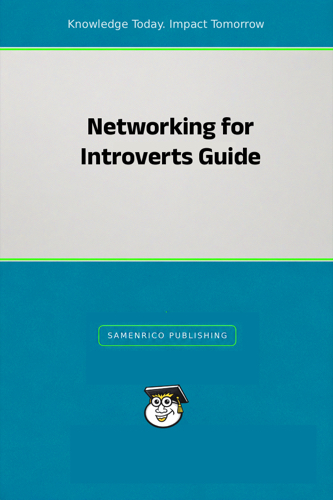
Non-FictionSelf-HelpNetworking
Networking for Introverts Guide eBook
Teaches low pressure connection strategies for qui
by Hardy Gina
Teaches low pressure connection strategies for quiet personalities.
Formats
Free sample
Chapter 1: The Relationship Map--–- Sarah had just finished her third lap around the conference ballroom. She had counted exactly sixty-seven people, seventeen name tags, and four empty chairs near the back. She had also successfully avoided eye contact with everyone. Thirty minutes remained in the networking breakfast, and her coffee had gone cold somewhere around lap two. She calculated the exit route: fifteen steps to the door, a sharp left past the restrooms, three strides to the coat check.
Freedom. But she didn't take it. Instead, she found a corner near a potted fern—a surprisingly good hiding spot—and pulled out her phone. Later, she would tell her partner the event was "fine" and that she had "met some nice people." She had not met anyone. She had spoken to no one.
She had paid forty-seven dollars for the privilege of walking in circles behind a fern.Sarah is not broken. She is not shy in the clinical sense, nor does she have social anxiety that requires treatment. She is simply an introvert who was handed an extrovert's playbook and told to run the same race. And like millions of other introverts, she concluded that networking was a form of torture designed by people who enjoy name tags and group icebreakers.Here is the truth that the networking industry does not want you to know: Sarah's strategy—the fern, the laps, the cold coffee, the quiet escape—was actually closer to effective networking than the glad-handing, room-scanning model she was rejecting. She was observing.
She was pacing her energy. She was refusing to perform. She just didn't have a framework yet. That is what this chapter—and this book—will give you.Before we teach you a single tactic, before we talk about Big Talk or weak ties or the perfect follow-up email, we have to start where almost every networking book ends. We have to start with the truth about where you are right now.
That means no strategies, no scripts, and no pretending. Just a map.The Myth of Starting from Zero Most introverts believe they have no network. This is almost always false. What they actually have is an unmapped network—a collection of relationships they have not categorized, valued, or learned to activate. The difference between "no network" and "unmapped network" is the difference between feeling helpless and feeling prepared.Consider your phone for a moment.
Open your contacts app if you have it nearby. Scroll. Do not count yet; just scroll. How many names do you see? One hundred?
Two hundred? Five hundred? Now ask yourself: how many of those people do you actually know? Not deeply. Not as friends.
Just know. The answer is probably more than you think.The average adult has between one hundred fifty and two hundred fifty stable social relationships, according to the research of British anthropologist Robin Dunbar. This is not a feel-good estimate; it is based on decades of brain-size-to-group-size correlations across primates. Dunbar's number—roughly one hundred fifty—represents the cognitive limit of how many people you can maintain a stable relationship with at one time. Below that number, you have layers: five people in your innermost circle (intimate support), fifteen in your next layer (close friends), fifty in your middle layer (meaningful but not daily contacts), and one hundred fifty in your outer layer (acquaintances you would recognize and speak to).You are not starting from zero.
You are starting from one hundred fifty. You have simply never looked at them as a network before.But let us address the person who is thinking, "That's fine for normal people, but I just moved to a new city. I changed careers. I work remotely. I spent the last three years as a stay-at-home parent.
I genuinely have no one." That is a fair objection, and you are not alone. The next section is written specifically for you.For Beginners: When the Map Is Blank If you truly have no existing network—or feel like you have none—you need to start with what we call a "seed network." A seed network is not built. It is found. And it exists in places you have not considered.Alumni directories. Every school you have ever attended, from high school to graduate programs, has an alumni association.
Most have online directories. These directories are filled with people who share a single, powerful commonality with you: a place and time. That is enough. You do not need to be friends with them. You need to exist near them.
Pick three alumni from your directory who live within fifty miles of you. That is your first seed.Professional association membership lists. Every industry has associations. Most are inexpensive to join as a basic member. Once you join—and you can do this today—you gain access to member directories.
These are people who have already signaled that they want to be connected to others in their field. They are pre-qualified. Pick three names from your industry association. That is your second seed.One free community event with zero pressure. This is the hardest one for introverts to hear, so let me be precise: you do not have to talk to anyone.
You do not have to stay for any length of time. You do not have to be "on." You simply have to exist in the same room as other humans for fifteen minutes. A library reading. A park clean-up. A free lecture at a community college.
Show up. Stand near the edge. Leave when you want. The goal is not to meet anyone; the goal is to remind your nervous system that being around people does not have to trigger a fight-or-flight response. Do this once.
Then you have your third seed.Three alumni. three association members. one event. That is seven seeds. Seven people who now exist in your awareness.
Seven potential weak ties. That is not zero. That is a beginning.The Two Tiers You Actually Need Now that we have established that you have more than zero, we need to name the two kinds of relationships that will matter for the rest of this book. Most networking books treat all contacts the same. This is a catastrophic error.
A former coworker you see once a year at a holiday party serves a completely different function than a mentor you text at 10 p.m. with a career crisis. Neither is better. Both are necessary. But they require different strategies, different energy investments, and different expectations.Tier One: Weak Ties.
These are your acquaintances. Your former coworkers. Your alumni association contacts. The neighbor you wave at. The person you worked with on a project three years ago and still follow on Linked In.
Weak ties are defined by two things: you have no expectation of emotional intimacy, and you have no history of deep personal disclosure. They are not your confidants. They are your bridges. Sociologist Mark Granovetter published a paper in 1973 called "The Strength of Weak Ties" that remains one of the most cited works in social science. His finding was counterintuitive: the most valuable job leads, information sources, and opportunities come not from your close…
This is the end of the free sample. Get the eBook to keep going. Buy now
About this book
Details
- Author
- Hardy Gina
- Publisher
- SamEnrico
- Language
- English
- Genre
- Non-Fiction, Self-Help, Networking
- Released
- 2026-06-06
- Pages (approx.)
- 136
- Available as
- eBook, Audiobook

Read better in the ZLOADR app
Your eBooks on your phone or tablet. Sign in with your SamEnrico account and start reading.
More by Hardy Gina
 Evening Release RitualHardy Gina$11.99
 Vegan B12 Supplement GuideHardy Gina$11.99
 Workplace Time AuditingHardy Gina$11.99
 Exposure Therapy for FailureHardy Gina$11.99
 SAD In Alaska GuideHardy Gina$11.99
 De escalation for TherapistsHardy Gina$11.99
 Creative Pause ProtocolsHardy Gina$11.99
 The Last Voyage of the SS America: A Ship That Outlived Its TimeHardy Gina$11.99
 The Forgotten Champions: How British Basketball Defied the Odds in the 1930sHardy Gina$11.99
 Property Tax ExemptionHardy Gina$12.99
 Angel Syndicates vs Solo AngelsHardy Gina$12.99
 Service Providers Guide to Fitness TrainersHardy Gina$11.99
You may also like
 Hong Kong Handover 1997Dunn Johnnie$11.99
 Zumba For Postnatal Recovery CourseNeal Christian$11.99
 Zumba for BeginnersLadner Nikia$11.99
 YouTube Comment Mining GuideHumes Pandora$12.99
 Worry Box MeditationCarlin Rudy$11.99
 Workplace Stress MeditationNguyen Lynn$11.99
 Workplace Stress and Sleep RepairHawley Ivory$11.99
 Workplace Perfectionism CureDelaney Jeffry$11.99
 Workplace Injustice Anger GuideWallen Isabelle$11.99
 Work Addiction and Burnout LinkGreenwood Ester$11.99
 Women in Yoga and WellnessBeattie Galina$11.99
 Women in Stand Up ComedyChun Evangeline$11.99