
Non-FictionSelf-HelpIntrovert Networking
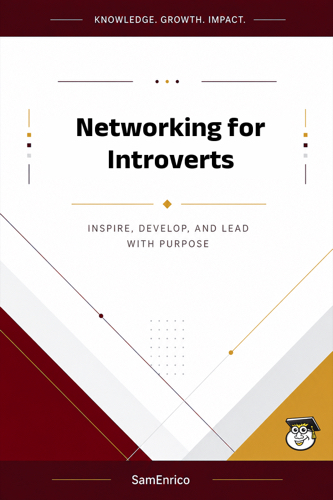
Networking for Introverts eBook
Build connections without exhausting your social b
by Bunn Lewis
Build connections without exhausting your social battery.
Formats
Free sample
Chapter 1: The Quiet Superpower--–- Maya had been standing in the corner of the hotel ballroom for forty-seven minutes. She had already nodded through three conversations about real estate, pretended to check her phone twice, and consumed exactly one glass of sparkling water—slowly, so she would not have to hold a full glass and a plate simultaneously. The badge on her chest said “Marketing Director.” Her brain screamed “Emergency Exit.”Around her, extroverts were thriving. They moved like schools of fish, laughing at jokes that had not been funny, exchanging business cards with the speed of blackjack dealers, and somehow remembering to ask follow-up questions while already scanning the room for their next target. Maya felt like a spy who had forgotten the mission parameters.
She was good at her job. She was terrible at this.The next morning, she would delete every contact she had made. Not because they were uninteresting, but because the thought of following up—of sending a clever, charming, non-desperate email to a stranger—felt more exhausting than the event itself. She would tell herself that networking just was not for her. That she would let her work speak for itself.
That someday, someone would discover her talent without requiring her to wear a name tag and make small talk about the weather.But deep down, she knew something was wrong with that picture. Her introversion was not a flaw. It was a filter. And no one had ever taught her how to use it.The Myth You Have Been Sold Let us begin with a confession: most networking advice was written by extroverts, for extroverts, about extroverts. It assumes that the goal is to meet as many people as possible, talk as much as possible, and follow up as quickly as possible.
It values volume over depth, speed over thoughtfulness, and visible energy over quiet competence.This advice does not merely fail introverts. It actively harms them.When an introvert reads “work the room,” she hears “perform for strangers until you collapse.” When she reads “sell yourself,” she hears “pretend to be someone you are not.” When she reads “collect fifty business cards,” she hears “create fifty obligations that will keep you up at night.”The result is a quiet epidemic of shame. Millions of capable, brilliant, kind introverts have concluded that they are simply bad at networking. They have built elaborate workarounds—avoiding conferences, hiding behind email, relying on existing contacts—rather than facing what feels like a personality defect.But here is the truth that changes everything: introverts are not bad at networking. They are bad at extroverted networking.
And extroverted networking is actually terrible at building real relationships.Research published in the Journal of Personality and Social Psychology has consistently shown that while extroverts excel at first impressions and large-group dynamics, introverts outperform them in one-on-one trust-building, long-term relationship maintenance, and follow-through reliability. In other words, extroverts win the first five minutes. Introverts win the next five years.This chapter is about why that is true—and how you can stop apologizing for your quiet nature and start leveraging it as the competitive advantage it has always been.The Three Hidden Strengths Every Introvert Already Possesses Before we build new skills, we must first recognize the ones you already have. Most introverts walk into networking situations carrying a mental list of their weaknesses: “I am not loud enough. I am not fast enough.
I am not comfortable interrupting.” But this list is backwards. Your so-called weaknesses are actually your superpowers in disguise.Let us examine the three strengths that introverts bring to networking—strengths that extroverts often miss entirely.Strength One: Active Listening Here is a simple experiment. The next time you attend a gathering, watch how people listen. Most do not listen at all. They wait.
They wait for a pause in the other person’s sentence so they can insert their own story, their own expertise, their own agenda. The average conversation looks like two monologues happening in parallel.Introverts, by contrast, tend to listen differently. Because you are less concerned with dominating the conversation, you are free to actually hear what the other person is saying. You notice the slight hesitation when they mention their work. You catch the enthusiasm in their voice when they shift to a personal project.
You remember the name of their child, the city they grew up in, the problem they mentioned in passing.This is not a small difference. In a world where most people feel unheard, the ability to truly listen is magnetic. When someone walks away from a conversation with you and thinks, “That person really understood me,” they are not responding to your charisma. They are responding to your attention.Strength Two: Thoughtful Preparation Extroverts often pride themselves on thinking on their feet. They walk into events without a plan, trusting their ability to improvise.
And often, this works—for them. But for introverts, improvisation is not freedom. It is anxiety. The uncertainty of not knowing what to say, who will be there, or how long the event will last drains energy before you even walk through the door.Your natural inclination to prepare is not a crutch. It is a strategy.When you research attendees in advance, you arrive with context.
When you prepare three opening lines, you arrive with confidence. When you set a micro-goal (“I will meet two people and learn one interesting thing about each”), you arrive with clarity. The extrovert is gambling on spontaneity. You are investing in competence.And here is the secret: preparation does not make you rigid. It makes you free.
Once you have a reliable framework, you can adapt within it, rather than freezing in the face of the unknown.Strength Three: Sincere Follow-Up Ask any experienced networker what separates successful relationship-builders from the rest, and they will give you the same answer: follow-up. Not the quantity of business cards collected, but the quality of the messages sent afterward.Introverts have a natural advantage here. Because you dislike shallow interactions, you are drawn to depth. When you follow up, you are not sending a generic “great to meet you” template. You are referencing a specific detail from your conversation.
You are sharing an article that reminded you of their problem. You are asking a thoughtful question that shows you were actually listening.Extroverts often struggle with follow-up because they have already moved on to the next event, the next handshake, the next room. Introverts move slower—and slower wins the long game.The Self-Assessment: Discovering Your Networking Archetype Not all introverts are the same. Some of you thrive in one-on-one conversations but freeze in groups of three. Some of you love making introductions between other people but hate promoting yourselves.
Some of you prefer to observe for twenty minutes before ever saying a word.The following self-assessment will help you identify your personal networking archetype. For each statement, rate yourself on a scale of 1 (strongly disagree) to 5 (strongly agree).Section A: Observation I prefer to watch a group’s dynamics before joining a conversation.I notice subtle cues in body language and tone that others miss.I feel anxious when I cannot…
This is the end of the free sample. Get the eBook to keep going. Buy now
About this book
Details
- Author
- Bunn Lewis
- Publisher
- SamEnrico
- Language
- English
- Genre
- Non-Fiction, Self-Help, Introvert Networking
- Released
- 2026-06-10
- Pages (approx.)
- 139
- Available as
- eBook, Audiobook

Read better in the ZLOADR app
Your eBooks on your phone or tablet. Sign in with your SamEnrico account and start reading.
More by Bunn Lewis
 Twelve Step Programs For Veterans HandbookBunn Lewis$11.99
 Stress Libido Loss GuideBunn Lewis$11.99
 The Nonprofit Leadership Pipeline GuideBunn Lewis$11.99
 Cash Flow for Cleaning ServicesBunn Lewis$12.99Cash Flow for Cleaning ServicesBunn Lewis$12.99
 Family Plan GuideBunn Lewis$11.99
 Startup Founder Stress GuideBunn Lewis$11.99
 SMART Recovery Goals GuideBunn Lewis$11.99
 Holiday Grief Without PetBunn Lewis$11.99
 En Pointe in the New World: The Revolutionary Ballet of Fanny ElsslerBunn Lewis$11.99
 The Sultan's Ransom: The 1879 Kidnapping of British Diplomat Sir Charles MurrayBunn Lewis$11.99
 How to Produce Mma Shin GuardsBunn Lewis$11.99
You may also like
 Hong Kong Handover 1997Dunn Johnnie$11.99
 Zumba For Postnatal Recovery CourseNeal Christian$11.99
 Zumba for BeginnersLadner Nikia$11.99
 YouTube Comment Mining GuideHumes Pandora$12.99
 Worry Box MeditationCarlin Rudy$11.99
 Workplace Stress MeditationNguyen Lynn$11.99
 Workplace Stress and Sleep RepairHawley Ivory$11.99
 Workplace Perfectionism CureDelaney Jeffry$11.99
 Workplace Injustice Anger GuideWallen Isabelle$11.99
 Work Addiction and Burnout LinkGreenwood Ester$11.99
 Women in Yoga and WellnessBeattie Galina$11.99
 Women in Stand Up ComedyChun Evangeline$11.99