
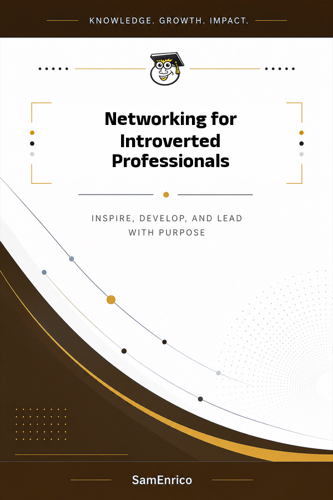
Non-FictionSelf-HelpIntrovert Success
Networking for Introverted Professionals eBook
Offers low-energy, high-impact strategies for buil
Offers low-energy, high-impact strategies for building connections without social exhaustion.
Formats
Free sample
Chapter 1: The Quiet Conspiracy--Networking for introverts isn't broken because introverts are broken. It's broken because the game was rigged before you arrived.Let me say that again, more directly: The loudest people in the room did not write the rules of networking because those rules work. They wrote them because those rules make them look good. And for three decades, everyone else has been quietly suffering under the weight of advice that was never designed for them.Consider the standard networking advice you've absorbed by cultural osmosis. "Get out there more." "Work the room." "Firm handshake, eye contact, elevator pitch." "Collect as many cards as possible." "Follow up within 24 hours." "Always be closing." This is the gospel of the extrovert, preached from business school lecture halls to Linked In influencer posts, and it has created a silent epidemic of professional exhaustion among the 30 to 50 percent of the population who identify as introverted.Not discomfort.
Exhaustion. The kind of bone-deep fatigue that comes from performing a version of yourself that does not exist.I have watched brilliant, thoughtful, deeply competent professionals burn out of industries they loved because they believed the lie that networking required them to become someone else. I have seen software engineers with extraordinary technical skills plateau in their careers because they couldn't stomach another happy hour. I have coached senior directors who would rather resign than give another "elevator pitch" at a conference mixer. And every single one of them shared the same quiet shame: "What's wrong with me?
Everyone else seems to handle this just fine."Here is the truth no one tells you: Everyone else is not handling it just fine. The extroverts are thriving. The rest are pretending. And the cost of that pretending is measured in sleepless Sunday nights, hidden recovery days, and careers that never quite reach their potential because the gatekeepers of opportunity still mistake volume for value.This book exists because that lie has gone on long enough.The Invention of "Good Networking"Before we can dismantle the current model, we need to understand where it came from. The standard networking playbook was not handed down from Mount Sinai.
It was invented, largely in the 1980s and 1990s, by a specific group of people for a specific context: sales professionals attending multi-day conferences in an era before email, Linked In, or any meaningful alternative to face-to-face interaction.Consider the classic text of the genre, Dale Carnegie's "How to Win Friends and Influence People," published in 1936. Carnegie's advice—smile, remember names, be a good listener—is actually quite introvert-friendly. The problem is that Carnegie's gentle wisdom was hijacked by the decade of excess. The 1980s brought us "power networking," a term popularized by Dr. Ivan Misner, founder of BNI (Business Network International).
Misner's model was effective for its time and audience, but it was built on a specific assumption: that the goal of networking was to generate as many referrals as possible, as quickly as possible, through structured weekly meetings and rigid accountability.Then came the 1990s and the explosion of "relationship marketing" gurus who added fuel to the fire. Keith Ferrazzi's "Never Eat Alone" (2005) became the gold standard, and while Ferrazzi's advice is more nuanced than his critics admit, the cultural takeaway was simple: network constantly, aggressively, and without apology. The introvert was left in the dust.What emerged was a set of unwritten rules that have since calcified into gospel:More contacts = more opportunities Every event is an opportunity to work the room Small talk is the necessary price of admission If you're not uncomfortable, you're not growing The best networkers are the ones who talk the most Each of these rules sounds reasonable on the surface. Each of them is catastrophically wrong for the introverted professional.The Quantity Myth: Why More Isn't Better Let's start with the most pernicious lie: that the size of your network correlates with your professional success.This belief persists because it feels intuitive. If one hundred people know your name, surely that's better than ten people knowing your name.
If you have five thousand Linked In connections, surely that's better than five hundred. The math seems simple. The math is wrong.In 1973, sociologist Mark Granovetter published a landmark study titled "The Strength of Weak Ties." His research, which tracked how professionals found new jobs, produced a counterintuitive finding: the most valuable job leads did not come from close friends or family (strong ties). They came from acquaintances (weak ties). This discovery has been replicated across industries and decades, and it has been wildly misunderstood.Here is what Granovetter actually found: Weak ties are valuable for job leads—for hearing about openings you wouldn't otherwise know about.
Weak ties provide information. They do not, however, provide endorsement, trust, or career acceleration. Those come from strong ties. And strong ties cannot be scaled.The research on strong ties is equally clear. A study published in the journal "Social Networks" (2016) found that professionals with a core group of 3 to 5 trusted relationships—people who actively advocated for them—were promoted at twice the rate of professionals with networks of 50+ casual contacts.
Another study from Harvard Business Review (2018) showed that the most successful professionals spent 70% of their networking energy on deepening existing relationships and only 30% on expanding to new ones. The average professional does the exact opposite.Let me translate this into plain language: Collecting business cards is not networking. It is a hobby. A pointless, exhausting hobby that makes you feel productive while delivering almost nothing of lasting value.The introvert's natural inclination—toward depth over breadth, toward a few meaningful relationships over a hundred superficial ones—is not a weakness to be overcome. It is a competitive advantage that the extroverted networking model has trained you to suppress.Matthew Pollard, author of "The Introvert's Edge to Networking," puts it bluntly: "Introverts make the best networkers—but only when armed with a plan.
Without a plan, they burn out. With a plan, they outperform extroverts because they listen more and talk less." The key phrase is "with a plan." The extrovert can stumble through a happy hour and come away with twenty new contacts. The introvert cannot. But the introvert can walk into that same room with a strategy—one good conversation, one follow-up, one relationship deepened—and walk out with something far more valuable than twenty business cards.The Energy Math: Why Exhaustion Is Not a Virtue There is a second lie embedded in the traditional networking model: that discomfort is the price of growth. "Get out of your comfort zone" has become a mantra, repeated so often that we have forgotten to ask a basic question: For how long?
At what cost?Comfort zones exist for a reason. They are not arbitrary boundaries designed to keep you small. They are energy conservation zones, and for introverts, the cost of leaving them is dramatically higher than for extroverts.The science here is well-established. Psychological research on introversion-extroversion (dating back to Hans Eysenck in the 1960s and refined by dozens of researchers since) shows that the difference between introverts and extroverts is not about shyness or social anxiety. It is about arousal thresholds.
Extroverts have naturally lower baseline cortical arousal, meaning they need external stimulation—social interaction, noise, activity—to reach an optimal state. Introverts…
This is the end of the free sample. Get the eBook to keep going. Buy now
About this book
Details
- Author
- Askew Basilia
- Publisher
- SamEnrico
- Language
- English
- Genre
- Non-Fiction, Self-Help, Introvert Success
- Released
- 2026-06-09
- Pages (approx.)
- 135
- Available as
- eBook, Audiobook

Read better in the ZLOADR app
Your eBooks on your phone or tablet. Sign in with your SamEnrico account and start reading.
More by Askew Basilia
 Uber Driver Health and WellnessAskew Basilia$11.99
 Korean War Family SeparationAskew Basilia$11.99
 IBS Pain Meditation GuideAskew Basilia$11.99
 Cocaine Crash Survival ManualAskew Basilia$11.99
 Press Release For Product LaunchesAskew Basilia$11.99
 Circadian Rhythm Support GroupAskew Basilia$11.99
 Quick Thinking ExercisesAskew Basilia$11.99
 Podium FamiliarizationAskew Basilia$11.99
 The Hollow Howl: The Last Banshee of ConnemaraAskew Basilia$11.99
 Vanished at Sea: The Mystery of the Missing Cruise PassengerAskew Basilia$11.99
 The Last Broadcast of the SS Voyager: A Generation Ship’s Final TransmissionAskew Basilia$11.99
 How to Produce Bathroom FaucetsAskew Basilia$11.99
You may also like
 Hong Kong Handover 1997Dunn Johnnie$11.99
 Zumba For Postnatal Recovery CourseNeal Christian$11.99
 Zumba for BeginnersLadner Nikia$11.99
 YouTube Comment Mining GuideHumes Pandora$12.99
 Worry Box MeditationCarlin Rudy$11.99
 Workplace Stress MeditationNguyen Lynn$11.99
 Workplace Stress and Sleep RepairHawley Ivory$11.99
 Workplace Perfectionism CureDelaney Jeffry$11.99
 Workplace Injustice Anger GuideWallen Isabelle$11.99
 Work Addiction and Burnout LinkGreenwood Ester$11.99
 Women in Yoga and WellnessBeattie Galina$11.99
 Women in Stand Up ComedyChun Evangeline$11.99