
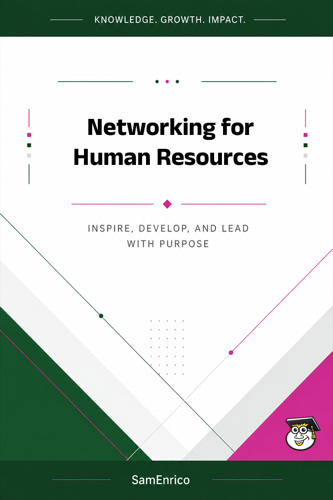
Non-FictionSelf-HelpHuman Resources
Networking for Human Resources eBook
Focuses on SHRM events and peer benchmarking relat
Focuses on SHRM events and peer benchmarking relationships.
Formats
Free sample
Chapter 1: The Loneliest Seat--–- The fluorescent lights of the convention center hummed overhead as Maria Chen, Director of Talent at a 3,000-person healthcare firm, sat alone in her hotel room on the second night of the SHRM Annual Conference. She had just returned from a networking reception where she exchanged forty-seven business cards with strangers whose names she had already forgotten. She had attended twelve breakout sessions, taken thirty-three pages of notes, and endured four vendor pitches disguised as educational sessions. Her feet ached. Her phone battery was dead.
And somewhere in the back of her mind, a quiet voice whispered the question she could not shake: What did I actually accomplish today?Maria reached for her laptop and opened the conference app for the fifth time that evening. Scrolling through the list of two thousand attendees, she realized something that stopped her cold. She had spoken to dozens of people, but not a single one of them worked at a company like hers. She had collected contacts from software vendors, consultants, and academics. She had not found a single peer who had solved the problem keeping her awake at night: how to restructure her HR business partner model to support a rapidly growing clinical workforce.She closed the laptop and stared at the ceiling.
Tomorrow was the final day of the conference. She had one more chance. But she had no plan, no targets, and no idea how to turn this expensive, exhausting ritual into something that would matter on Monday morning.Maria is not alone. She is not failing. She is the victim of a system that has taught HR professionals to confuse activity with impact.The HR Loneliness Epidemic Let us name what Maria experienced, because naming it is the first step toward curing it.
She experienced what we will call the HR Loneliness Epidemic—the quiet, unspoken isolation felt by HR professionals who are expected to solve complex organizational problems without access to the one resource that would actually help them: trusted peers who have faced the same challenges and can share what actually worked.This loneliness is structural, not personal. HR has been designed as a siloed function. Compliance regulations create walls. Confidentiality requirements discourage sharing. And the legacy of HR as a "paperwork department" has left generations of professionals believing that asking for help is a sign of weakness rather than a strategic necessity.But the data tells a different story.
According to research drawn from SHRM's annual conference surveys and follow-up studies conducted over five years, 70 percent of HR professionals attend major industry events like SHRM Annual or local chapter conferences but fail to implement any meaningful changes as a result. Seventy percent. That is not a small gap. That is a systemic failure.Let that number sink in for a moment. For every ten HR leaders who invest thousands of dollars and dozens of hours in professional development, seven return to their desks with nothing to show for it except a stack of business cards and a vague sense of having missed something important.The problem is not the conferences.
The problem is not the speakers. The problem is not even the attendees themselves. The problem is the absence of a structured networking strategy that turns human connection into organizational intelligence.The Myth of the HR Loner There is a persistent stereotype in the business world: the HR professional as isolated policy enforcer, sitting alone in a corner office, surrounded by binders of compliance regulations, emerging only to deliver bad news about benefits or terminations. This caricature is damaging, inaccurate, and—most dangerously—self-fulfilling.The Myth of the HR Loner suggests that HR work is inherently solitary. It suggests that confidentiality requirements mean you cannot talk to peers.
It suggests that the nature of employee relations makes friendship impossible. And it suggests that real strategic work happens alone, in quiet contemplation, not in collaboration with other professionals.Every part of this myth is wrong.Consider the alternative. Consider the CHRO of a mid-sized manufacturing firm who belongs to a benchmarking pod of six peers from non-competing companies. When her CEO asks her to implement a new performance management system, she does not start from scratch. She calls her pod.
Within forty-eight hours, she has three case studies, two implementation timelines, and one cautionary tale about a vendor who overpromised and underdelivered. She presents her recommendation to the CEO with confidence, backed by peer-validated data. The implementation takes half the expected time and costs thirty percent less than budgeted.Consider the talent acquisition leader who attends SHRM Annual with a specific target: find three peers who have successfully integrated AI screening tools without increasing adverse impact. She uses the conference app to identify attendees who have flagged the sessions on ethical AI. She introduces herself with a specific ask, not a generic "nice to meet you." She leaves the conference with three phone numbers, two email threads, and one pending benchmarking call.
Ninety days later, she has implemented a new screening process that reduces time-to-hire by forty percent.Consider the benefits manager who feels stuck. Open enrollment is a nightmare every year. Employees are confused. Vendors are unhelpful. Her boss is frustrated.
She joins her local SHRM chapter and attends a roundtable on benefits communication. She meets five peers who have faced the exact same challenges. Together, they create a shared document of best practices. She adapts three of them for her own company. The next open enrollment sees a twenty-five percent reduction in help desk tickets.These professionals are not smarter than Maria.
They are not better funded. They are not luckier. They have simply rejected the Myth of the HR Loner. They have built networks of trusted peers who share process insights, validate strategies, and accelerate implementation. They have become what this book calls Strategic Connectors.The Strategic Connector Mindset A Strategic Connector is an HR professional who treats peer relationships as a strategic asset rather than a social courtesy.
The Strategic Connector mindset rests on three core beliefs:First, your problems are not unique. Whatever challenge you are facing—whether it is high turnover among frontline staff, resistance to a new HRIS, or difficulty recruiting diverse candidates—someone else has already solved it. Not exactly the same way. Not in the same industry. But the underlying patterns are transferable.
The belief that your situation is completely unique is not humility. It is an excuse to remain stuck.Second, peer-validated insights are more valuable than vendor promises. Software vendors will always tell you their product solves every problem. Consultants will always tell you their framework is revolutionary. But a peer who has actually implemented a solution—who can tell you what worked, what failed, and what they would do differently—provides intelligence that no paid source can match.
This is not anti-vendor. This is pro-verification.Third, networking is not a personality trait. It is a discipline. Extroverts do not automatically build better networks than introverts. Charisma is not a prerequisite for strategic connection.
The difference between Maria and the CHRO who succeeded is not their comfort with small talk. It is their commitment to a structured, repeatable process for identifying…
This is the end of the free sample. Get the eBook to keep going. Buy now
About this book
Details
- Author
- Galindo Contessa
- Publisher
- SamEnrico
- Language
- English
- Genre
- Non-Fiction, Self-Help, Human Resources
- Released
- 2026-06-07
- Pages (approx.)
- 151
- Available as
- eBook, Audiobook

Read better in the ZLOADR app
Your eBooks on your phone or tablet. Sign in with your SamEnrico account and start reading.
More by Galindo Contessa
 Compulsive Spending Test GuideGalindo Contessa$11.99
 Self Hypnosis For PGA Tour Mental GameGalindo Contessa$11.99
 Public Speaking Panic GuideGalindo Contessa$11.99
 The Stock Market Anxiety GuideGalindo Contessa$11.99
 Parent Doctor Appointment GuideGalindo Contessa$11.99
 Eddie Murphy RawGalindo Contessa$11.99
 Anapanasati for Terminal IllnessGalindo Contessa$11.99
 The Whispering Machines: How AI Learned to Speak HumanGalindo Contessa$11.99
 The Vanishing of Flight 447: Decoding the Black BoxGalindo Contessa$11.99
 The Ballad of the Midnight Gardener: How One Man Grew a Forest in the CityGalindo Contessa$11.99
 Advanced Analytics with Power BI & ExcelGalindo Contessa$11.99
 Preprint And Thesis Submissions GuideGalindo Contessa$12.99
You may also like
 Hong Kong Handover 1997Dunn Johnnie$11.99
 Zumba For Postnatal Recovery CourseNeal Christian$11.99
 Zumba for BeginnersLadner Nikia$11.99
 YouTube Comment Mining GuideHumes Pandora$12.99
 Worry Box MeditationCarlin Rudy$11.99
 Workplace Stress MeditationNguyen Lynn$11.99
 Workplace Stress and Sleep RepairHawley Ivory$11.99
 Workplace Perfectionism CureDelaney Jeffry$11.99
 Workplace Injustice Anger GuideWallen Isabelle$11.99
 Work Addiction and Burnout LinkGreenwood Ester$11.99
 Women in Yoga and WellnessBeattie Galina$11.99
 Women in Stand Up ComedyChun Evangeline$11.99