
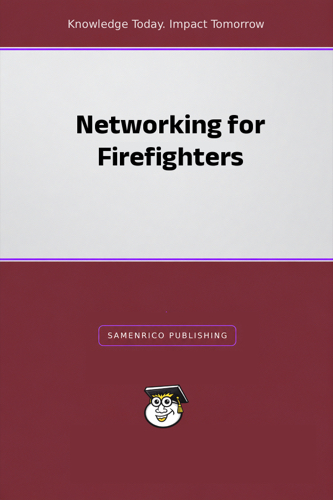
Non-FictionSelf-HelpFirefighter
Networking for Firefighters eBook
Builds interdepartmental and community relationshi
by Almond Kaila
Builds interdepartmental and community relationships.
Formats
Free sample
Chapter 1: Trust Capital...--The mayday call came at 2:17 AM. Firefighter Mike Coleridge keyed his mic, chest heaving, smoke so thick he couldn't see the gloved hand in front of his face. "Mayday, mayday, mayday!" Silence. He keyed again. Nothing but static.
The department on the other side of the county—the one he'd never trained with, never shared a meal with, never even exchanged phone numbers with—used different frequencies, different protocols, and, as he would learn later, different priorities. For forty-seven seconds—an eternity when your SCBA is screaming and the floor could give way any moment—Mike was utterly alone in a burning basement. He survived. Barely. Forty-seven seconds.
That's all it takes for a network gap to become a line-of-duty death.This book exists because Mike survived. But thousands of firefighters haven't. And in almost every case where a mayday call went unanswered or a crew failed to coordinate, the root cause wasn't a lack of courage, equipment, or training. It was a failure of relationships. It was trust capital that hadn't been banked.
It was a network that existed only on paper, not in the bones of the people who needed to move as one when the world was on fire.Welcome to a different kind of firefighter book. This is not about ladder throws or hose layouts. This is not about ventilation techniques or search patterns. This is about the invisible infrastructure that makes all of that possible: the web of relationships, the currency of trust, and the deliberate, disciplined practice of building a network that can save your life.Networking has a reputation problem in the fire service. It sounds corporate.
It sounds like glad-handing at conferences, exchanging business cards with people you'll never call, performing the hollow rituals of professional ambition. That is not what this is. This book redefines networking as critical infrastructure—as essential to your safety as your SCBA, as vital to your crew as your radio, as foundational to your career as your physical fitness.From this point forward, when you read the word "networking" in these pages, you will understand it as follows: Networking is the deliberate cultivation of trust-based relationships that serve three purposes: safety, service, and sustainability.Safety (Chapters 1-4): The relationships that ensure you and your crew go home at the end of every shift. Trust capital that answers a mayday. Peer support that catches you before PTSD swallows you whole.Service (Chapters 5-7): The relationships that connect your department to the community you swore to protect.
Trust capital that turns a smoke detector installation into a budget vote. Family capital that keeps your household stable while you save others.Sustainability (Chapters 8-12): The relationships that carry you through promotions, career transitions, and retirement. Professional capital that opens doors when your back gives out. Legacy capital that ensures your name means something after you hang up your gear.This chapter focuses on the first pillar: safety. Because nothing else matters if you don't go home.The Myth of the Lone Hero Every firefighter enters the service carrying a quiet mythology.
It's the story of the lone hero—the one who kicks down the door when others hesitate, who charges in while others calculate, who needs no one because they are enough. Hollywood sells this myth. So do the war stories told around station tables, where the details of the rescue grow more dramatic with each retelling and the contributions of everyone else slowly fade from the frame.The myth is seductive. It makes us feel powerful, self-sufficient, invincible. But it is also a lie—and a dangerous one.No firefighter has ever made a solo rescue.
Not really. Behind every "hero" is a dispatcher who took the call, an officer who made the decision, a driver who got the rig there, a crew who held the line, a communications team who kept the frequencies clear, a rehab team who watched for exhaustion, and a dozen other people whose names will never appear in the newspaper. The hero is simply the most visible node in a network. Remove the network, and the hero is just a person standing alone in front of a burning building.This is not humility. This is accuracy.
And recognizing it is the first step toward building a network that actually works.Think of the closest call you've ever had. Not the one where everything went right—the one where it almost went wrong. The hydrant that was farther than expected. The crew that arrived two minutes late. The order that was misunderstood on the radio.
The partner who wasn't where you thought they'd be. In every one of those moments, the gap between disaster and survival was filled by relationships. Someone trusted you enough to push harder. Someone knew you well enough to anticipate your next move. Someone had banked enough trust capital with you that you didn't hesitate when they shouted.That is what this chapter means by safety.
Not the absence of danger, but the presence of a network that catches you when danger finds you anyway.Defining Trust Capital: The Currency of the Firehouse If networking is the cultivation of relationships, then trust capital is the currency those relationships run on. It is the invisible ledger that tracks who owes whom, who can be counted on, and who has earned the right to lead, to correct, or to ask for help.Trust capital is earned in small moments, not grand gestures. It is the probie who stays late to clean the bathroom without being asked. The senior firefighter who notices a rookie struggling and offers quiet advice instead of public correction. The officer who takes a meal to a crew member's family when that crew member is stuck on a long call.
The firefighter who admits a mistake instead of hiding it. Every single one of these actions deposits a few coins into the trust capital account.And like any currency, trust capital can be spent. When you need someone to cover your shift, you spend trust capital. When you make a decision that your crew disagrees with, you spend trust capital. When you ask a neighboring department for mutual aid on a questionable call, you spend trust capital.
When you key the mic and say "Mayday," you are spending every last coin in your account—and praying that the balance is high enough to bring help.Here is the hard truth that no academy teaches: Trust capital cannot be withdrawn in an emergency if it was never deposited in peacetime.You cannot build a relationship in the middle of a mayday. You cannot establish trust while the building is collapsing. You cannot explain your communication style to a crew you've never worked with while your air is running out. The time to deposit trust capital is long before you need to withdraw it. The time to build your network is when the station is quiet, the trucks are clean, and the only sound is the coffee pot dripping.The Anatomy of a Life-Saving Network What does a safety network actually look like?
It is not a Linked In connection or a business card collection. It is a living, breathing web of relationships…
This is the end of the free sample. Get the eBook to keep going. Buy now
About this book
Details
- Author
- Almond Kaila
- Publisher
- SamEnrico
- Language
- English
- Genre
- Non-Fiction, Self-Help, Firefighter
- Released
- 2026-06-08
- Pages (approx.)
- 156
- Available as
- eBook, Audiobook

Read better in the ZLOADR app
Your eBooks on your phone or tablet. Sign in with your SamEnrico account and start reading.
More by Almond Kaila
 High Carb Low Fat VeganAlmond Kaila$11.99
 Workplace Values AlignmentAlmond Kaila$11.99
 SAD And Bipolar DisorderAlmond Kaila$11.99
 Humming Bee BreathAlmond Kaila$11.99
 Fear of Failure in DatingAlmond Kaila$11.99
 Anger De escalation OnlineAlmond Kaila$11.99
 Team Creative OnboardingAlmond Kaila$11.99
 The Phantom of the Danube: How a Hungarian Folk Legend Inspired a Global Country StarAlmond Kaila$11.99
 The Vanishing of the SS Poet: The Unsolved Mystery of the Lost ShipAlmond Kaila$11.99
 A Collector's Handbook to the Mercedes-benz 220Almond Kaila$11.99
 How to Become a Rubber-tubing SplicerAlmond Kaila$11.99
 Belly Breathing for AnxietyAlmond Kaila$12.99
You may also like
 Hong Kong Handover 1997Dunn Johnnie$11.99
 Zumba For Postnatal Recovery CourseNeal Christian$11.99
 Zumba for BeginnersLadner Nikia$11.99
 YouTube Comment Mining GuideHumes Pandora$12.99
 Worry Box MeditationCarlin Rudy$11.99
 Workplace Stress MeditationNguyen Lynn$11.99
 Workplace Stress and Sleep RepairHawley Ivory$11.99
 Workplace Perfectionism CureDelaney Jeffry$11.99
 Workplace Injustice Anger GuideWallen Isabelle$11.99
 Work Addiction and Burnout LinkGreenwood Ester$11.99
 Women in Yoga and WellnessBeattie Galina$11.99
 Women in Stand Up ComedyChun Evangeline$11.99