
Non-FictionSelf-HelpEvent Planning
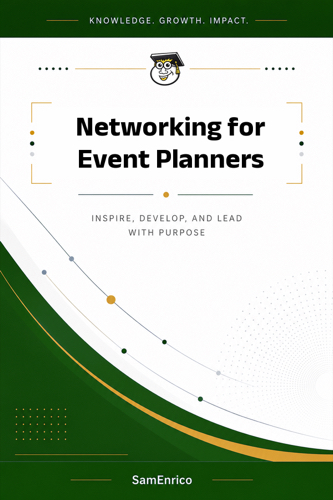
Networking for Event Planners eBook
Build vendor relationships and repeat corporate cl
Build vendor relationships and repeat corporate client business after successful events.
Formats
Free sample
Chapter 1: The Exhaustion Lie--–- The conference ended forty-seven minutes ago. The keynote speaker had been a hit. The AV cues landed perfectly. The catering staff cleared the last of the dessert plates. And the corporate client—a senior director of events at a Fortune 1000 company—had actually hugged you.
"Best sales kickoff we've ever had," she said. "I don't know what we would have done without you."You smiled. You thanked her team. You watched her walk toward the exit, still buzzing from a flawless evening.Then you got in your car. And you crashed.By the time you pulled into your driveway, you had already mentally filed that event under "done." Tomorrow, you told yourself, you would sleep in.
Then you would catch up on emails that had piled up while you were onsite. Then you would start hunting for the next contract, because a planner without a pipeline is just a person with a laptop and anxiety.This is the exhaustion lie. It is the single most expensive belief in the event planning industry, and almost every planner believes it.The exhaustion lie says: After a successful event, you deserve to rest. The work is finished. The relationship has reached its natural endpoint.
Now you must find new business.Every word of that is wrong.The Invisible Asset You Just Walked Away From Let us examine what actually happened in the forty-seven minutes between the client's hug and your car door closing.The client was not just happy. She was emotionally elevated. Her team had just executed something difficult in front of hundreds of her colleagues and superiors. There had been moments of tension—a last-minute room flip, a speaker who ran long—and you had handled them without her ever knowing. In her memory, the event was not just successful.
It was effortless.Psychologists call this the peak-end rule. Human beings judge an experience not by every moment, but by two things: the most intense moment (the peak) and the final moment (the end). Your event had a strong peak—the CEO's standing ovation—and a strong end—that hug in the lobby. The client's memory is currently locked in a state of maximum goodwill.This state will not last. Within seventy-two hours, the peak-end effect begins to fade.
Emails pile up. Other priorities intrude. By the end of the week, that glowing memory will have been replaced by whatever crisis landed on her desk Tuesday morning.The forty-eight to seventy-two hours immediately following a successful event are what this book calls the Golden Window. It is the highest-leverage networking period in the entire client lifecycle. And most planners spend it sleeping, catching up on admin, or—worst of all—chasing strangers on Linked In while ignoring the person who just hugged them.The Project-Based Mindset: A Professional Suicide Pact Why do smart, hardworking planners consistently make this mistake?
The answer lies in how the industry trains us to think.Event planning education—whether formal or learned on the job—is almost entirely organized around projects. You learn how to source a venue. How to negotiate with a caterer. How to build a run of show. How to manage a budget.
Every certification, every webinar, every template assumes that an event has a beginning, a middle, and an end.The problem is not that this framework is false. The problem is that it is incomplete.When you treat an event as a project, you naturally treat the relationship with the client as coterminous with the project. The relationship begins when the contract is signed. It intensifies during planning. It climaxes during the event itself.
And then—logically, within the project framework—it ends.But the client does not think this way. The client does not think of you as a project. She thinks of you as the person who made her look good in front of her boss. She thinks of you as the person who solved the catering crisis without drama. She thinks of you as safe.When you disappear after the event, she does not think, "Well, the project is over." She thinks, "I guess they don't care about our relationship." And then, six months later, when her next event budget is approved, she calls around for bids.
Not because she was unhappy with you. But because you taught her that you were a one-night stand, not a long-term partner.This is the project-based mindset, and it is a professional suicide pact.Consider the math. A typical independent event planner might produce fifteen to twenty corporate events per year. If each client has an average lifetime value of three events before moving on, that planner is constantly backfilling lost business just to stay flat. But if that same planner could extend the average client relationship to six events, revenue would double without acquiring a single new client.The project-based mindset keeps you on a treadmill.
The relationship asset mindset builds a staircase.The Relationship Asset Mindset This book proposes a different framework: the Relationship Asset Mindset.Every event you produce generates not just revenue, but an asset. That asset is composed of three distinct layers that work together to create long-term value.First: Goodwill. The client's emotional trust in you is not abstract. Goodwill translates directly into faster approvals, fewer second-guesses, and higher tolerance for the inevitable small problems that arise during planning. When you have goodwill, a client says "yes" to your recommendations.
When you lack goodwill, a client asks for three bids and six references.Second: Data. Every event produces information about what the client values, what their team responds to, and what their internal politics look like. You learn who the real decision-maker is. You learn which vendors they love and which they tolerate. You learn their budget patterns and approval timelines.
This data is gold. It tells you exactly how to pitch them for the next contract.Third: Social Capital. Every successful event gives you standing to ask for introductions to other departments, other decision-makers, other companies. The client who just hugged you will open doors that no cold email ever will. She will introduce you to her counterpart in the European office.
She will recommend you to the head of HR who needs a retreat planner. She will vouch for you when her friend at another company asks for a referral.The job of the planner, under the Relationship Asset Mindset, is not to finish the event and move on. The job is to convert the asset into repeat business.This shifts everything. It changes how you measure success. It changes how you spend your time.
And it fundamentally changes the question you ask yourself after every event.Instead of "What's my next lead?" you ask: "What is the value of the relationship asset I just generated, and how do I capture it before it decays?"The ROI of Retention: Why Your Current Metrics Are Lying to You Let us put numbers on this, because planners are businesspeople and businesspeople care about math.Acquiring a new corporate client typically requires a combination of marketing, networking, proposals, and follow-up. If you are paying for lead generation software, attending industry events, or running digital…
This is the end of the free sample. Get the eBook to keep going. Buy now
About this book
Details
- Author
- Whiting Catherin
- Publisher
- SamEnrico
- Language
- English
- Genre
- Non-Fiction, Self-Help, Event Planning
- Released
- 2026-06-09
- Pages (approx.)
- 146
- Available as
- eBook, Audiobook

Read better in the ZLOADR app
Your eBooks on your phone or tablet. Sign in with your SamEnrico account and start reading.
More by Whiting Catherin
 George HW BushWhiting Catherin$11.99
 MBSR For Diabetes ManagementWhiting Catherin$11.99
 The Prevention Social Rhythm GuideWhiting Catherin$11.99
 Stress Breathing PhysiologyWhiting Catherin$11.99
 Identifying Emotional TriggersWhiting Catherin$11.99
 Discussing Non compete AgreementsWhiting Catherin$11.99
 Morning Pages Creative RitualWhiting Catherin$11.99
 Trance For Public SpeakingWhiting Catherin$11.99
 The Klondike Gold Rush: A Heist of OpportunityWhiting Catherin$11.99
 The Celestial Cartographers: Mapping the Heavens in the Age of EnlightenmentWhiting Catherin$11.99
 Echoes of the Forgotten: The Lost Tapes of the 1977 New York BlackoutWhiting Catherin$11.99
 Scaling Paid Traffic ProfitablyWhiting Catherin$11.99
You may also like
 Hong Kong Handover 1997Dunn Johnnie$11.99
 Zumba For Postnatal Recovery CourseNeal Christian$11.99
 Zumba for BeginnersLadner Nikia$11.99
 YouTube Comment Mining GuideHumes Pandora$12.99
 Worry Box MeditationCarlin Rudy$11.99
 Workplace Stress MeditationNguyen Lynn$11.99
 Workplace Stress and Sleep RepairHawley Ivory$11.99
 Workplace Perfectionism CureDelaney Jeffry$11.99
 Workplace Injustice Anger GuideWallen Isabelle$11.99
 Work Addiction and Burnout LinkGreenwood Ester$11.99
 Women in Yoga and WellnessBeattie Galina$11.99
 Women in Stand Up ComedyChun Evangeline$11.99