
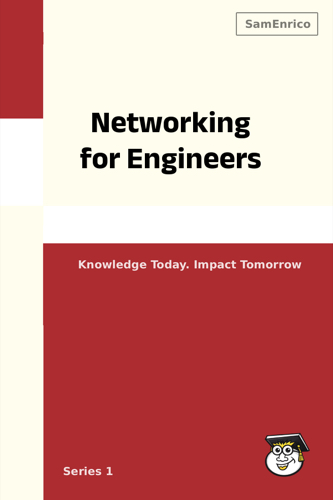
Networking for Engineers eBook
Builds professional connections in technical field
Builds professional connections in technical fields.
Formats
Free sample
Chapter 1: The Graph Beneath--–- The first time a senior engineer told me “networking is just showing up,” I almost quit the industry. Not because I was shy—I had presented at three conferences that year. Not because I was antisocial—I led a weekly board game night. No, I almost quit because that advice was technically wrong, and as an engineer, nothing offends me more than a technically wrong answer masquerading as wisdom.“Just show up” is not a protocol. It is not a debuggable process.
It does not have retransmission timers or error detection. It is the professional equivalent of telling a junior developer to “just write good code.” It offers no handshake, no state management, no feedback loop. And yet, for years, I accepted it. I showed up to conferences, stood in the general reception area like a node in a broadcast storm, collected business cards I never used, and returned home wondering why my career graph had zero new edges.Then I stopped accepting bad metaphors. I started treating professional networking like what it actually is: a graph discovery problem.This chapter is not a pep talk.
It will not tell you to “be more extroverted” or “just be yourself.” Those are platitudes, not engineering. Instead, this chapter will give you a precise, mathematical reframing of networking that turns social anxiety into a solvable system. By the end, you will understand why traditional networking feels broken, why your aversion is actually a rational response to poorly designed interactions, and how a simple graph model can unlock opportunities you did not even know existed.The Engineer’s Objection: Why We Hate “Networking”Let us name the enemy. When most engineers hear the word “networking,” they conjure a specific set of images: a crowded hotel ballroom, a nametag stuck to a cheap suit jacket, a person with a too-wide smile asking “So, what do you do?” while scanning the room for someone more important. It feels fake.
Transactional. Manipulative. Reserved for people who use words like “synergy” without irony.Here is the uncomfortable truth: that feeling is correct.Traditional networking, as practiced in most industries, is broken. It prioritizes broadcast over unicast. It confuses activity with connectivity.
It rewards the loudest nodes regardless of the value they carry. And it offers no diagnostic tools when a connection fails. If you hate it, you are not broken—the protocol is.But here is where most advice goes wrong. The typical response to the engineer’s objection is: “Get over it. Networking is a necessary evil.” That is like telling a TCP stack to “get over” packet loss.
It ignores the fact that the engineer has identified a real inefficiency and wants to solve it, not endure it.This book operates on a different premise: Your analytical mind is not a liability. It is the tool.The reason graph theory and network protocols resonate with engineers is that they already are the correct description of human professional relationships. Every person you know is a node. Every introduction, collaboration, or shared project is an edge. Your career mobility is a routing problem.
Your lack of opportunities is a missing route in your routing table.So let us stop pretending that networking is about “being liked.” It is about completing a graph.Graph Theory for Humans: Nodes, Edges, and the Discovery Layer In computer science, a graph is a set of nodes (vertices) connected by edges. That is it. No morality. No charisma score. No “synergy.” Just structure.Your professional network is exactly that: a graph where each node is a person, and each edge is a relationship.
Some edges are strong (you talk weekly, you have worked together, you would lend them money). Some edges are weak (you met once at a conference, you exchanged Linked In invites, you share a Slack channel but have never DM’d).Here is the first revelation: The graph already exists. You do not need to build it from scratch.You already have nodes. You already have edges. The problem is that most engineers never map their graph.
They operate on a tiny, local subset—their team, their manager, their three work friends—and assume that is the whole network. It is like running a routing protocol with a routing table that contains only three entries. You cannot route to destinations you do not know exist.The discovery layer is the process of mapping the graph. It involves two simple actions:Identifying nodes (people) that you are not yet connected to but could be.Finding paths (chains of existing connections) to reach those nodes.Notice what is not in that definition: manipulation, pretending to be someone you are not, or “working the room.” Discovery is an information-gathering exercise. It is technically identical to running nmap on a subnet to see which hosts are up.
There is no emotional weight to it unless you add it.So why does discovery feel so hard? Because most engineers skip straight to the request. They try to establish a direct edge to a high-value node (a senior director, a hiring manager, a famous researcher) without checking if a path exists. That is like trying to send a packet to an IP address without a route. The packet will be dropped, and you will feel rejected.The solution is not to “try harder.” It is to discover the path.Structural Holes: Where Opportunity Actually Lives Now we arrive at the first empirical concept that will change how you see your career.
Structural holes are gaps between different groups in a network. Imagine three clusters: the hardware team, the software team, and the product team. Within each cluster, edges are dense—everyone knows everyone. But between clusters, there are few or no edges. Those gaps are structural holes.Here is the staggering finding from social network research: People who bridge structural holes earn more, get promoted faster, and produce more innovation than people who stay inside a single cluster.Why?
Because information flows within a cluster redundantly. Everyone on the hardware team already knows what everyone else knows. But the hardware team does not know what the software team is planning for next quarter. The person who has an edge to both clusters—the bridge—possesses unique, non-redundant information. They see the whole graph while others see only their local subnet.Let me give you a concrete example.
At a previous company, two engineers had identical technical skills. Engineer A stayed on the firmware team for three years. She knew every detail of the USB stack, but she never talked to the cloud team. Engineer B spent six months on firmware, then volunteered to help the cloud team with a latency issue. He did not become a cloud expert—he just became a bridge.
When the company needed to design a new over-the-air update system (which required both firmware and cloud expertise), who do you think got the lead role? Engineer B. Not because he was smarter, but because he occupied a structural hole.The lesson is brutal but liberating: Technical skill alone is a commodity inside a cluster. Bridging skill is rare.Your goal, therefore, is not to collect as many nodes…
This is the end of the free sample. Get the eBook to keep going. Buy now
About this book
Details
- Author
- Garris Deonna
- Publisher
- SamEnrico
- Language
- English
- Genre
- Non-Fiction, Self-Help, Engineering
- Released
- 2026-06-05
- Pages (approx.)
- 149
- Available as
- eBook, Audiobook

Read better in the ZLOADR app
Your eBooks on your phone or tablet. Sign in with your SamEnrico account and start reading.
More by Garris Deonna
 Five Finger BreathGarris Deonna$11.99
 Fear of Failure in PerfectionistsGarris Deonna$11.99
 Workplace Feedback ReceptionGarris Deonna$11.99
 Vegan Vitamin D GuideGarris Deonna$11.99
 Morning Cold Shower GuideGarris Deonna$11.99
 Team Creative RitualsGarris Deonna$11.99
 Anger De escalation with BorderlineGarris Deonna$11.99
 Harald Hardrada: The Last Viking King Who Dared to Challenge William the ConquerorGarris Deonna$11.99
 The Olmec Healers: Masters of Ancient MedicineGarris Deonna$11.99
 How to Produce Waffle and Pancake MixesGarris Deonna$11.99
 A Collector's Handbook to the Mercedes-benz 180Garris Deonna$11.99
 Venture Debt for Hardware StartupsGarris Deonna$12.99
You may also like
 Relationship Building for EngineersGetz Cordie$11.99
 Dreaming for Engineering DesignKline Sharee$11.99
 Constraints for EngineersSlaughter Birgit$11.99
 Emotional Intelligence For EngineersWorth Zina$11.99
 Personal Branding for EngineersKimmel Cletus$11.99
 Failure Fear in EngineeringSpalding Richard$11.99
 TRIZ Problem SolvingMcdade Refugio$11.99
 NVC for EngineersCrump Krysta$11.99
 Workaholism in EngineeringHughes Derrick$11.99
 Fear of Failure for EngineersSchott Charline$11.99
 Engineering Student StressBurris Trinh$11.99
 Engineer Imposter SyndromeMoreau Melodee$11.99