
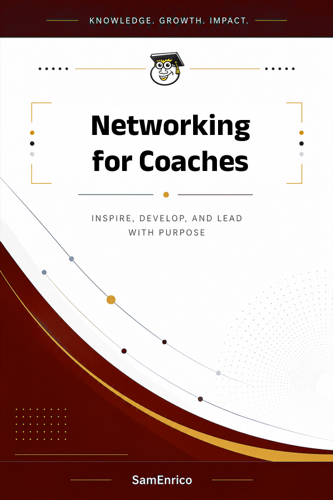
Networking for Coaches eBook
Builds client and peer coaching relationships.
by Dollar Dell
Builds client and peer coaching relationships.
Formats
Free sample
Chapter 1: The Empty Calendar--It was 11:47 on a Tuesday morning when Sarah realized she had become the thing she feared most: a coach with no clients.Her calendar, once a proud mosaic of color-coded sessions, now stretched before her as a vast white wasteland. Three certifications hung on her office wall—ICF accredited, no less. A thousand Linked In connections populated her network. She had attended every free webinar, perfected her intake call script, and could recite the elevator pitch in her sleep. And yet, for the sixth consecutive week, not a single paid conversation appeared on her schedule.The shame arrived before the panic did.
She caught herself scrolling past a fellow coach's Instagram post—a smiling testimonial, a waiting list announcement, a "thrilled to be fully booked through Q3"—and felt her stomach tighten. What was she doing wrong? Was she not smart enough? Not charismatic enough? Had she chosen the wrong niche, the wrong pricing model, the wrong headshot?She had asked all the wrong questions.
And she was about to learn that her empty calendar was not a marketing problem. It was a relationship problem—but not the one she thought.The Referral Myth That Is Bankrupting Coaches Let me tell you what Sarah did next, because it is exactly what ninety percent of struggling coaches do. She doubled down on transactional networking.She attended a local business mixer. She collected seventeen business cards. She sent twenty-three Linked In connection requests with the note "Would love to learn about your work!" She asked every single person she met the question that every networking guide had told her to ask: "Do you know anyone who might need a coach?"And nothing happened.Seventeen business cards led to zero conversations.
Twenty-three connection requests led to two generic "thanks for connecting" messages and then silence. The question "Do you know anyone who might need a coach?" was met with polite smiles, vague promises to "keep me in mind," and a slow, crushing realization: the more she asked for referrals, the fewer she received.This is the Referral Myth—the pervasive, almost religious belief in coaching business circles that networking is a numbers game, that asking for referrals is simply "how business works," and that an empty calendar is a sign that you haven't asked enough people. The myth says: collect more contacts. Attend more mixers. Send more emails.
Ask more directly. And eventually, the law of averages will deliver.The data tells a different story.A 2022 survey of 1,500 independent coaches found that those who reported the highest levels of "networking fatigue" also reported the highest rates of transactional asking behavior—and the lowest rates of client acquisition. Conversely, coaches who reported never asking for referrals directly had client rosters that were, on average, forty-three percent fuller. The correlation was so strong that the researchers initially assumed a data error. They re-ran the analysis.
The numbers held.Asking for referrals repels the very people you need most.Why "Can You Send Me Anyone?" Makes People Run To understand why the referral ask backfires, we need to understand a psychological principle called reactance. Discovered by psychologist Jack Brehm in the 1960s, reactance is the uncomfortable motivational state we experience when we feel our freedom to choose is being threatened. When someone asks us for something before we have offered it voluntarily, our brain registers the request as an encroachment. We feel used. And our immediate, often unconscious response is to pull away.Think about the last time someone asked you for a favor before you had established any genuine connection.
A stranger at a conference who opened with "What do you do?" and then immediately pivoted to "Can you introduce me to your manager?" A Linked In message from someone you had never spoken to that began with "I'd love to pick your brain about your network." How did it feel? If you are like most people, it felt slightly grimy. You may have said yes to be polite. You almost certainly did not follow through.The same principle applies to referral asks in coaching. When a coach says "Do you know anyone who might need a coach?" the peer on the receiving end hears something quite different.
They hear: "I see you as a vending machine for clients." They hear: "I am not interested in you as a person—only in what you can give me." They hear: "I am in scarcity mode, and I am willing to make you feel uncomfortable to relieve my own anxiety."None of these messages build trust. All of them activate reactance. And reactance does not lead to referrals. It leads to avoidance.There is a second, more subtle reason that referral asks fail. When you ask someone to send you "anyone who needs coaching," you are asking them to perform a cognitively demanding task.
They must scan their mental database of hundreds of acquaintances, evaluate each one against an invisible criteria they do not fully understand (what kind of coaching? what problem? what price point?), and then make a judgment call about whether that person would welcome an introduction. Most people, under this cognitive load, simply say "I'll let you know" and then forget the request within thirty seconds.The ask is too vague. The burden is too high.
And the result is predictable: nothing.The Giver/Taker Spectrum (Introduced Here, Not Repeated Later)Let me introduce a framework that will underpin everything that follows in this book. It comes from organizational psychologist Adam Grant, whose research on reciprocity and success patterns has reshaped how we understand professional relationships.Grant divides the professional world into three categories: givers, takers, and matchers.Takers approach relationships as extraction opportunities. They ask themselves: "What can this person do for me?" They keep score. They offer help only when they can see an immediate return. In networking contexts, takers are the ones who open with the referral ask, who calculate the "value" of a connection based on that person's network size, and who disappear the moment it becomes clear there is no direct benefit to themselves.Givers approach relationships differently.
They ask themselves: "What can I do for this person?" They offer help without tracking reciprocity. They share introductions, offer resources, and provide support even when there is no obvious benefit to themselves. In Grant's research, givers occupy both the very bottom and the very top of success metrics. The least successful people in his studies were givers who burned out because they gave indiscriminately, without boundaries, and were exploited by takers. But the most successful people were also givers—strategic givers who had learned to give generously while protecting their own energy and recognizing when to say no.Matchers operate on a principle of fairness.
They ask: "What have you done for me, and what can I do in return?" They keep an internal ledger. If you do them a favor, they will return it. If you slight them, they will retaliate. Matchers are the most common category, and they form the backbone of most professional networks.Here is what matters for coaching networking: sustainable success comes from strategic giving, not from taking or matching. The coaches who…
This is the end of the free sample. Get the eBook to keep going. Buy now
About this book
Details
- Author
- Dollar Dell
- Publisher
- SamEnrico
- Language
- English
- Genre
- Non-Fiction, Self-Help, Coaching
- Released
- 2026-06-05
- Pages (approx.)
- 140
- Available as
- eBook, Audiobook

Read better in the ZLOADR app
Your eBooks on your phone or tablet. Sign in with your SamEnrico account and start reading.
More by Dollar Dell
 Teaching Active Listening to StudentsDollar Dell$11.99
 The Leasing by GenerationDollar Dell$11.99
 Benefit Benchmarking Annual ReportDollar Dell$11.99
 Cyclical Keto for AthletesDollar Dell$11.99
 Chunking Names And FacesDollar Dell$11.99
 Crisis Intervention Team GuideDollar Dell$11.99
 Morning Audiobook HabitDollar Dell$11.99
 The Red Fox Affair: Canada's Cold War Spy Who VanishedDollar Dell$11.99
 Blood, Sweat, and Glory: The Untold Story of France's 2011 Rugby World Cup RevolutionDollar Dell$11.99
 How to Produce Wall Mount FansDollar Dell$11.99
 A Collector's Handbook to the Mercedes-benz 190slDollar Dell$11.99
 US LLC Operating Agreement BlueprintDollar Dell$12.99
You may also like
 Hong Kong Handover 1997Dunn Johnnie$11.99
 Zumba For Postnatal Recovery CourseNeal Christian$11.99
 Zumba for BeginnersLadner Nikia$11.99
 YouTube Comment Mining GuideHumes Pandora$12.99
 Worry Box MeditationCarlin Rudy$11.99
 Workplace Stress MeditationNguyen Lynn$11.99
 Workplace Stress and Sleep RepairHawley Ivory$11.99
 Workplace Perfectionism CureDelaney Jeffry$11.99
 Workplace Injustice Anger GuideWallen Isabelle$11.99
 Work Addiction and Burnout LinkGreenwood Ester$11.99
 Women in Yoga and WellnessBeattie Galina$11.99
 Women in Stand Up ComedyChun Evangeline$11.99