
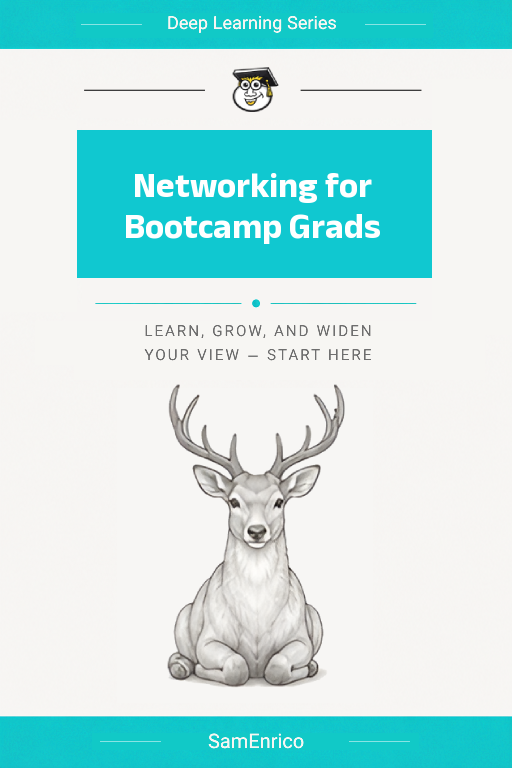
Non-FictionStudent's ShortcutNetworking
Networking for Bootcamp Grads eBook
Build professional network without university alum
Build professional network without university alumni system using tech meetups and LinkedIn.
Formats
Free sample
Chapter 1: The Hidden Truth...-- The old saying is wrong. It's not "who you know." It's "who knows what you can do."You have been lied to. Not maliciously, not by any single person, but by a culture that has quietly perpetuated one of the most damaging myths in professional life. The myth sounds like common sense: Networking is about collecting contacts. It is about who you already know.
It is about being born into the right family, attending the right university, or working at the right company long enough to accumulate a Rolodex of powerful people who will someday open doors for you.This myth has caused more talented, driven, capable people to give up before they have even started than almost any other career misconception. And for bootcamp graduates, it is uniquely paralyzing. Because if networking truly is about who you already know, then you are playing a game you lost before the first whistle. You do not have the alumni database. You do not have the fraternity brothers at Goldman Sachs.
You do not have the family friend who is a senior vice president at Google. You have a certificate from a twelve-to-sixteen-week program, a Git Hub portfolio with seven solid projects, and a burning desire to prove yourself. And according to the myth, that is not enough.This chapter exists to destroy that myth. Completely. Permanently.
And to replace it with something far more useful: a new definition of networking that works for people with no built-in advantages, no family connections, and no university alumni system to fall back on.The Million-Dollar Misunderstanding Let us start with a story. Not a hypothetical, not a feel-good anecdote from a self-help guru, but a documented case from the research of sociologist Mark Granovetter, whose 1974 study Getting a Job forever changed how we understand professional networks.Granovetter surveyed hundreds of professional, technical, and managerial workers who had recently changed jobs. He asked them a simple question: How did you find out about the job you ultimately accepted? The results were shocking. Most people expected that close friends and family members would be the primary source of job leads.
After all, those are the people who love you, who want to see you succeed, who will go out of their way to help you. But Granovetter found the opposite. The majority of job leads came not from close friends, not from family, but from weak ties—acquaintances, former coworkers, people met briefly at conferences, friends of friends, and even strangers who shared a single conversation.The data was clear. People you barely know are statistically more likely to help you find a job than the people who know you best.This finding is so counterintuitive that it almost feels like a trick. But the logic is straightforward.
Your close friends and family move in the same social and informational circles as you. They know what you know. They have heard about the same job openings, the same companies, the same opportunities. Weak ties, by contrast, bridge you to entirely different networks. The person you met once at a meetup works at a company you have never heard of.
The engineer who responded to your Linked In message knows about a role that was never publicly posted. The acquaintance from your bootcamp's alumni Slack channel has a former colleague who is hiring for a junior position right now.This is the million-dollar misunderstanding. Most bootcamp graduates believe they need to turn strangers into close friends before those strangers can help them. That is not only inefficient—it is actively counterproductive. You do not need deep relationships.
You need access to different networks. And access comes from weak ties.Why Bootcamp Graduates Have a Hidden Advantage Here is where the story flips. University alumni networks are full of weak ties—thousands of people who share a school name but have never spoken. The problem is that those weak ties are often too weak. They are based on nostalgia, not on current relevance.
A Harvard graduate from 1992 and a Harvard graduate from 2024 have almost nothing in common except a campus and a mascot. Their technical skills, industry focus, and career challenges are completely different.Bootcamp graduates have something better. They have recent, intense, skill-based weak ties. The person who sat next to you in your bootcamp cohort is not a distant alum from a decade ago. They are someone who pair-programmed with you three months ago.
They know exactly what technologies you struggled with, which projects you excelled at, and what kind of work environment suits you. The Discord moderator who answered your late-night debugging questions remembers your username. The meetup organizer who saw you attend three events in a row recognizes your face.These are not weak ties in the traditional sense. They are warm weak ties—relationships that are low-intensity but high-specificity. And they are more valuable than almost any alumni connection because they are based on shared recent experience, not on a faded diploma.The chapter's first major action item is this: Stop envying university alumni.
Start auditing your existing warm weak ties. Open a new document right now. Write down every person from your bootcamp experience who is not already a close friend. Include classmates you only spoke to twice. Include teaching assistants who helped you debug.
Include the person who sat in the back row and never turned on their camera. Include the Slack user with the obscure profile picture who always shared useful links. These people are your hidden network. They are more likely to help you than any Ivy League stranger. And you have been ignoring them because the myth told you they do not count.The 80/20 Rule of Tech Networking Now that we have reframed who your network actually is, we need to reframe how networking works.
The standard approach to networking is exhausting and ineffective: attend events, collect business cards, send generic follow-up emails, and hope that something sticks. This approach fails because it is built on extraction—taking value from others without giving anything in return.The alternative is the 80/20 Rule of Tech Networking. Eighty percent of your networking effort should be devoted to giving value. Twenty percent can be devoted to asking for help. This ratio is not arbitrary.
It is derived from the psychological principle of reciprocity, first documented by anthropologists studying gift economies across human cultures. When you give to someone—even something small—they experience a powerful, often unconscious urge to give back.The chapter's second major action item is a practical framework for the 80% giving side. You do not need to be a senior engineer with decades of experience to give value. You need to be attentive and creative. Here are three ways bootcamp graduates can give value immediately, with no money and no seniority:First, become a notetaker.
Attend a tech meetup, a webinar, or even a You Tube live stream. Take detailed, organized notes. Share those notes publicly in the event's Slack channel, Discord server, or Linked In feed. Tag the speaker and thank them. Within twenty-four hours, dozens of people will see your name attached to something useful.
You have given value. You have done nothing but take notes.Second, become a connector. When you meet two people who…
This is the end of the free sample. Get the eBook to keep going. Buy now
About this book
Details
- Author
- Schwarz Enriqueta
- Publisher
- SamEnrico
- Language
- English
- Genre
- Non-Fiction, Student's Shortcut, Networking
- Released
- 2026-06-01
- Pages (approx.)
- 134
- Available as
- eBook, Audiobook

Read better in the ZLOADR app
Your eBooks on your phone or tablet. Sign in with your SamEnrico account and start reading.
More by Schwarz Enriqueta
 Self Doubt In Ministry GuideSchwarz Enriqueta$11.99
 Media Streaming PreferencesSchwarz Enriqueta$11.99
 Anger and Property DamageSchwarz Enriqueta$11.99
 The Visual Distraction EliminatorSchwarz Enriqueta$11.99
 Low Carb For IBS ReliefSchwarz Enriqueta$11.99
 Sociopathy Versus Psychopathy DefinedSchwarz Enriqueta$11.99
 Digital Nomad RetirementSchwarz Enriqueta$11.99
 70 Percent Rule DelegationSchwarz Enriqueta$11.99
 The Last Kingpin: How a Quiet Neighborhood Became a Cartel HubSchwarz Enriqueta$11.99
 Ravana's Lament: The Fall of the Ten-Headed KingSchwarz Enriqueta$11.99
 Understanding HypercortisolismSchwarz Enriqueta$11.99
 A Collector's Handbook to the Cadillac 370aSchwarz Enriqueta$11.99
You may also like
 Hong Kong Handover 1997Dunn Johnnie$11.99
 Zumba For Postnatal Recovery CourseNeal Christian$11.99
 Zumba for BeginnersLadner Nikia$11.99
 YouTube Comment Mining GuideHumes Pandora$12.99
 Worry Box MeditationCarlin Rudy$11.99
 Workplace Stress MeditationNguyen Lynn$11.99
 Workplace Stress and Sleep RepairHawley Ivory$11.99
 Workplace Perfectionism CureDelaney Jeffry$11.99
 Workplace Injustice Anger GuideWallen Isabelle$11.99
 Work Addiction and Burnout LinkGreenwood Ester$11.99
 Women in Yoga and WellnessBeattie Galina$11.99
 Women in Stand Up ComedyChun Evangeline$11.99