
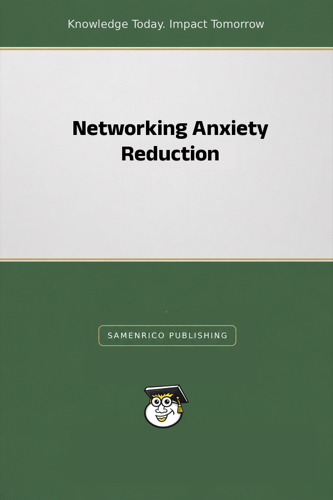
Networking Anxiety Reduction eBook
Overcome event dread with preparation and mindset
Overcome event dread with preparation and mindset techniques.
Formats
Free sample
Chapter 1: The Amygdala's Mistake--–- You are standing in a hotel ballroom, plastic cup of lukewarm white wine in your left hand, phone pressed to your ear with your right shoulder, pretending to read an email you have already read four times. Your face is hot. Your palms are damp. You have made eye contact with no one for twenty-three minutes, and you are calculating the earliest possible moment you can leave without being remembered as "the person who stood by the pillar and fled." Your heart is pounding not because you are in danger, but because your brain has confused a room full of strangers with a predator in the grass.This is not a character flaw. This is not a sign that you are broken, antisocial, or destined for a life of professional isolation.
This is a neurological misfire—an ancient alarm system doing its job too well. And once you understand how that alarm system works, you can stop fighting it and start working with it.The Bear in the Ballroom Let us go back about two hundred thousand years. You are a hominid on the savanna. You see a rustle in the tall grass. Your brain has a fraction of a second to decide: is that the wind, or is that a saber-toothed cat?
If you guess wrong and it was just the wind, you feel embarrassed for a moment. If you guess wrong and it was a predator, you are dead. So your brain evolved a bias: assume threat first, ask questions later. The amygdala—two small, almond-shaped clusters deep in your brain—is the smoke detector of this system. It does not wait for proof.
It does not ask for a second opinion. It screams FIRE and floods your body with cortisol and adrenaline.Now fast forward to Tuesday night. You are at a professional mixer. There is no predator. There is no physical threat.
But your amygdala does not know the difference between a lion and a lawyer named Jennifer who is holding a sparkling water. The social environment—unfamiliar faces, judgmental eyes, the possibility of saying something stupid—triggers the exact same cascade of stress hormones. Your heart races. Your breathing shallows. Your palms sweat.
Your peripheral vision narrows. Your digestive system shuts down. This is not anxiety as a metaphor. This is anxiety as a physiological event, measurable in your blood chemistry.Here is what most self-help books get wrong. They tell you to "calm down" or "just be yourself" or "imagine everyone in their underwear"—as if anxiety were a choice you were making, a moral failure you could fix with positive thinking.
But you cannot think your way out of a physiological response any more than you can think your way out of a sunburn. The goal is not to eliminate the fear. The goal is to understand it, label it, and redirect it.The Spotlight That Follows You Everywhere There is a famous psychology experiment that you need to know about. Researchers asked college students to wear a ridiculous t-shirt—a bright yellow shirt with a giant photo of the singer Barry Manilow's face. The students were then sent into a room full of other students and asked to estimate how many people would notice the shirt.
The students guessed that about fifty percent of people would notice. The actual number? Twenty-three percent. And of those who noticed, almost none remembered it five minutes later.This is the Spotlight Effect. It is the cognitive bias that makes you believe everyone is watching you, judging you, cataloging your every mistake.
When you stumble over a word, you think the entire room is silently mocking you. When your face flushes, you think everyone is thinking, "Look at how red she is." When you stand alone by the cheese table, you think everyone is thinking, "Look at that loser standing alone by the cheese table."Here is the truth that will set you free: they are not thinking about you at all. They are thinking about themselves. They are worried about their own flushed face, their own awkward pause, their own cheese-table loneliness. The spotlight is not on you.
You are standing in a room full of people, each convinced that the spotlight is on them. The math is liberating: everyone is too busy performing to be watching your performance.Introversion Is Not Social Anxiety Before we go any further, we need to clear up a confusion that has damaged countless lives. Introversion and social anxiety are not the same thing, and treating them as identical has led millions of introverts to believe they are broken and millions of socially anxious people to believe they just need more alone time.Introversion is a preference. It means you find high-stimulation environments draining and low-stimulation environments energizing. An introvert can give a brilliant speech to five hundred people and then need ninety minutes of quiet reading to recover.
An introvert can network effectively, enjoy it, and then go home exhausted. Introversion is about where you get your energy, not whether you fear judgment.Social anxiety is a fear. It is the anticipation of negative evaluation. A socially anxious person might desperately want to attend the event, might crave connection, might be extroverted in private—but the terror of being judged keeps them away. Social anxiety is treatable.
Introversion is not a condition to treat; it is a temperament to accommodate.You can be an introvert without social anxiety (you like quiet but you are not afraid of people). You can be an extrovert with social anxiety (you crave connection but you are terrified of judgment). And you can be both. The first step to solving your problem is naming it correctly. If you have been calling yourself "just shy" when you are actually experiencing social anxiety, you have been using the wrong map.
No wonder you have been lost.The Lie Your Body Tells You Let us talk about what happens in your body when you walk into that ballroom. Your amygdala fires. Your hypothalamus activates your sympathetic nervous system. Your adrenal glands release adrenaline and cortisol. Your heart rate increases to pump blood to your large muscles (in case you need to run).
Your breathing becomes shallow and rapid (to oxygenate your blood). Your pupils dilate. Your digestion slows or stops (your body does not want to waste energy on digestion when it thinks you are about to be eaten). Your sweat glands activate (to cool you down for the coming exertion).All of this happens in less than a second. And then your conscious mind looks at these physical sensations—racing heart, sweaty palms, short breath—and asks, "What does this mean?" If you are being chased by a lion, the answer is "I am in danger." If you are standing in a ballroom with no lion in sight, your conscious mind looks for an explanation and lands on the nearest available target: the people.
"I feel this way," you conclude, "because these people are threatening."But here is the lie. The physical sensations of fear and excitement are almost identical. Racing heart? Check. Sweaty palms?
Check. Shallow breathing? Check. Your body does not know the difference between "I am terrified of this presentation" and "I…
This is the end of the free sample. Get the eBook to keep going. Buy now
About this book
Details
- Author
- Burrows Riley
- Publisher
- SamEnrico
- Language
- English
- Genre
- Non-Fiction, Self-Help, Social Anxiety
- Released
- 2026-06-12
- Pages (approx.)
- 122
- Available as
- eBook, Audiobook

Read better in the ZLOADR app
Your eBooks on your phone or tablet. Sign in with your SamEnrico account and start reading.
More by Burrows Riley
 Binge Eating in College CourseBurrows Riley$11.99
 Caregiver Joy RetrievalBurrows Riley$11.99
 Adrenal Support Vitamin ProtocolBurrows Riley$11.99Adrenal Support Vitamin ProtocolBurrows Riley$11.99
 High School Student Stress PlanBurrows Riley$11.99
 The Phantom Ticker: Wall Street's Ghostly WhispersBurrows Riley$11.99
 Frozen in Time: The Lost Dinosaurs of the Gobi DesertBurrows Riley$11.99
 How to Become a Quilting-machine OperatorBurrows Riley$11.99
 Financial Data Breach GuideBurrows Riley$12.99
 Voiceover Remote RecordingBurrows Riley$12.99
 Understanding Ectrodactyly Diaphragmatic Hernia Corpus CallosumBurrows Riley$17.99
 ECE AssistantBurrows Riley$11.99
You may also like
 Story View Anxiety GuideMattison Ayanna$11.99
 Social Anxiety Improv CureBlanco Verline$11.99
 Self Hypnosis For Social Anxiety GuideChoi Darby$11.99
 NVC For Social AnxietyKeefe Tamra$11.99
 Mindfulness Meditation for Social AnxietyAustin Ricky$11.99
 Conversation Starters for Social AnxietyKhan Awilda$11.99
 Alcoholism and Social Anxiety WorkbookGillette Bret$11.99
 Stress and Social Anxiety in CouplesHiggins Tony$11.99
 The Body Scan for Social AnxietyLeal Ima$11.99
 Social Confidence BuilderNowlin Alla$11.99
 Social Anxiety Loneliness GuideMccann Letisha$11.99
 Social Anxiety Couple GuideBurgess Damon$11.99