
Non-FictionInformativeEducational
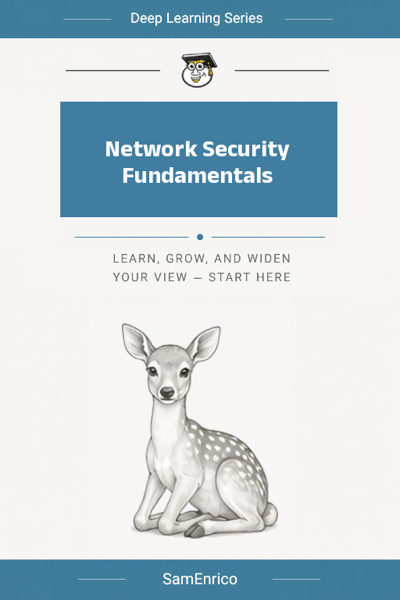
Network Security Fundamentals eBook
A Coursebook on Network Security Fundamentals
A Coursebook on Network Security Fundamentals
Formats
Free sample
Chapter 1: The Broken Castle--–- On a Tuesday morning in March 2021, a security analyst at a mid-sized insurance company watched his dashboard light up like a Christmas tree. Forty-seven alerts in under ninety seconds. Most were false positives—they always were—but one stood out. An internal server was sending encrypted traffic to an IP address in a country where the company had no business partners. The analyst escalated the alert.
His manager said to monitor it. The next day, ransomware had encrypted every file on the network’s primary file share. The backup tapes were also encrypted because an administrator’s credentials had been stolen three weeks earlier during a spear-phishing campaign that no one had reported. The company paid 2.3 million dollars in Bitcoin. They never recovered fully.This story is not unique.
It is not even unusual. It is the quiet catastrophe of modern network security, repeated thousands of times per year across every industry. And the root cause is almost always the same: an obsolete mental model of what a network is and how it should be defended.For nearly three decades, the dominant metaphor in network security was the castle. Build a high, thick wall. Dig a moat.
Install a drawbridge. Station guards at the gates. Everything inside the walls is trusted. Everyone outside is suspect. This is the castle-and-moat model, and it has failed.The Myth of the Hard Shell The castle model made sense in the 1990s.
Most corporate data lived inside a physical building. Employees came to work, plugged into a wired network, and accessed servers that sat in a locked room down the hall. The perimeter was real. You could touch it. You could lock it.
A firewall was the castle wall, and a VPN was the drawbridge. If you protected the perimeter, you protected everything inside.That world no longer exists.Today, the average enterprise network spans on-premises data centers, three or more public cloud providers, dozens of software-as-a-service applications, and hundreds or thousands of home offices and coffee shops. The perimeter is not a line. It is a fog. Data lives everywhere, and users connect from everywhere, using devices that the company does not own and cannot fully control.The Target breach of 2013 is the textbook case.
Attackers stole credentials from a heating, ventilation, and air conditioning vendor. Those credentials had no business being on Target’s payment network, but because the network was flat—everything inside the castle walls was equally trusted—the attackers moved laterally from the HVAC system to point-of-sale terminals. Forty million credit card numbers. Eight hundred million dollars in damages. All because one vendor’s credentials, intended for a thermostat, could reach a cash register.The castle model failed because it assumes that once you are inside, you are safe.
That assumption is now dangerous.Redefining the Network Before we can defend a network, we must understand what a network actually is in the twenty-first century. A network is no longer a physical place. It is a set of relationships between users, devices, applications, and data, connected by varying degrees of trust, speed, and latency, distributed across multiple administrative domains, and continuously changing.Consider a typical employee named Priya. She works from home on her company-issued laptop. The laptop connects to the internet through her home Wi-Fi router, which she bought at a retail store and has never updated.
She logs into the company’s virtual desktop infrastructure through a VPN. She accesses a customer relationship management system that runs in Salesforce, a file server that sits in an Amazon Web Services virtual private cloud, and an internal ticketing system that still lives in the on-premises data center. She also checks her personal Gmail and uploads a spreadsheet to her personal Dropbox because the corporate file-sharing system is slow.Where is the perimeter in this scenario? Is it the home router? The VPN gateway?
The cloud provider’s security boundary? The answer is that there is no single perimeter. There are dozens of micro-perimeters, each with different owners, different security postures, and different levels of visibility.This is the new reality. And it demands a new mental model.From Castle to Zero Trust The Zero Trust model emerged in 2010 from Forrester Research, but its principles are older. The core idea is simple: trust is a vulnerability.
The Zero Trust model treats every access request as if it originates from an untrusted network, regardless of where the request comes from or what device it uses. Trust is never granted implicitly. It must be earned continuously through verification, authentication, authorization, and encryption.Zero Trust is often summarized as “never trust, always verify.” But that phrase is too simple. The practical implementation of Zero Trust rests on several principles.First, authenticate and authorize every request. Not just the first request of the session.
Every request. This means that even after a user logs in, subsequent actions require fresh verification of both the user’s identity and the device’s health.Second, enforce least privilege. Users and devices should have only the minimum access necessary to perform their immediate task, and that access should be revoked as soon as it is no longer needed. This is the opposite of the traditional model, where employees accumulated access privileges over years and never lost them.Third, assume breach. This is not pessimism.
It is operational realism. The assumption that a breach has already occurred or will occur soon changes how you design your network. Instead of trying to build an impenetrable wall, you focus on limiting blast radius, detecting intrusions quickly, and responding effectively.Fourth, inspect and log all traffic. In the castle model, traffic inside the perimeter was often unmonitored because it was considered trusted. In Zero Trust, east-west traffic—traffic that moves laterally between internal systems—is just as suspect as north-south traffic that crosses the perimeter.
Every packet, every connection, every authentication event is logged and analyzed.Fifth, encrypt everything. Not just sensitive data. Everything. Encryption in transit and at rest is the baseline, not a special measure for special data.These principles are not theoretical. They are implemented every day in organizations that have abandoned the castle model.The Vocabulary of Risk To understand why the castle model fails and what to do about it, we need precise language.
Three terms are foundational: vulnerability, threat, and risk.A vulnerability is a weakness in a system that could be exploited. It might be an unpatched operating system, a default password on a router, a misconfigured firewall rule, or a human being who will click anything that flashes. Vulnerabilities are inevitable. No system is perfect. No human is infallible.A threat is a potential actor or event that could exploit a vulnerability.
Threats include hackers, malware, insider threats, natural disasters, and even simple human error. Threats are also inevitable. As long as there is value to be gained from breaking into a network, someone will try.Risk is the intersection of vulnerability and threat. More precisely, risk is the likelihood that a threat will exploit a vulnerability, multiplied by the impact of that exploitation. If a vulnerability exists but no threat can reach it, there is no risk.
If a threat exists but there is no vulnerability to exploit, there is also no risk. Risk lives in the…
This is the end of the free sample. Get the eBook to keep going. Buy now
About this book
Details
- Author
- Burgess Damon
- Publisher
- SamEnrico
- Language
- English
- Genre
- Non-Fiction, Informative, Educational
- Released
- 2026-06-02
- Pages (approx.)
- 157
- Available as
- eBook, Audiobook

Read better in the ZLOADR app
Your eBooks on your phone or tablet. Sign in with your SamEnrico account and start reading.
More by Burgess Damon
 Drug Dependency AffirmationsBurgess Damon$11.99
 Social Anxiety Couple GuideBurgess Damon$11.99
 EQ For Rural Communities GuideBurgess Damon$11.99
 TikTok Highlight Reel DetoxBurgess Damon$11.99
 Loci for Art HistoryBurgess Damon$11.99
 Music Note Mnemonic GuideBurgess Damon$11.99
 France Remote Tax GuideBurgess Damon$11.99
 B12 Neuropathy GuideBurgess Damon$11.99
 Bipolar Adolescent Mood SwingsBurgess Damon$11.99
 The Unseen Architects: How Two Syrian Refugees Built a Tech Empire from ScratchBurgess Damon$11.99
 The Silk and Gold Empire: How a Black Merchant Prince Built a Global Trade DynastyBurgess Damon$11.99
 Burning the Library of Alexandria: The Lost Fire That Erased HistoryBurgess Damon$11.99
You may also like
 Hong Kong Handover 1997Dunn Johnnie$11.99
 Zumba For Postnatal Recovery CourseNeal Christian$11.99
 Zumba for BeginnersLadner Nikia$11.99
 YouTube Comment Mining GuideHumes Pandora$12.99
 Worry Box MeditationCarlin Rudy$11.99
 Workplace Stress MeditationNguyen Lynn$11.99
 Workplace Stress and Sleep RepairHawley Ivory$11.99
 Workplace Perfectionism CureDelaney Jeffry$11.99
 Workplace Injustice Anger GuideWallen Isabelle$11.99
 Work Addiction and Burnout LinkGreenwood Ester$11.99
 Women in Yoga and WellnessBeattie Galina$11.99
 Women in Stand Up ComedyChun Evangeline$11.99