
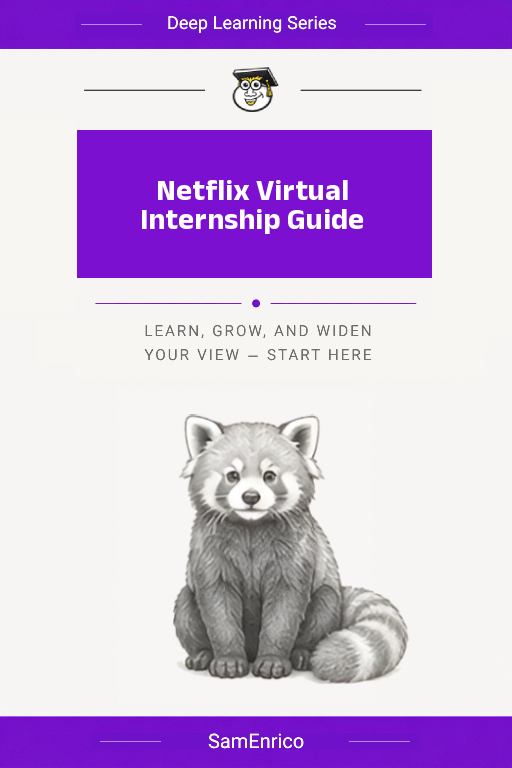
Non-FictionStudent's ShortcutEntertainment
Netflix Virtual Internship Guide eBook
Land remote internships at Netflix in content stra
by Kohn Lauri
Land remote internships at Netflix in content strategy, engineering, or data science departments.
Formats
Free sample
Chapter 1: The Keeper's Mirror...--In the summer of 2019, a Stanford computer science student named Priya completed a virtual internship at Netflix. She never stepped foot on a campus. She never attended a single in-person meeting. She worked from her childhood bedroom in suburban Chicago, communicating entirely through Slack, Zoom, and email. At the end of twelve weeks, she received a full-time offer with a starting salary of over two hundred thousand dollars.
When asked what separated her from the hundreds of other applicants who were rejected, she said something that should be printed on every page of this book: "I didn't wait for anyone to tell me what to do. I acted like I already worked there from day one."That sentence captures everything you need to know about landing and succeeding in a virtual internship at Netflix. This is not a company that coddles. It does not offer training wheels. It does not believe in "developmental opportunities" as an excuse for mediocrity.
Netflix hires what its former Chief Talent Officer Patty Mc Cord famously called "fully formed adults"—people who do not need constant supervision, who can navigate ambiguity, who give and receive feedback with radical candor, and who understand that freedom is not a perk but a responsibility.This chapter is the foundation upon which every other chapter in this book will be built. Before you learn how to reverse-engineer a job description, before you study system design for streaming, before you practice A/B testing case studies, you must first understand the psychological and cultural terrain you are about to enter. Netflix is not Google. It is not Amazon. It is not Meta.
It has a culture that is radically different from any other major tech company, and if you try to navigate it using the playbook you would use elsewhere, you will fail before you even submit your application.The Keeper Test. Radical Candor. The Dream Team philosophy. High freedom with high accountability. These are not buzzwords or HR slogans.
They are the operating system of Netflix. They dictate who gets hired, who gets fired, who gets promoted, and who gets a return offer. More importantly for your purposes, they dictate what your manager will be thinking about you from your very first day as a virtual intern. You will be evaluated not on your potential, not on your effort, not on how many hours you logged into Slack, but on one simple question: Would this person be a keeper on our Dream Team?Let us be honest with each other from the start. This chapter may scare you.
That is intentional. Netflix is not for everyone. The company is explicit about this. Reed Hastings, the co-founder and former co-CEO, has said repeatedly that he would rather have a team of ten brilliant, self-directed performers than a hundred average employees who need constant management. The internship program reflects that philosophy.
It is not a charity. It is not a diversity pipeline in the traditional sense (though Netflix does care about inclusion). It is a twelve-week audition for one of the most coveted full-time roles in the entire technology industry.If you are the kind of person who needs a manager to check in with you every day, who waits for assignments rather than creating them, who avoids difficult conversations, or who requires external validation to feel motivated, this book will help you identify those patterns and change them. But you must change them before you apply, not during your internship. The virtual environment at Netflix does not have the patience for on-the-job personality reconstruction.Conversely, if you are the kind of person who thrives on autonomy, who has already launched projects without being asked, who has told a professor or a manager that their idea was flawed, and who gets energized by solving problems that no one has clearly defined, then you have found your tribe.
The chapters ahead will give you the tactical tools to translate that mindset into an internship offer and, eventually, a full-time career.Let us begin by decoding the legendary Netflix Culture Deck, then move into the three pillars of the Dream Team philosophy, followed by a rigorous self-assessment, and finally a practical checklist of traits that signal you are ready for this environment.The Gospel of the Culture Deck In 2009, Netflix published a one hundred and twenty-seven slide presentation titled "Reference Guide on Our Freedom and Responsibility Culture." It was posted to Slide Share, a platform then known mostly for boring corporate training materials. Within weeks, it had been viewed millions of times. Sheryl Sandberg called it "the most important document ever to come out of Silicon Valley." Business schools began teaching it as a case study. Startups printed out copies and pinned them to their walls.But the Culture Deck is not a mission statement. It is not a set of aspirational values that everyone pretends to believe while acting differently.
It is a living, breathing operational manual that every Netflix employee is expected to read, understand, and apply daily. If you become a Netflix intern, you will be given a copy on your first day. You will be expected to have opinions about it.The core argument of the Culture Deck is simple and radical: most companies manage by adding rules. When someone makes a mistake, the typical response is to create a new policy to prevent that mistake from happening again. Over time, this results in a dense thicket of approvals, sign-offs, and restrictions that slow everyone down and treat competent adults like children.Netflix does the opposite.
When a mistake happens, the company asks a different set of questions: Did we give that person enough context to make a good decision? Did we hire someone with the right judgment? Could this mistake have been prevented by more freedom, rather than less? The assumption is that mistakes are inevitable in any complex system, and that adding rules is almost always the wrong response.This philosophy manifests in specific, tangible policies that would seem insane at most companies. Netflix has no formal vacation policy.
Employees can take as much time off as they want, whenever they want, with no approval required. There is no timesheet. No one tracks your days. The only expectation is that you do not abuse the policy and that your work gets done.Similarly, Netflix has no expense approval process. Need to fly to a conference?
Book the flight. Need to take a client to dinner? Pay for it. Need new equipment for your home office? Buy it.
The company trusts you to spend its money as if it were your own. If you violate that trust by expensing something clearly inappropriate, you will be fired—not because you broke a specific rule, but because you demonstrated bad judgment.This is the heart of the Netflix culture: high freedom, high accountability. You get the freedom to make your own decisions. In exchange, you are held to an extremely high standard of performance. There is no safety net.
There is no "everyone gets a trophy." There is only the Keeper Test.The Keeper Test: The Engine of Evaluation Imagine you are a manager at Netflix. Every…
This is the end of the free sample. Get the eBook to keep going. Buy now
About this book
Details
- Author
- Kohn Lauri
- Publisher
- SamEnrico
- Language
- English
- Genre
- Non-Fiction, Student's Shortcut, Entertainment
- Released
- 2026-05-30
- Pages (approx.)
- 150
- Available as
- eBook, Audiobook

Read better in the ZLOADR app
Your eBooks on your phone or tablet. Sign in with your SamEnrico account and start reading.
More by Kohn Lauri
 The 90 Day Gambling Free ChallengeKohn Lauri$11.99
 Ayurvedic Menopause GuideKohn Lauri$11.99
 Precedent Transaction Multiples GuideKohn Lauri$11.99
 Fear Then Relief GuideKohn Lauri$11.99
 Stationery Shopping AddictionKohn Lauri$11.99
 Vaping Heart RisksKohn Lauri$11.99
 Psychoeducation GuideKohn Lauri$11.99
 Desert Well FindingKohn Lauri$11.99
 Love Letters from the Eastern Front: The Secret Correspondence of Vera Brittain and Roland LeightonKohn Lauri$11.99
 Love Letters from the Front: How a Soap Opera United a Nation at WarKohn Lauri$11.99
 How to Produce Hope ChestsKohn Lauri$11.99
 How to Produce Terex VehiclesKohn Lauri$11.99
You may also like
 Hong Kong Handover 1997Dunn Johnnie$11.99
 Zumba For Postnatal Recovery CourseNeal Christian$11.99
 Zumba for BeginnersLadner Nikia$11.99
 YouTube Comment Mining GuideHumes Pandora$12.99
 Worry Box MeditationCarlin Rudy$11.99
 Workplace Stress MeditationNguyen Lynn$11.99
 Workplace Stress and Sleep RepairHawley Ivory$11.99
 Workplace Perfectionism CureDelaney Jeffry$11.99
 Workplace Injustice Anger GuideWallen Isabelle$11.99
 Work Addiction and Burnout LinkGreenwood Ester$11.99
 Women in Yoga and WellnessBeattie Galina$11.99
 Women in Stand Up ComedyChun Evangeline$11.99