
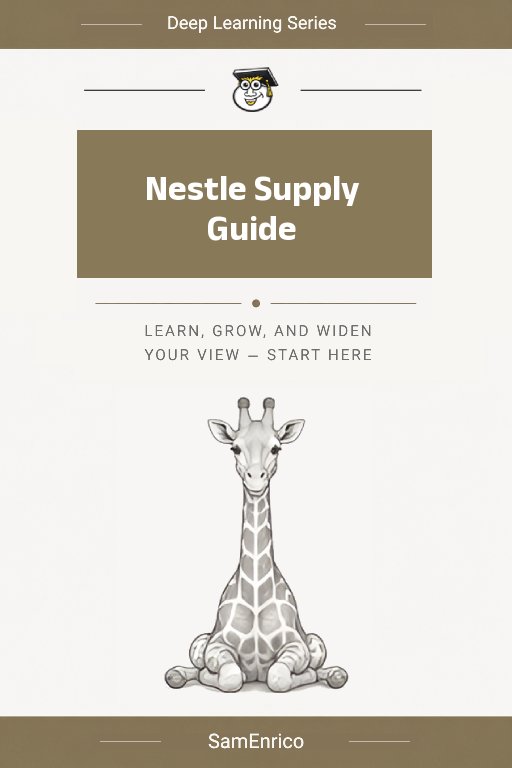
Non-FictionStrategic AtlasCPG Logistics
Nestle Supply Guide eBook
Trace global commodity sourcing, local manufacturi
by Hitt Otha
Trace global commodity sourcing, local manufacturing, and emergency response logistics for CPG giant.
Formats
Free sample
Chapter 1: The Living Supply Chain--–- Every supply chain manager knows the nightmare. You receive a routine update from your procurement team: the price of black pepper has doubled overnight. No war has been declared. No port has closed. No factory has burned down.
The cause is something far more mundane and far more terrifying: a late monsoon in southern India.The pepper vines of Kerala’s Idukki district, where nearly thirty percent of India’s black pepper is cultivated, received rainfall three weeks later than the fifty-year average. The delayed flowering reduced yields by an estimated forty percent. Traders in Kochi, sensing scarcity, began hoolding stock. Within ten days, the spot price for Tellicherry peppercorns jumped from 2,800permetrictonto2,800 per metric ton to 2,800permetrictonto5,600. Nestlé, which uses black pepper across dozens of products from Maggi noodles to bouillon cubes, suddenly faced a multimillion-dollar cost increase for an ingredient that represents less than one percent of any finished product’s weight.This is the fundamental truth that this book will repeatedly return to: Nestlé’s supply chain is not a factory line.
It is a living agricultural system. And living systems are unpredictable.The purpose of this chapter is to establish the foundational geography of that system. Before we can discuss how Nestlé sources responsibly, how it manufactures locally, or how it responds to emergencies, we must first understand what it buys, where those things come from, and why that matters. This chapter identifies the fourteen critical ingredient categories that drive Nestlé’s business, maps their geopolitical and ecological origins, and introduces the distinction between direct and complex sourcing that will structure much of the book’s early discussion. By the end of this chapter, you will understand why a delayed monsoon in India, a labor dispute in Brazil, or a coup in Indonesia can ripple through the global food system and land on your kitchen table as a higher price or unavailable product.The Fourteen Pillars Nestlé purchases more than nine million metric tons of agricultural raw materials annually from approximately seven million direct and indirect suppliers across seventy countries-1.
These purchases can be grouped into fourteen critical categories, each with its own supply dynamics, risk profile, and sourcing strategy.Dairy is far and away the largest category by volume. Nestlé is one of the world’s largest buyers of milk, purchasing nearly fourteen billion liters annually from farms primarily in Europe, the United States, China, Pakistan, and Brazil. Milk is unusual among Nestlé’s raw materials because it is sourced predominantly through direct, contracted relationships with farms. A Nestlé buyer in Switzerland knows the name of the farmer who supplied the milk for that package of Nido powdered milk. This direct relationship gives Nestlé significant control over quality, animal welfare, and environmental practices.Cereals—wheat, corn, rice, oats, and barley—represent the second largest category.
These are commodity crops grown on massive scales in North and South America, Europe, and Asia. Unlike dairy, cereals are typically sourced through commodity traders rather than direct contracts. Nestlé does not know which specific farm grew the wheat in your bowl of breakfast cereal. This lack of traceability is a persistent challenge.Vegetables occupy a middle position. Some vegetables, like tomatoes for Maggi sauces and peas for frozen dinners, are sourced through direct contracts with growers in Europe and North America.
Others, like onions and garlic powder, come through complex commodity chains originating in China, India, and Egypt. The difference matters because direct contracts allow for varietal selection and quality control; commodity sourcing does not.Cocoa is arguably Nestlé’s most emotionally charged ingredient. Sourced primarily from Côte d’Ivoire and Ghana (which together produce more than sixty percent of the world’s cocoa), cocoa carries the heaviest reputational risk due to historic associations with child labor and deforestation. Nestlé has invested more in cocoa sustainability than almost any other ingredient category, yet the fundamental challenge remains: approximately two million smallholder farmers cultivate cocoa on plots averaging two to five hectares, and tracking beans from those farms to finished chocolate bars is extraordinarily difficult.Coffee follows a similar pattern but with more progress on traceability. Nestlé sources coffee from more than fifty countries, with Brazil, Vietnam, Colombia, and Indonesia as major origins.
The company’s Nescafé brand alone requires half a million metric tons of green coffee annually. Like cocoa, coffee is predominantly a smallholder crop, but Nestlé has built more robust direct sourcing relationships in coffee over a longer period.Palm oil is the most controversial ingredient on the list. Used in everything from confectionery to infant formula for its textural properties, palm oil has been linked to massive deforestation in Indonesia and Malaysia, which produce nearly eighty-five percent of global supply. Nestlé has committed to zero deforestation in its palm oil supply chain by 2023, but the sheer complexity of the supply web—palm oil passes through refineries, traders, and processors before reaching Nestlé—makes verification difficult.Spices are the hidden complexity in Nestlé’s supply chain. Black pepper, cardamom, nutmeg, cloves, cinnamon, turmeric, cumin, coriander, chili, ginger, garlic, and dozens of others appear in tiny quantities across thousands of products.
Yet their aggregate spend is substantial, and their supply risk is enormous. Spices typically come from smallholders in developing countries—Vietnam for pepper, Guatemala for cardamom, Indonesia for nutmeg, India for cumin and turmeric. A single spice blend might contain ingredients from twelve countries and two hundred villages. The 2014 melamine contamination of Chinese chili powder, added illegally to boost protein readings, triggered a global recall of Maggi noodles and a billion-dollar crisis for Nestlé.Sugar is sourced from both sugarcane (Brazil, India, Thailand) and sugar beets (Europe, United States). Like cereals, sugar is a commodity with relatively good traceability due to centralized milling and refining.Fish and seafood, primarily for pet food products like Purina, comes from wild capture fisheries and aquaculture.
The risks here include overfishing, illegal fishing, and forced labor on fishing vessels.Poultry and eggs are sourced from industrial operations in developed countries. The risks are primarily animal welfare and antibiotic use rather than traceability.Nuts—hazelnuts for Nutella (though Ferrero is the dominant buyer, Nestlé uses nuts across confectionery), almonds, walnuts—come from Turkey, the United States, and Europe. Hazelnuts from Turkey have faced aflatoxin contamination (a carcinogenic mold) and child labor concerns.Fruits, particularly bananas, mangoes, and berries, come from tropical and subtropical regions. The challenge is seasonality and spoilage.Water is not agricultural, but it is a critical ingredient. Nestlé bottles water from springs and aquifers globally, and it also uses water in processing.
The risk is over-extraction and community opposition.Other includes a long tail of minor ingredients: lecithin (from soy or sunflower), vanilla (primarily synthetic but increasingly natural from Madagascar and Indonesia), citric acid, emulsifiers, and preservatives.Direct Versus Complex Sourcing The most important distinction in this chapter is between direct sourcing and complex commodity sourcing.Direct sourcing means Nestlé has a contractual relationship with the producer. This is possible when the supply base is relatively concentrated, the product is high-value, or Nestlé has made a strategic investment in vertical integration. Dairy is the classic example: Nestlé contracts directly with dairy farms in Europe and…
This is the end of the free sample. Get the eBook to keep going. Buy now
About this book
Details
- Author
- Hitt Otha
- Publisher
- SamEnrico
- Language
- English
- Genre
- Non-Fiction, Strategic Atlas, CPG Logistics
- Released
- 2026-06-01
- Pages (approx.)
- 126
- Available as
- eBook, Audiobook

Read better in the ZLOADR app
Your eBooks on your phone or tablet. Sign in with your SamEnrico account and start reading.
More by Hitt Otha
 EQ at Work Professional GuideHitt Otha$11.99
 Campfire RelaxationHitt Otha$11.99
 Indoor Fitness PreferrersHitt Otha$11.99
 MMR Vaccine Facts HandbookHitt Otha$11.99
 John Wayne Gacy Media Sensation StudyHitt Otha$11.99
 The Long White Cloud: New Zealand's Scientific and Cultural RenaissanceHitt Otha$11.99
 Understanding Mulibrey NanismHitt Otha$17.99
 Quality Assurance RepresentativeHitt Otha$11.99
 AI Video Production ROI GuideHitt Otha$12.99
 A Beginners Guide to Cross-country skiing (Volume 1)Hitt Otha$11.99
You may also like
 Hong Kong Handover 1997Dunn Johnnie$11.99
 Zumba For Postnatal Recovery CourseNeal Christian$11.99
 Zumba for BeginnersLadner Nikia$11.99
 YouTube Comment Mining GuideHumes Pandora$12.99
 Worry Box MeditationCarlin Rudy$11.99
 Workplace Stress MeditationNguyen Lynn$11.99
 Workplace Stress and Sleep RepairHawley Ivory$11.99
 Workplace Perfectionism CureDelaney Jeffry$11.99
 Workplace Injustice Anger GuideWallen Isabelle$11.99
 Work Addiction and Burnout LinkGreenwood Ester$11.99
 Women in Yoga and WellnessBeattie Galina$11.99
 Women in Stand Up ComedyChun Evangeline$11.99