
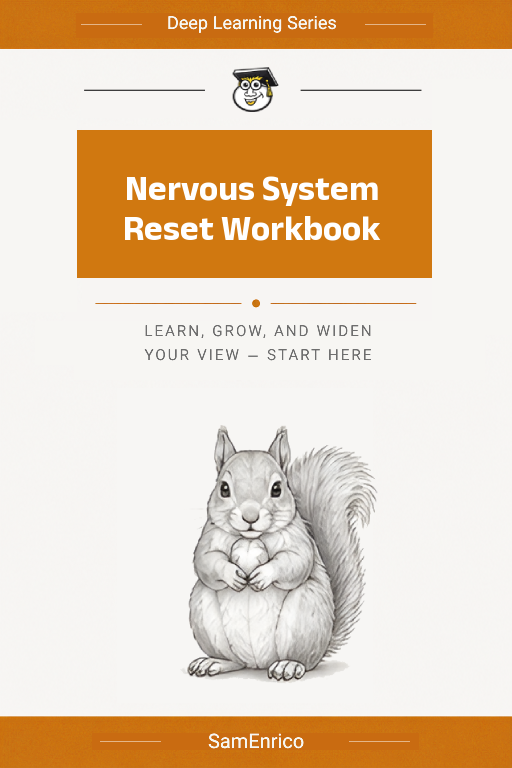
Non-FictionMental WealthPolyvagal Theory
Nervous System Reset Workbook eBook
Apply polyvagal theory with practical exercises to
by Hurst Jeana
Apply polyvagal theory with practical exercises to shift from fight or flight to rest and digest mode.
Formats
Free sample
Chapter 1: The Owner’s Manual You Never Received--–- You’ve tried to relax. You’ve tried deep breathing, positive thinking, meditation apps, and maybe even a glass of wine or a weekend away. And yet, somehow, your body still feels like it’s bracing for impact. Your shoulders live somewhere near your ears. Your jaw aches from clenching.
Your mind races at 2 a.m. over an email you sent six hours ago. You’ve told yourself a thousand times to “just calm down,” but your body refuses to listen. That’s not a personal failure. That’s biology.You are not bad at relaxing.
You are speaking the wrong language.Your brainstem—the ancient part of your nervous system that runs the show behind the scenes—does not understand English. It does not understand logic, reassurance, or New Year’s resolutions. It understands one thing only: sensation. And for years, perhaps decades, no one gave you the owner’s manual for this system. This chapter is that manual.Welcome to the first real conversation you’ll have with your autonomic nervous system (ANS)—the hidden survival computer that has kept your ancestors alive through famines, predators, and wars, and that now keeps you hypervigilant in traffic, anxious in meetings, and exhausted by Sunday night.
By the end of this chapter, you will know exactly why “trying to relax” backfires, what the three main nervous system states are, how to identify which one you live in most of the time, and—most importantly—what a “reset” actually means. You will also learn the single most important mindset shift of this entire workbook: you are not fixing a broken machine. You are learning to offer safety to a brilliant, overprotective guardian.The Great Misunderstanding: Why “Just Relax” Never Works Let’s start with a scene you probably know well. You’re lying in bed at 11:30 p.m. You have an early meeting tomorrow.
You tell yourself, “Okay, relax. Go to sleep. You need rest.” Your heart rate increases. Your mind starts listing everything you forgot to do. By midnight, you’re angry at yourself for not being able to sleep, which makes sleeping even more impossible.
Sound familiar?This is the relaxation paradox. The more you try to force a calm state, the more your nervous system interprets that effort as a threat. Why? Because effort—especially frustrated, self-critical effort—looks a lot like vigilance to your brainstem. And vigilance means danger.Your autonomic nervous system evolved roughly 500 million years ago.
It is older than your thoughts, older than your sense of self, older than language itself. Its only job is survival. It does not care if you feel good. It does not care if you look foolish. It cares about one thing: keeping you alive until tomorrow.When you tell yourself to “calm down,” your thinking brain (the prefrontal cortex) is sending a message to your brainstem.
But your brainstem doesn’t speak words. It speaks neurochemicals, muscle tension, heart rate, and breathing patterns. So when you say “calm down” while your shoulders are up, your jaw is clenched, and your breath is shallow, your brainstem hears a confused signal: “I’m saying calm but my body is braced. That’s inconsistent. Inconsistency means danger.” And then it doubles down on alert.This is not a flaw.
It is a design feature. Your nervous system prioritizes false positives (thinking there’s a threat when there isn’t) over false negatives (missing a real threat). A gazelle that thinks every rustle is a lion lives to see another day. A gazelle that thinks a lion might be a rustle becomes lunch. You are that gazelle.
Your anxiety, your hypervigilance, your inability to “just let go”—these are not bugs. They are survival features running in an environment that no longer matches the one they were built for.The Polyvagal Ladder: Your Three Nervous System States Now let’s map the territory. In the 1990s, Dr. Stephen Porges introduced Polyvagal Theory, which revolutionized our understanding of the autonomic nervous system. Before Porges, most textbooks described the ANS as having two modes: fight-or-flight (sympathetic) and rest-and-digest (parasympathetic).
Porges discovered that the parasympathetic system actually has two distinct branches: an older, more primitive one (dorsal vagal) and a newer, more sophisticated one (ventral vagal). This changes everything.Think of your nervous system as a three-rung ladder. You are always on one rung, and you move down the ladder when threatened, and up the ladder when safe. You cannot skip rungs. You cannot jump from the bottom to the top without passing through the middle.
This is the single most important mechanical fact in this entire workbook.Top Rung: Ventral Vagal (Safety and Connection)This is your home base. When you are in ventral vagal, you feel: calm but alert, socially engaged, curious, flexible, able to think clearly and feel emotions without being overwhelmed. Your voice has natural melody (prosody). Your eye contact is soft. Your middle ears are tuned to the frequency of human speech.
You can digest food, sleep restoratively, and repair tissues. This is the “rest and digest” state you’ve been chasing—except you don’t have to chase it. When you feel truly safe, you land here automatically.The ventral vagal complex is the newest addition to your nervous system in evolutionary terms. It is uniquely mammalian. It connects your brainstem to the muscles of your face, throat, middle ear, and heart.
This is why making eye contact, hearing a soothing voice, or seeing a genuine smile can literally change your heart rate. Your nervous system is designed to be regulated by other nervous systems.Middle Rung: Sympathetic (Mobilization – Fight or Flight)When your neuroception (more on this in Chapter 2) detects a threat—real or imagined—you drop from ventral vagal down to sympathetic. This is the gas pedal. Your heart rate increases. Blood shunts from your digestive organs to your large muscles.
Pupils dilate. Your breathing becomes shallow and fast. You are ready to run or fight. This state feels like: anxiety, irritability, urgency, restlessness, a sense of being “wired,” racing thoughts, muscle tension, jaw clenching, and that feeling of wanting to scream but not knowing why.Here’s the crucial reframe: sympathetic activation is not bad. It is heroic.
It has saved your life more times than you know. The problem is not activation. The problem is stuck activation—when the threat passes but your nervous system stays in the gas pedal. Modern life is full of threats you cannot fight or flee from: critical emails, traffic jams, unpaid bills, passive-aggressive comments. Your body prepares for battle, but the battle never comes.
So the energy stays trapped as chronic tension, irritability, and burnout.Bottom Rung: Dorsal Vagal (Shutdown – Freeze or Collapse)If the sympathetic response fails to resolve the threat—or if the threat is overwhelming—your nervous system drops to the oldest, most primitive rung: dorsal vagal. This is the emergency brake. In the wild, this is the “playing dead” response. A possum doesn’t choose to play dead; its nervous system shuts down motor function to conserve energy and hope the predator loses interest. In humans, dorsal vagal collapse feels…
This is the end of the free sample. Get the eBook to keep going. Buy now
About this book
Details
- Author
- Hurst Jeana
- Publisher
- SamEnrico
- Language
- English
- Genre
- Non-Fiction, Mental Wealth, Polyvagal Theory
- Released
- 2026-06-01
- Pages (approx.)
- 129
- Available as
- eBook, Audiobook

Read better in the ZLOADR app
Your eBooks on your phone or tablet. Sign in with your SamEnrico account and start reading.
More by Hurst Jeana
 Low Earner Benefit BoostHurst Jeana$11.99
 Reconstruction of Underwater Crime ScenesHurst Jeana$11.99
 Jallianwala Bagh MassacreHurst Jeana$11.99
 The Inventory Optimization HandbookHurst Jeana$11.99
 Alabama Capital Punishment FlawsHurst Jeana$11.99
 Method Of Loci For GardeningHurst Jeana$11.99
 Morning Dream Journaling RitualHurst Jeana$11.99
 Pomodoro for Truck DriversHurst Jeana$11.99
 The Timbuktu Scribe: Love Letters in the Golden Age of LearningHurst Jeana$11.99
 The Walls of Xi'an: The Great Architect Who Defied the SteppeHurst Jeana$11.99
 Mastering The QuadricepsHurst Jeana$11.99
 How to Become a Mercury WasherHurst Jeana$11.99
You may also like
 Hong Kong Handover 1997Dunn Johnnie$11.99
 Zumba For Postnatal Recovery CourseNeal Christian$11.99
 Zumba for BeginnersLadner Nikia$11.99
 YouTube Comment Mining GuideHumes Pandora$12.99
 Worry Box MeditationCarlin Rudy$11.99
 Workplace Stress MeditationNguyen Lynn$11.99
 Workplace Stress and Sleep RepairHawley Ivory$11.99
 Workplace Perfectionism CureDelaney Jeffry$11.99
 Workplace Injustice Anger GuideWallen Isabelle$11.99
 Work Addiction and Burnout LinkGreenwood Ester$11.99
 Women in Yoga and WellnessBeattie Galina$11.99
 Women in Stand Up ComedyChun Evangeline$11.99