
Non-FictionSelf-HelpNegotiation
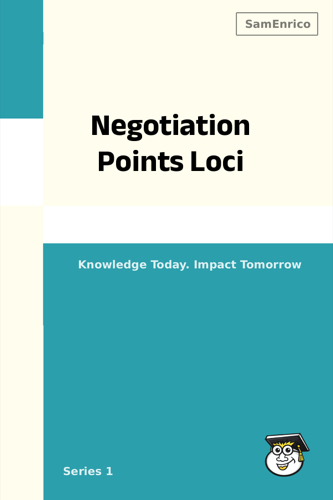
Negotiation Points Loci eBook
Store negotiation talking points and concessions i
by Smalley See
Store negotiation talking points and concessions in memory palace.
Formats
Free sample
Chapter 1: The Broken Clipboard...--–- The conference room was beige. Not the warm, intentional beige of a designer’s choice, but the defeated beige of a building that had given up. Fluorescent lights hummed a frequency designed to erode willpower. Across the table, a vendor named Marcus smiled the smile of someone who had done this a thousand times. On my side of the table, I had three yellow legal pads, four different colored highlighters, a printed concession matrix from my manager, and a growing sense that I was about to lose a lot of money.I was thirty-two years old, six years into a procurement career, and I had prepared for this $12 million software negotiation for three weeks.
I knew the data. I knew the benchmarks. I knew exactly what my walkaway price was. And then Marcus opened his mouth.“We’re looking at $14.5 million,” he said. “But I think we can find some flexibility if you’re willing to move on implementation timelines.”I looked down at my legal pad.
Page one had my opening anchor. Page two had my concession sequence. Page three had my BATNA calculations. In the three seconds it took me to find the right page, Marcus saw it. He saw the hesitation.
He saw the flinch. He saw that I was looking for permission in my own notes.By the end of that meeting, I had accidentally conceded my floor price. Not because I was stupid. Not because I was unprepared. But because I was looking down when I should have been looking up.
I lost $1.8 million in the time it takes to blink twice.That night, I did what any rational professional would do: I blamed my manager for giving me bad guidance. Then I blamed Marcus for being a shark. Then I blamed the conference room for its soul-crushing beige. It took me three days to arrive at the truth: the problem was my clipboard. Not the physical object, but the entire philosophy of preparation it represented.
I had been taught that negotiation preparation meant writing things down. I had been taught wrong.The Cognitive Load Trap Every negotiator faces the same fundamental problem. Your brain has limited working memory. Cognitive psychologists sometimes call this “dual-task interference.” When you try to do two cognitive tasks at the same time, you do both of them worse than if you had done each separately. Reading and listening is dual-task interference.
Writing and thinking is dual-task interference. Flipping through pages while tracking someone’s tone of voice is not multitasking—it is task-switching so fast that you succeed at nothing.Let me give you a number: the average person’s working memory can hold approximately four chunks of information at once. Not forty. Not fourteen. Four.
When you walk into a negotiation with a legal pad full of bullet points, you are not bringing information into your brain. You are outsourcing your memory to paper, which is fine until the moment the paper becomes a liability. And the paper becomes a liability the second you look down at it.Why? Because looking down signals weakness. This is not a metaphor.
It is a hardwired human response. When someone looks away from you during a conversation, your brain interprets it as uncertainty, discomfort, or deception. In negotiation, the person who looks at their notes is the person who is not in control. The person who keeps eye contact while recalling complex numbers and conditional trades is the person who commands attention. The difference between those two postures is not charisma.
It is memory architecture.I learned this the hard way. After the beige conference room disaster, I started recording my negotiations. Not the audio—I recorded my own eye movements. I set up a camera on my laptop during practice negotiations and watched where I looked. In my first recording, I looked down at my notes approximately every eighteen seconds.
In a forty-five minute negotiation, that was roughly one hundred fifty breaks in eye contact. One hundred fifty moments where the other person saw me check out of the conversation. One hundred fifty micro-signals that I was not fully present.The vendors I negotiated against? They looked down an average of three times per meeting. They had internalized something I had not yet learned: the best negotiators do not take notes during the negotiation.
They prepare before, they recall during, and they document after. The negotiation itself is a performance of presence, and presence requires your eyes to be on the other person, not on the page.The Res Distinction: Things, Not Words The ancient Romans had a concept that solves this problem. They called it “res” (pronounced “race”). Res means thing, substance, matter, reality. In classical rhetoric, the Res Distinction was the difference between memorizing the words of a speech and memorizing the ideas behind the words.
A mediocre orator memorized sentences. A great orator memorized arguments. When the great orator stood up to speak, he was not reciting. He was thinking out loud from a memorized architecture of ideas.Negotiation works exactly the same way. When you memorize a script— “If you can offer a twelve-month warranty, then I can consider a five percent price increase”—you are memorizing words.
Words are brittle. Words break under pressure. Words sound rehearsed because they are rehearsed. But when you memorize the res—the underlying structure of the trade, the conditional logic, the relative value of the warranty versus the price—you are free to speak naturally. You are free to adapt.
You are free to sound like a human being who knows what they are talking about.Let me give you a concrete example. In the negotiation I lost, I had prepared a script. It said: “Based on market benchmarks and our internal cost models, we see a reasonable range between $11.2 million and $12.8 million. We would need to see significant movement on implementation support to go above that range.” That script took me twenty minutes to write. I memorized it perfectly.
And then Marcus opened with $14.5 million, and my script became useless. It did not account for his anchor. It did not account for his framing of implementation timelines. It was a beautiful script for a negotiation that was not happening.What I should have memorized was the res. The res of my position was: my walkaway is $11.2 million.
I have $500,000 of flexibility in implementation support. I value payment terms more than delivery speed. Those three facts are the res. They take up almost no mental space. They cannot be shattered by an unexpected opening offer.
And they can be spoken in a thousand different ways, each one appropriate to the moment. That is the power of remembering things instead of words.Why Your Notes Are Lying to You There is a deeper problem with traditional note-taking, one that goes beyond cognitive load and eye contact. Your notes are lying to you because they freeze a negotiation that is inherently fluid. Every concession you write down becomes a commitment, even when it should not be. Every number you circle becomes an anchor, even when circumstances change.
The act of writing creates the illusion of certainty, and certainty is the enemy of good negotiation.I have watched negotiators…
This is the end of the free sample. Get the eBook to keep going. Buy now
About this book
Details
- Author
- Smalley See
- Publisher
- SamEnrico
- Language
- English
- Genre
- Non-Fiction, Self-Help, Negotiation
- Released
- 2026-06-10
- Pages (approx.)
- 132
- Available as
- eBook, Audiobook

Read better in the ZLOADR app
Your eBooks on your phone or tablet. Sign in with your SamEnrico account and start reading.
More by Smalley See
 Veteran Student Stress GuideSmalley See$11.99
 HGH Nail Health IndicatorSmalley See$11.99
 Trauma Informed Dream WorkSmalley See$11.99
 HGH And Insulin SensitivitySmalley See$11.99
 Talking to Teens About Sensitive IssuesSmalley See$11.99
 Post Game Recovery RitualsSmalley See$11.99
 TM for PsychologistsSmalley See$11.99
 Norwegian EV Tax IncentivesSmalley See$11.99
 The Moscow Protocol: The Spy Who Vanished in the Cold War's ShadowSmalley See$11.99
 The Lost City of Yonaguni: Japan’s Sunken Mystery and the Divers Who Uncovered ItSmalley See$11.99
 The Dragon’s Bride: A Slavic Arthurian RomanceSmalley See$11.99
 Exception Handling in Automated WorkflowsSmalley See$12.99
You may also like
 Hong Kong Handover 1997Dunn Johnnie$11.99
 Zumba For Postnatal Recovery CourseNeal Christian$11.99
 Zumba for BeginnersLadner Nikia$11.99
 YouTube Comment Mining GuideHumes Pandora$12.99
 Worry Box MeditationCarlin Rudy$11.99
 Workplace Stress MeditationNguyen Lynn$11.99
 Workplace Stress and Sleep RepairHawley Ivory$11.99
 Workplace Perfectionism CureDelaney Jeffry$11.99
 Workplace Injustice Anger GuideWallen Isabelle$11.99
 Work Addiction and Burnout LinkGreenwood Ester$11.99
 Women in Yoga and WellnessBeattie Galina$11.99
 Women in Stand Up ComedyChun Evangeline$11.99