
Non-FictionSelf-HelpNegotiationBusiness
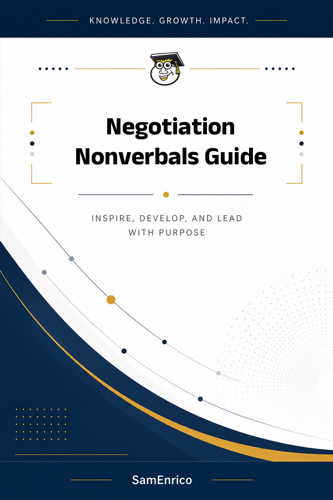
Negotiation Nonverbals Guide eBook
Use silence, posture, and eye contact to gain leve
Use silence, posture, and eye contact to gain leverage in business deals.
Formats
Free sample
Chapter 1: The Silent Opening--The first thirty seconds of any negotiation are played in silence, yet most negotiators arrive already talking—to themselves, to their phones, to their own anxiety—and by the time they reach the handshake, they have already lost leverage they never knew they had.Consider this: You enter a conference room. The other party is already seated. You have not yet said hello. You have not yet stated your position or opened your laptop. And yet, in that wordless interval, the other party has already formed a judgment about your status, your confidence, and your likely willingness to walk away.
They have read your posture as you walked through the door. They have assessed your handshake before your fingers touched. They have scanned your choice of seat and drawn conclusions about whether you are a collaborator or an adversary. You have been negotiating for twenty-two seconds, and you have not spoken a single word.This chapter is about reclaiming those thirty seconds. It is about transforming the silent opening from a period of unconscious leakage into a deliberate sequence of leverage-building moves.
By the end of this chapter, you will understand exactly how to sit, stand, enter, shake, and position yourself before the first verbal offer is made—and why these nonverbal choices often determine the final number more than anything said across the table.The Science of First Impressions in Negotiation Before we examine specific techniques, we must understand why the silent opening carries such disproportionate weight. Research on thin-slice judgments—first described by psychologists Nalini Ambady and Robert Rosenthal—demonstrates that people form stable impressions of others within milliseconds of exposure. In negotiation contexts specifically, a 2015 study published in the Journal of Applied Psychology found that observers could predict the outcome of mock negotiations with above-chance accuracy after watching only thirty seconds of silent video showing the parties entering the room and taking their seats. The predictors were not verbal. They were postural.Why does this happen?
Cognitive science offers an explanation rooted in evolutionary psychology. The human brain is wired to assess threat and status instantly because survival once depended on it. When you enter a negotiation room, the other party's amygdala—the brain's rapid threat-detection system—activates before their prefrontal cortex (responsible for rational analysis) has fully engaged. In those first seconds, they are not evaluating your argument. They are evaluating whether you are predator or prey.
Every nonverbal signal you emit during the silent opening is filtered through this ancient lens.This creates both danger and opportunity. The danger is that unconscious habits—slouching, hesitating, fidgeting, averting your gaze—will trigger a low-status classification before you have a chance to demonstrate your competence. The opportunity is that deliberate, practiced nonverbal behaviors can trigger a high-status classification that predisposes the other party to make more favorable opening offers and larger concessions.The silent opening is not a waiting period before the real negotiation begins. It is the first phase of the negotiation itself. Treat it as such.Pre-Negotiation Posture: How You Sit Before They Enter Most negotiators arrive early to a meeting room and immediately begin reviewing notes, checking email, or scrolling their phones.
This is a costly mistake. The moment before the other party enters is not downtime. It is your opportunity to establish a baseline posture that will communicate status the instant the door opens.The key concept here is open versus closed posture as a status signal. Open posture—shoulders back, arms uncrossed, hands visible, chest slightly expanded—signals confidence, transparency, and high status. Closed posture—shoulders rolled forward, arms crossed or hands hidden, chest compressed—signals defensiveness, anxiety, and low status.
The difference is not subtle. Research from social psychologist Amy Cuddy's lab at Harvard demonstrated that even two minutes of open posture significantly increases testosterone (the dominance hormone) and decreases cortisol (the stress hormone), while closed posture produces the opposite effect. Your posture does not just signal your status to others. It changes your status internally.When you sit alone before the other party enters, adopt what I call the Pre-Entry Anchor. Sit at the head of the table if no designated seats exist.
Place your hands on the table, not in your lap or under the table. Keep your feet flat on the floor, shoulder-width apart. Avoid crossing your legs, which reduces your perceived stability. Angle your torso slightly toward the door so that when the other party enters, you are already oriented toward them without needing to swivel abruptly. Abrupt movements signal surprise or nervousness.
Deliberate, slow movements signal control.If you must review documents before the meeting, do so standing or with your posture deliberately expanded. Never hunch over a phone or tablet. The image you project in those solitary seconds—even if no one is watching yet—will affect your own hormonal state, which in turn affects your voice, your facial expressions, and your willingness to take risks once the negotiation begins.The Entrance: Decisive Stride vs. Hesitant Shuffle The moment the door opens, the negotiation enters its most visible phase. How you move from standing to seated—the transition—is surprisingly revealing.
Negotiators who hesitate, check their phone one last time, or stand uncertainly while waiting to be invited to sit unconsciously signal that they are guests, not equals. Negotiators who move decisively—rising smoothly, stepping forward with purpose, selecting a seat without hesitation—signal that they belong at the table.The key is decisive stride. When you enter a room where the other party is already seated, walk directly to your chosen seat without pausing, circling, or asking where to sit. Your path should be straight, your pace steady (neither rushed nor dragging), and your gaze directed at the other party's face or the seat itself—not at the floor, your phone, or the ceiling. Hesitation in movement is interpreted as hesitation in conviction.
If you cannot commit to a chair, the other party will assume you cannot commit to a position.What if you are already seated when the other party enters? In that case, your task is to rise to greet. Never remain seated when someone enters your space for a negotiation. The seated party signals dominance only in very specific contexts (a judge on a bench, a CEO behind a desk). In a negotiation room, remaining seated when the other party enters signals disrespect or social ineptitude, neither of which helps your leverage.
Rise smoothly, step around the table if necessary, and greet them at standing height before gesturing to their seat.A note on timing: If you arrive first, use the waiting period to adopt your Pre-Entry Anchor. If you arrive second, do not stand awkwardly in the doorway. Enter immediately, move to your seat, and sit. The pause in the doorway—that moment of visible uncertainty—is one of the most damaging nonverbal leaks in negotiation. It reads as, "I am not sure I belong here." Never show that uncertainty.
Enter as if you own the room, even if you do not.The Handshake as Leverage: Opening Moves Only The handshake is the most scrutinized nonverbal behavior in business, yet most people shake hands reflexively, without strategy. This…
This is the end of the free sample. Get the eBook to keep going. Buy now
About this book
Details
- Author
- Bentley Julieta
- Publisher
- SamEnrico
- Language
- English
- Genre
- Non-Fiction, Self-Help, Negotiation, Business
- Released
- 2026-06-08
- Pages (approx.)
- 148
- Available as
- eBook, Audiobook

Read better in the ZLOADR app
Your eBooks on your phone or tablet. Sign in with your SamEnrico account and start reading.
More by Bentley Julieta
 Rapid Fire Conversation StartersBentley Julieta$11.99
 Des Plaines Discovery GuideBentley Julieta$11.99
 The Strength Training for RunnersBentley Julieta$11.99
 The Damascus Poisoner: A Trial of Madness in Ottoman Syria (1858)Bentley Julieta$11.99
 EducatorBentley Julieta$11.99
 Learn to Play the TubaxBentley Julieta$11.99
 Lately AI Social CopywritingBentley Julieta$12.99
 How to Start a Carnival Article Business (Beginners Guide)Bentley Julieta$11.99
You may also like
 Hong Kong Handover 1997Dunn Johnnie$11.99
 Zumba For Postnatal Recovery CourseNeal Christian$11.99
 Zumba for BeginnersLadner Nikia$11.99
 YouTube Comment Mining GuideHumes Pandora$12.99
 Worry Box MeditationCarlin Rudy$11.99
 Workplace Stress MeditationNguyen Lynn$11.99
 Workplace Stress and Sleep RepairHawley Ivory$11.99
 Workplace Perfectionism CureDelaney Jeffry$11.99
 Workplace Injustice Anger GuideWallen Isabelle$11.99
 Work Addiction and Burnout LinkGreenwood Ester$11.99
 Women in Yoga and WellnessBeattie Galina$11.99
 Women in Stand Up ComedyChun Evangeline$11.99