
Non-FictionBusiness BriefHigh Stakes
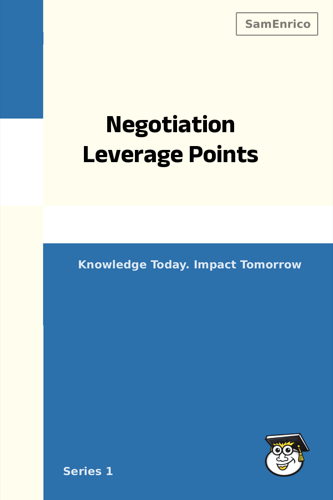
Negotiation Leverage Points eBook
Teaches using reciprocity and scarcity in high sta
Teaches using reciprocity and scarcity in high stakes deals.
Formats
Free sample
Chapter 1: The Gift Before the Ask...--The merger was dead. Everyone at the table knew it. Two billion-dollar companies had spent eleven weeks negotiating, and they were further apart than when they started. The seller wanted $1.2 billion. The buyer was stuck at $950 million.
Lawyers had stopped taking notes. Principals had stopped making eye contact. The only thing moving was the coffee cups, pushed in small, frustrated circles across the polished mahogany.Then something unexpected happened.The lead negotiator for the buyer reached into his briefcase and pulled out a single sheet of paper. It was not a revised offer. It was not a legal threat.
It was a detailed analysis of the seller's biggest operational headache—a supply chain bottleneck that had been costing them $40 million annually for three years. The buyer's team had spent two weeks modeling the problem, and this sheet contained a solution. No charge. No strings. No request attached.He slid it across the table."I thought you might find this useful," he said.
"We have our own analysts, and they enjoy a good puzzle. Anyway, back to the price."Twenty minutes later, the seller moved to $1.15 billion.By the end of the day, the deal closed at $1.1 billion—a $150 million concession from the seller's original position, all unlocked by a piece of paper that cost the buyer's team perhaps $8,000 in analytical time. The buyer's negotiator had not applied pressure. He had not threatened to walk away. He had not cited market comps or invoked legal clauses.
He had simply given something first.And the seller, without realizing it, felt that he now owed something in return.This is the hidden architecture of high-stakes deals. It is not about who has the bigger bank account, the stronger BATNA, or the more aggressive legal team. It is about who understands that leverage is not power—it is psychology. And the two most powerful psychological levers in human negotiation are not taught in MBA programs, not because they are secret, but because they are so deeply wired into our brains that we use them without understanding them. Reciprocity: the crushing weight of a favor returned.
Scarcity: the terror of an opportunity lost.This book is about those two levers. But before we pull them, we need to understand why everything you have been taught about negotiation is built on a foundation of sand.The Myth of Rational Leverage Walk into any business school negotiation class, and you will hear the same vocabulary. BATNA. Reservation price. ZOPA.
Anchoring. These are useful tools, but they share a fatal assumption: that the people across the table are rational actors who process information logically and make decisions based on self-interested calculation.They are not. And you are not either.The human brain did not evolve to maximize deal value. It evolved to survive on the savanna. And on the savanna, two things mattered more than anything else: reciprocal obligation (you share food today, I save your life tomorrow) and resource scarcity (the watering hole is shrinking, so drink now or die).
These impulses are not quaint evolutionary leftovers. They are the operating system of the human social brain. Every negotiation you will ever enter is running on that operating system, whether you know it or not.Consider the evidence. In one study, researchers asked strangers to rate the attractiveness of a set of photographs. Simple enough.
But before the rating task, an assistant—actually a confederate of the researchers—left the room and returned with two soft drinks. One was offered to the participant. The other was kept for himself. This small, unsolicited gift, worth perhaps fifty cents, increased the participant's willingness to buy raffle tickets from the assistant later by 200 percent. Not because the participants were calculating the value of the soda.
Because their brains had registered a debt, and the only way to clear that debt was to reciprocate.In another study, participants were offered a choice between two chocolate chip cookies. The cookies were identical. They had been baked from the same batch, on the same tray, at the same temperature. The only difference was the jar they came from. One jar held ten cookies.
The other jar held two cookies. Participants rated the cookie from the nearly empty jar as significantly more desirable—more flavorful, more valuable, more worth paying for—than the identical cookie from the abundant jar. The scarcity did not change the cookie. It changed the brain's perception of the cookie.These are not laboratory curiosities. They are the same mechanisms that drive billion-dollar merger outcomes, real estate bidding wars, and salary negotiations that determine the trajectory of careers.
And yet, the vast majority of negotiators enter high-stakes conversations armed only with spreadsheets and walk-away numbers, completely blind to the psychological architecture that will actually determine the outcome.This book is the correction.The Leverage Points Model The central framework of this book could not be simpler. It rests on a single claim: every negotiation, regardless of industry, dollar amount, or cultural context, is shaped by two primary psychological forces. Everything else—anchoring, framing, mirroring, labeling, even the famous "never split the difference"—is a secondary amplifier. The two primary forces are:Reciprocity: The automatic, involuntary, physically uncomfortable need to return a favor, match a concession, or repay a debt. Reciprocity is why salespeople give you free pens.
It is why charities send address labels with their fundraising letters. It is why, in the merger story that opened this chapter, the seller moved $150 million after receiving an unsolicited gift of analytical work. The gift created a debt. The debt demanded repayment. The repayment was called a concession.Scarcity: The panic-driven, dopamine-flooded, cortisol-spiked terror of losing access to something desirable.
Scarcity is why limited-time offers work. It is why "only three left in stock" triggers an immediate purchase. It is why, in real estate, a single "other offer" can drive a bidding war that pushes prices twenty percent above asking. The possibility of loss overrides the calculation of gain. Every time.These two forces are not techniques you can choose to use or ignore.
They are evolutionary adaptations that predate human language, human reason, and human civilization. You cannot negotiate with them. You cannot argue someone out of a reciprocity obligation any more than you can argue someone out of feeling hungry. You cannot persuade someone that a scarce opportunity is not actually valuable any more than you can persuade them that water is not wet.This is the Leverage Points Model. Two inputs.
One output: psychological willingness to concede.Most negotiators spend their careers accumulating power—money, alternatives, legal standing, organizational authority. They believe that leverage is something you have or you do not have. They are wrong. Leverage is something you create. And you create it by triggering reciprocity and scarcity in the mind of the person across the table.The Positional Bargaining Trap To understand why the Leverage Points Model is so powerful, you must first understand what it replaces.
Positional bargaining is the default negotiation strategy of the rational actor. It goes like this:You state a position. "I want $100."The other party states a position. "I will pay $50."You argue. You cite…
This is the end of the free sample. Get the eBook to keep going. Buy now
About this book
Details
- Author
- Grigsby Simona
- Publisher
- SamEnrico
- Language
- English
- Genre
- Non-Fiction, Business Brief, High Stakes
- Released
- 2026-06-05
- Pages (approx.)
- 130
- Available as
- eBook, Audiobook

Read better in the ZLOADR app
Your eBooks on your phone or tablet. Sign in with your SamEnrico account and start reading.
More by Grigsby Simona
 Teacher Student Name GuideGrigsby Simona$11.99
 Monaco Grand Prix GloryGrigsby Simona$11.99
 Self Esteem for EczemaGrigsby Simona$11.99
 Grover Cleveland GuideGrigsby Simona$11.99
 Acupuncture Cessation SupportGrigsby Simona$11.99
 Mendeleev Chemical Industry PioneerGrigsby Simona$11.99
 Divorce Social Media GuideGrigsby Simona$11.99
 The Silent Witness: The Unsolved Murder of Anna Andersen and the Rise of Forensic ScienceGrigsby Simona$11.99
 Riders of the Red HorizonGrigsby Simona$11.99
 How to Produce Sheet MusicGrigsby Simona$11.99
 How to Setup and Launch a Family DinnerGrigsby Simona$11.99
 How to Become a Cotton-ball-machine TenderGrigsby Simona$11.99
You may also like
 Hong Kong Handover 1997Dunn Johnnie$11.99
 Zumba For Postnatal Recovery CourseNeal Christian$11.99
 Zumba for BeginnersLadner Nikia$11.99
 YouTube Comment Mining GuideHumes Pandora$12.99
 Worry Box MeditationCarlin Rudy$11.99
 Workplace Stress MeditationNguyen Lynn$11.99
 Workplace Stress and Sleep RepairHawley Ivory$11.99
 Workplace Perfectionism CureDelaney Jeffry$11.99
 Workplace Injustice Anger GuideWallen Isabelle$11.99
 Work Addiction and Burnout LinkGreenwood Ester$11.99
 Women in Yoga and WellnessBeattie Galina$11.99
 Women in Stand Up ComedyChun Evangeline$11.99