
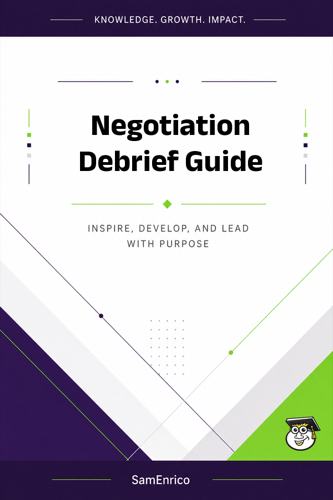
Non-FictionBusiness BriefAfter Action
Negotiation Debrief Guide eBook
Analyzes past deals to improve future principled p
Analyzes past deals to improve future principled performance.
Formats
Free sample
Chapter 1: The Silence After Victory--The conference room smelled like stale coffee and defeated ambition. Fifteen people sat around a polished mahogany table, each one carefully avoiding eye contact with the woman at the head. She had just lost a $47 million deal—the largest in her company's history—and everyone knew it. The CEO had flown in from headquarters. The regional vice president had cleared his calendar.
The legal team had prepared three versions of the contract. And yet, the client had signed with a competitor two hours ago.For the next forty-five minutes, no one spoke about what had actually happened. They talked about the weather in Chicago, where the client was based. They talked about the upcoming quarterly earnings call. They talked about the new coffee machine in the break room.
They talked about everything except the $47 million that had just evaporated.Finally, the CEO stood up. "Tough loss," he said. "We'll get the next one." He walked out. The meeting ended. The team dispersed.
And the lessons from that $47 million disaster—the miscalculated assumptions, the missed signals, the emotional triggers that no one had managed—walked out with them, never to be examined, never to be learned, never to be applied to the next deal.This scene plays out thousands of times every day in conference rooms around the world. A deal closes—win or lose—and the team immediately moves on. The celebration of a victory or the mourning of a defeat becomes the final act. But the most important act, the one that separates average negotiators from world-class performers, never happens.This book exists to ensure that you never let another $47 million walk out of your conference room.The Problem That No One Talks About The post-completion trap is one of the most well-documented but least discussed phenomena in organizational psychology. When humans complete a significant goal—whether winning a contract, closing a sale, or simply finishing a project—their brains release a cocktail of neurochemicals that includes dopamine (reward satisfaction), serotonin (mood elevation), and endorphins (pain relief).
This feels wonderful. It also makes you stupid.Research from the Journal of Experimental Psychology found that individuals who experienced a post-goal dopamine spike were 40 percent less likely to engage in reflective analysis than those who had not yet achieved their goal. In plain English: success makes you stop thinking. Your brain literally rewards you for moving on rather than looking back.The pharmaceutical sales team from the introduction didn't lose that $50 million contract once. They lost it three times.
The first loss was painful but understandable—a new competitor had entered the market. The second loss, eighteen months later, was to the same competitor. The third loss, another year after that, followed an identical pattern. When a consultant finally interviewed the team, she discovered that no one had ever conducted a post-loss debrief. Not once.
The lead negotiator had been promoted after the first loss (ironically, for "managing a difficult situation professionally"), and his replacement had no idea that the pricing mistake that cost them the first deal was the same mistake that would cost them the third.This is the repetition tax. It is the hidden cost of making the same negotiation error twice, three times, or—in the case of one financial services firm the author studied—eleven times over seven years. The repetition tax is not just the value of the lost deals. It is the cumulative cost of eroded confidence, damaged team morale, and the slow normalization of failure. When you lose the same way twice, you aren't just losing money.
You are teaching your team that learning doesn't matter.Why Most Debriefs Fail Before They Start Before we can build a system for learning, we must understand why most debriefs are worthless. The author has analyzed over two hundred post-negotiation debriefs across forty organizations. The results are sobering. Only 12 percent of debriefs produced actionable insights that changed future behavior. The remaining 88 percent fell into one of three failure modes.The first failure mode is the Blame Game.
In these debriefs, the team spends the entire time assigning responsibility for what went wrong. "You should have asked about their budget." "You were too aggressive on the pricing call." "You didn't loop in legal early enough." The Blame Game feels productive because it identifies problems, but it identifies them in a way that makes everyone defensive. Research from Stanford psychologist Carol Dweck shows that blame-oriented feedback triggers a fixed mindset—the belief that abilities are static and failures reveal inherent flaws. In a fixed mindset, people hide mistakes rather than learn from them. The Blame Game doesn't produce better negotiators.
It produces better liars.The second failure mode is the Whitewash. This is the opposite of the Blame Game. In a Whitewash, the team collectively agrees that everything went well, that the outcome was beyond their control, and that no significant changes are needed. Whitewashes are most common after wins, especially large ones. The logic seems sound: why mess with success?
But as we will see in Chapter 2, a win can be the most dangerous outcome of all because it reinforces bad processes. The Whitewash feels good, but it plants the seeds of future failure.The third failure mode is the Vortex. In these debriefs, the team generates dozens of insights but never translates them into action. The whiteboard fills with observations. The conversation is rich and nuanced.
Everyone feels smart. And then the meeting ends, the whiteboard is erased, and nothing changes. The Vortex is the most insidious failure mode because it creates the illusion of learning without the reality of behavior change.Every one of these failure modes can be traced to a single root cause: the absence of psychological safety. Psychological safety is the belief that you will not be punished or humiliated for speaking up with ideas, questions, concerns, or mistakes. It is not about being nice.
It is about being honest. And without it, your debrief will produce either blame, silence, or empty insight.The Google Study That Changed Everything Between 2012 and 2015, Google conducted one of the largest studies of team effectiveness ever attempted, codenamed Project Aristotle. The research team analyzed 180 internal teams, conducted over 200 interviews, and reviewed more than 250 academic papers. They wanted to know what separated Google's highest-performing teams from its average ones.The answer surprised everyone. It wasn't the intelligence of team members.
It wasn't their experience or their educational background. It wasn't even the clarity of their goals. The single strongest predictor of team performance was psychological safety. Teams where members felt safe to take risks, admit mistakes, and challenge ideas outperformed teams without psychological safety by a staggering margin. They generated more revenue, solved problems faster, and—most relevant to this book—learned from their failures more effectively.Project Aristotle also identified five specific behaviors that create psychological safety in a team setting.
Each of these behaviors is directly applicable to the negotiation debrief.The first behavior is frame work as learning, not execution. Teams that view their work as an ongoing experiment rather than a series of executions are more likely to share information about what isn't working. In a negotiation debrief, this means…
This is the end of the free sample. Get the eBook to keep going. Buy now
About this book
Details
- Author
- Bateman Valarie
- Publisher
- SamEnrico
- Language
- English
- Genre
- Non-Fiction, Business Brief, After Action
- Released
- 2026-06-08
- Pages (approx.)
- 134
- Available as
- eBook, Audiobook

Read better in the ZLOADR app
Your eBooks on your phone or tablet. Sign in with your SamEnrico account and start reading.
More by Bateman Valarie
 Legacy Through ScienceBateman Valarie$11.99
 Social Media Baby ComparisonBateman Valarie$11.99
 Spouse Sobriety Partnership GuideBateman Valarie$11.99
 The Peg System for MemoryBateman Valarie$11.99
 Notion Linked Databases Across PagesBateman Valarie$11.99
 Family HIIT Together GuideBateman Valarie$11.99
 Divorce and WritingBateman Valarie$11.99
 Excalibur’s Lost Heir: The Forgotten Knight of the Round TableBateman Valarie$11.99
 The Kings of the North: Viking Expansion and the Birth of European TradeBateman Valarie$11.99
 AI Press Release Production WorkbookBateman Valarie$12.99
 Gaslighting Boss Recognition GuideBateman Valarie$12.99
 How to Produce Motorcycle Alarms and LocksBateman Valarie$11.99
You may also like
 Hong Kong Handover 1997Dunn Johnnie$11.99
 Zumba For Postnatal Recovery CourseNeal Christian$11.99
 Zumba for BeginnersLadner Nikia$11.99
 YouTube Comment Mining GuideHumes Pandora$12.99
 Worry Box MeditationCarlin Rudy$11.99
 Workplace Stress MeditationNguyen Lynn$11.99
 Workplace Stress and Sleep RepairHawley Ivory$11.99
 Workplace Perfectionism CureDelaney Jeffry$11.99
 Workplace Injustice Anger GuideWallen Isabelle$11.99
 Work Addiction and Burnout LinkGreenwood Ester$11.99
 Women in Yoga and WellnessBeattie Galina$11.99
 Women in Stand Up ComedyChun Evangeline$11.99