
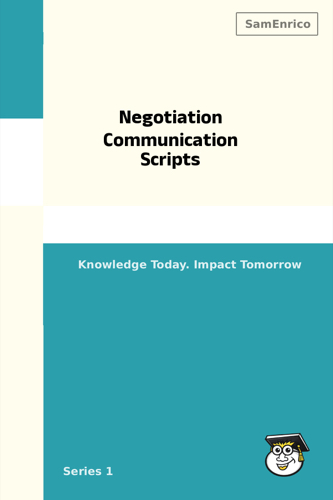
Negotiation Communication Scripts eBook
Provides word for word principled responses to har
by Riggs Lahoma
Provides word for word principled responses to hard bargaining.
Formats
Free sample
Chapter 1: The Fortress Before the Fight--Most people begin negotiating the moment the other person starts talking. That is their first mistake. By the time you hear the words “Your price is too high” or “That’s my final offer,” the battle is already underway, and you are playing defense on their home field. You are reacting. And reaction, in the world of hard bargaining, is the closest cousin to defeat.This chapter is going to teach you something radically different.
You are going to learn how to build a fortress before the first arrow is ever loosed. You are going to establish a social contract in the first sixty seconds of any negotiation that will prevent most dirty tactics from ever appearing. No anchoring. No nibbling. No personal attacks.
No good cop, bad cop. No silent walkaways. Because you will have already agreed—out loud, face to face—that those behaviors are off the table.This is not theory. This is not wishful thinking. This is a tested, repeatable script drawn from behavioral psychology, game theory, and the world’s most successful negotiation methodologies.
It synthesizes the pre-commitment strategies of Thomas Schelling, the reciprocity principles of Robert Cialdini, and the principled negotiation framework of Fisher and Ury into fifteen seconds of spoken words that will change everything about how you negotiate.Let me tell you about Maria.Maria was a procurement director for a mid-sized manufacturing company. She was tasked with negotiating a three-year supply contract for raw materials worth nearly four million dollars annually. The supplier was a large, aggressive firm with a reputation for playing hardball. Their lead negotiator was a man named Derek—the composite antagonist you will meet throughout this book—who had built his career on extracting concessions through intimidation, anchoring, and the strategic use of silence.In their first meeting, Derek walked into the conference room, threw his notebook on the table, and said, “Let’s make this quick. What’s your budget?”This is the anchor drop.
Derek was trying to force Maria to name a number first, locking her into a low anchor before any substantive discussion had occurred. Most people would have flinched. They would have said something like, “Well, we were hoping for around two dollars per unit,” and Derek would have won in the first thirty seconds. The rest of the negotiation would have been a slow, painful march toward his preferred outcome.But Maria had read this chapter. She smiled.
She did not answer the question. Instead, she sat down slowly, placed her notebook on the table, and said, “Before we get into numbers, I want to make sure we have a productive conversation. Let’s agree on three things. No personal attacks. No last-minute changes.
And if we hit a wall, we take a ten-minute break instead of walking out. Deal?”Derek blinked. He was not expecting this. He was prepared to anchor, to bogey, to nibble, to deploy the full dirty dozen. He was not prepared to agree to rules.
But refusing to agree would have made him look unreasonable. So he said, “Fine. Deal.”For the next forty-five minutes, Derek was strangely polite. He tried to anchor once, and Maria simply said, “Remember our rule? Let’s focus on the terms.” Derek backed down.
He tried a small nibble at the end, asking for free shipping on the first shipment. Maria said, “We agreed to no last-minute changes.” Derek dropped it. He tried to escalate, raising his voice and saying, “This is ridiculous. You’re being impossible.” Maria said, “We agreed to call a break instead of a tantrum. Let’s take ten minutes.” She stood up and walked to the restroom.
When she returned, Derek was calm.Maria saved her company over eight hundred thousand dollars on that contract. Not because she was a better tactical negotiator on price—Derek had twenty years of experience on her. She won because she changed the rules of the game before price was ever discussed.That is the power of the fortress.THE SCRIPTThe script is short. This is intentional. Long scripts sound rehearsed and defensive.
Short scripts sound confident and reasonable. You will deliver this script in the first sixty seconds of any negotiation where you anticipate hard bargaining or where the relationship matters. For one-off, low-stakes transactions—a garage sale, a used car from a stranger, a single e Bay purchase—you may skip this chapter and proceed to the tactic-specific responses later in the book. But for any negotiation involving an ongoing relationship, significant money, or high emotional stakes, you will use this script.Here it is. Memorize it.
Practice it. Own it.“I want us to get a great deal for both of us. To do that, let’s agree on three things before we start. No personal attacks. No last-minute nibbles.
And if we hit a wall, we call a ten-minute break, not a tantrum. Deal?”That is it. Fifteen seconds. Four sentences. Three rules.
One question.Let me break down each component so you understand not just what to say, but why it works.“I want us to get a great deal for both of us.” This opening sentence does two critical things. First, it establishes your good faith. You are not adversarial. You are not trying to “win” at their expense. You are looking for mutual gain.
This is the language of principled negotiation, drawn directly from Fisher and Ury’s “Getting to Yes,” the foundational text of modern negotiation theory. By stating your desire for a mutually beneficial outcome, you signal that you are not their enemy. You are their partner in creating value.Second, this sentence subtly signals that you expect a deal. You are not negotiating to see what happens. You are negotiating to close.
That expectation creates forward momentum. It frames the conversation as a problem-solving exercise rather than a battle. Hard bargainers thrive on battle. They struggle with collaboration.“To do that, let’s agree on three things before we start.” This sentence frames the agreement as a collaborative tool, not a demand. You are not telling them what to do.
You are proposing a shared structure. The word “agree” is critical. You are asking for their consent, not imposing your will. This reduces defensiveness. If you had said, “Here are my rules,” they would have pushed back.
By saying, “Let’s agree,” you invite them into the process.“No personal attacks.” This is the first rule. Hard bargainers often attack your competence, your ethics, or your logic to put you on the defensive. They say things like, “You’re being unreasonable,” or “I expected better from someone with your experience,” or “That’s not how professionals behave.” These attacks trigger your amygdala, the brain’s fear center, and cause you to make concessions to prove you are “reasonable.”Chris Voss, the former FBI hostage negotiator, calls this “tactical empathy”—the ability to recognize and label your counterpart’s emotions without adopting them. But tactical empathy is a response to an attack. The pre-negotiation contract prevents the attack entirely.
By agreeing to no personal attacks upfront, you have a pre-existing standard to point to when they cross the line.…
This is the end of the free sample. Get the eBook to keep going. Buy now
About this book
Details
- Author
- Riggs Lahoma
- Publisher
- SamEnrico
- Language
- English
- Genre
- Non-Fiction, Business Brief, Scripts
- Released
- 2026-06-09
- Pages (approx.)
- 145
- Available as
- eBook, Audiobook

Read better in the ZLOADR app
Your eBooks on your phone or tablet. Sign in with your SamEnrico account and start reading.
More by Riggs Lahoma
 Emotional Sobriety Training ManualRiggs Lahoma$11.99
 The Story Method MemoryRiggs Lahoma$11.99
 The Shame Prism ModelRiggs Lahoma$11.99
 Social Media Home ComparisonRiggs Lahoma$11.99
 Legacy Through CommunityRiggs Lahoma$11.99
 Hotel Room HIIT GuideRiggs Lahoma$11.99
 Divorce and NatureRiggs Lahoma$11.99
 The Shadow of the Golden Triangle: Mexico's First Narco-WarlordRiggs Lahoma$11.99
 The Harp of Ishtar: Divine Melodies of the Mesopotamian GoddessRiggs Lahoma$11.99
 Generative AI Case Study GuideRiggs Lahoma$12.99
 Co Founder Online Communities ListRiggs Lahoma$12.99
 A Collector's Handbook to the Riley 2½-litre RmcRiggs Lahoma$11.99