
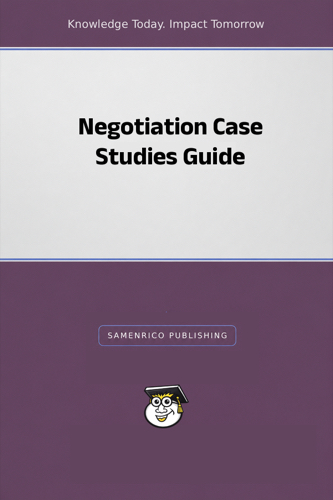
Negotiation Case Studies Guide Audiobook
Analyzes real world deals through getting to yes f
by Kruse Marlyn
Analyzes real world deals through getting to yes framework.
Formats
Free sample
Chapter 1: The Harbor Audit...--–- On a humid morning in July 1983, Charles Susskind walked into a windowless conference room in Boston where forty-three lawyers representing the Metropolitan District Commission and a coalition of cities were ready to tear each other apart. The room smelled of stale coffee and desperation. The Boston Harbor, once a source of colonial pride, had become a national embarrassment—so polluted that swimmers risked hepatitis, fishermen pulled up deformed lobsters, and the stench of raw sewage drifted across the waterfront during summer heatwaves. The Environmental Protection Agency had sued everyone in sight. The judge had ordered mandatory mediation.
And after eighteen months of positional warfare, the parties had spent more on legal fees than on actual cleanup planning.Susskind, a little-known mediator from the Harvard Negotiation Project, did not open with a speech about collaboration. He did not distribute a proposed settlement. Instead, he asked each side to write down, on a single sheet of paper, three things: what they wanted, why they wanted it, and what would happen if no deal was reached. That simple act—separating demands from motivations—would transform a $6 billion environmental disaster into one of the most celebrated negotiated agreements in American history. It would also demonstrate, in real time, the four pillars of principled negotiation that this chapter will teach you.This is not a book about negotiation theory.
It is a book about what happens when theory meets pressure—when millions of dollars, political careers, environmental justice, and human dignity hang in the balance. Chapter 1 introduces the foundational audit that every negotiator must run before opening their mouth: the diagnostic framework from Getting to Yes that separates professionals who create value from amateurs who fight over scraps. You will learn why hard bargaining fails in complex deals, how to diagnose your own default negotiation style, and why the Boston Harbor cleanup succeeded where a thousand other environmental lawsuits failed. By the end of this chapter, you will have a personalized negotiation audit tool that you can apply to your next high-stakes conversation—whether you are mediating a corporate merger, negotiating a salary, or resolving a family dispute.The Collapse of Positional Bargaining Before we examine what worked in Boston Harbor, we must first understand why traditional negotiation fails in complex, multi-party, long-term deals. Most professionals learn to negotiate through a combination of instinct, mimicry, and painful experience.
Their default approach is what Fisher and Ury call positional bargaining—the art of staking a claim, defending it, conceding incrementally…
This is the end of the free sample. Get the Audiobook to keep going. Buy now
About this book
Details
- Author
- Kruse Marlyn
- Publisher
- SamEnrico
- Language
- English
- Genre
- Non-Fiction, Business Brief, Case Studies
- Released
- 2026-06-10
- Pages (approx.)
- 157
- Available as
- eBook, Audiobook

Listen in the VoxFlicks app
Audiobooks and audio dramas wherever you go. Sign in with your SamEnrico account and press play.
More by Kruse Marlyn
 Social Media Academic ComparisonKruse Marlyn$11.99
 Alcohol Relapse Emergency KitKruse Marlyn$11.99
 Legacy Through SportsKruse Marlyn$11.99
 Virtual HIIT Class GuideKruse Marlyn$11.99
 The Sleep Memory ConsolidationKruse Marlyn$11.99
 Divorce and PetsKruse Marlyn$11.99
 The Fear of Speaking Up WorkbookKruse Marlyn$11.99
 The Dragon Tamer of Carpathia: A Beastiary of WondersKruse Marlyn$11.99
 The Blue Sky Scandal: How a Wall Street Fraudster Fleeced AmericaKruse Marlyn$11.99
 How to Produce Machinery Parts Processing ServicesKruse Marlyn$11.99
 Growing BelamcandaKruse Marlyn$11.99
 How to Produce Motorcycle Chest and Back ProtectorsKruse Marlyn$11.99
You may also like
 Property Management Success StoriesEnnis Laronda$11.99
 Empowerment Success StoriesDoan Sarina$11.99
 Remote Productivity Case StudiesEspinosa Pennie$11.99
 Case Study Persuasion FrameworkMcmahon Catarina$11.99
 Business Plan Executive Summary Examples WorkbookCrenshaw Jessenia$11.99
 Franchising Your Local Brand Across Borders Success StoriesYork Odell$11.99
 Pop Up Retail Success StoriesLacey Karine$12.99
 Small Business AI Accounting Case StudiesCoyle Lona$12.99
 Non Resident LLC Formation Case StudiesStrain Jenell$12.99
 Remote Hiring Mistakes Case StudiesEckert Astrid$12.99
 Payment Success Stories Africa GuideLevine Suzie$12.99
 Bank API Success StoriesOlivas Eldridge$12.99