
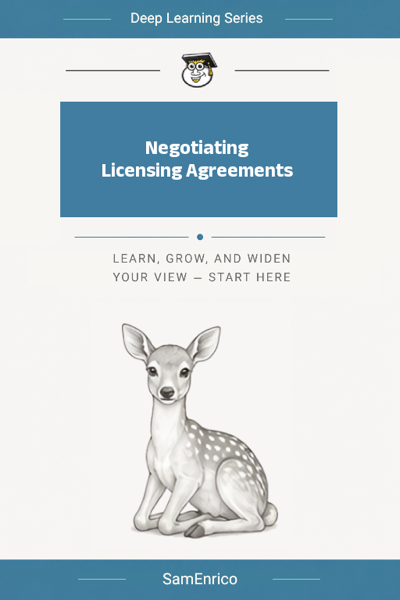
Non-FictionInformativeEducational
Negotiating Licensing Agreements eBook
A Coursebook on Negotiating Licensing Agreements
A Coursebook on Negotiating Licensing Agreements
Formats
Free sample
Chapter 1: The Invisible Trap--– Most licensing disputes do not begin with a lie, a theft, or a betrayal. They begin with a sentence that sounds perfectly reasonable at the signing table: “We’ll figure out the details later.” That sentence is the invisible trap. It is the single most expensive phrase in licensing because it transforms ambiguity into litigation. This chapter is about why licensing deals fail before they start—not because of bad faith, but because of mismatched expectations, sloppy scope definitions, and the seductive belief that a handshake is enough when intellectual property is on the line.The Case of the $50 Million Definition In 2016, a medical device company licensed a patent for a new type of surgical stapler from a university research foundation. The agreement granted an “exclusive worldwide license to make, use, and sell products embodying the patented technology.” Both sides celebrated.
The university received a 2millionupfrontpayment.Thecompanyprojected2 million upfront payment. The company projected 2millionupfrontpayment.Thecompanyprojected200 million in annual sales.Eighteen months later, the company launched not one but three products. The first used the precise mechanism described in the patent. The second used a modified mechanism that replaced a spring with a hydraulic piston. The third used an entirely different closure method but incorporated a single sensor from the original patent.
The university demanded audits and additional royalties for all three products. The company argued that only the first product fell within the license’s scope. Litigation lasted four years. Legal fees exceeded 9million.Thefinalsettlementawardedtheuniversityanadditional9 million. The final settlement awarded the university an additional 9million.Thefinalsettlementawardedtheuniversityanadditional12 million, but by then the market opportunity had passed, and both sides lost far more than they gained.What went wrong?
Not fraud. Not theft. The problem was hiding in plain sight: the license never defined what “products embodying the patented technology” actually meant. Did a product that used a different mechanical principle but the same electrical sensor “embody” the patent? Did a product that improved upon the patent by replacing one component “embody” the original?
The parties had fundamentally different answers to these questions on the day they signed the agreement. They just did not know it yet.This is the central argument of this book: Most licensing disputes are not about bad faith. They are about mismatched expectations and poor scope definition baked into the contract before the first royalty payment is due.Why Licensing Is Different from Every Other Contract If you buy a car, you know what you are getting. The car has a VIN, a color, a mileage reading, and a price. If the seller delivers a different car, you have a clear breach.
If you hire an employee, you have an offer letter, a start date, and a salary. If the employee does not show up, you know what went wrong.Licensing is fundamentally different because you are not buying a thing. You are buying a bundle of rights over an intangible asset. A patent is not a physical object. A copyright does not sit on a shelf.
A trade secret has no weight or dimension. When you license intellectual property, you are purchasing permission to do certain things in certain places for a certain period of time—and nothing more. Everything else remains with the owner.This creates a radical asymmetry. The licensor (the IP owner) wants the broadest possible grant because broader rights command higher royalties. The licensee (the user) wants the narrowest possible grant because narrower rights mean fewer restrictions and lower obligations.
Both parties can look at the exact same sentence in a contract and genuinely believe it means different things because the sentence describes an abstraction, not a physical object.Consider the difference between licensing a patent and renting an apartment. In an apartment lease, “the premises” refers to a specific address with specific square footage and specific rooms. You can walk through it, measure it, and photograph it. In a patent license, “the licensed technology” refers to claims written in legal language that can take days to interpret. Two patent lawyers can read the same claim and disagree about whether a particular product falls within its scope.
That ambiguity is not a bug. It is a feature of the patent system. But it becomes a catastrophic bug when the license fails to define the scope with precision.The Three Most Dangerous Words in Licensing Before we dive into the specific concepts, you need to recognize the three most dangerous words in any licensing agreement: “related to” or “based on” or “derived from.” Any time you see these phrases in a scope clause, a warning bell should go off in your head. They are ambiguity grenades.“Licensee may use the technology related to the licensed patent.” What does “related to” mean? Does it include downstream improvements?
Does it include workarounds that achieve the same result through different means? Does it include products that use only one small component of the patent? The answer is: no one knows until a judge decides. By then, you have already spent millions on litigation.The best licensing negotiators eliminate these phrases entirely. They replace them with precise, technical descriptions that reference specific patent claim numbers, specific product characteristics, or specific fields of use.
This chapter will teach you how to do exactly that.Exclusive vs. Non-Exclusive vs. Sole: Getting Exclusivity Right The first major decision in any license is whether the grant is exclusive, non-exclusive, or sole. These three terms sound similar, but they create radically different economic and strategic outcomes.Exclusive License An exclusive license means that the licensor grants rights to a single licensee, and the licensor itself may also be excluded from using the IP. This is the most powerful grant a licensor can give.
In exchange for exclusivity, the licensee typically pays higher royalties, makes larger upfront payments, and accepts more stringent performance obligations.For the licensor, exclusivity is a double-edged sword. If the chosen licensee performs well, exclusivity maximizes revenue. If the licensee underperforms, warehous the technology, or goes bankrupt, the licensor is locked into a failed relationship. That is why exclusive licenses almost always include termination rights tied to performance milestones (discussed in Chapter 5) and minimum annual royalties (Chapter 5).For the licensee, exclusivity provides market protection. It prevents competitors from using the same technology.
It creates a moat. But it also comes with obligations. An exclusive licensee cannot simply sit on the patent. Most exclusive licenses require “diligent commercialization” or specific sales targets.Sole License A sole license grants rights to a single licensee, but unlike an exclusive license, the licensor retains the right to use the IP itself. This is common in university licensing where the professor-inventor wants to continue research use.
It is also common in software licensing where the developer wants to use its own tools internally while granting a single company the right to sell commercial products.From the licensee’s perspective, a sole license is slightly less valuable than an exclusive license because the licensor remains a competitor (even if a small one). Consequently, royalty rates for sole licenses typically fall between exclusive and non-exclusive rates.Non-Exclusive License A non-exclusive license means the licensor can grant the same rights to any number of licensees. This…
This is the end of the free sample. Get the eBook to keep going. Buy now
About this book
Details
- Author
- Fennell Tiara
- Publisher
- SamEnrico
- Language
- English
- Genre
- Non-Fiction, Informative, Educational
- Released
- 2026-05-04
- Pages (approx.)
- 141
- Available as
- eBook, Audiobook

Read better in the ZLOADR app
Your eBooks on your phone or tablet. Sign in with your SamEnrico account and start reading.
More by Fennell Tiara
 Growth Capital Allocation GuideFennell Tiara$11.99
 The Pet Loss JournalFennell Tiara$11.99
 E Cigarette Toxin Exposure GuideFennell Tiara$11.99
 Scripting Deepener TechniquesFennell Tiara$11.99
 Childhood Trigger Healing GuideFennell Tiara$11.99
 Skin Glycation Reversal CourseFennell Tiara$11.99
 Pivot or Persevere GuideFennell Tiara$11.99
 Dreaming for Marketing CampaignsFennell Tiara$11.99
 Alcohol Recovery Goal SettingFennell Tiara$11.99
 The Siege of Candia: Venice's Last Stand (1648-1669)Fennell Tiara$11.99
 The Last Crossing: The Tragic Journey of the Silk Road NomadsFennell Tiara$11.99
 Silicon Shadow: The Billion-Dollar Betrayal of Travis KalanickFennell Tiara$11.99
You may also like
 Hong Kong Handover 1997Dunn Johnnie$11.99
 Zumba For Postnatal Recovery CourseNeal Christian$11.99
 Zumba for BeginnersLadner Nikia$11.99
 YouTube Comment Mining GuideHumes Pandora$12.99
 Worry Box MeditationCarlin Rudy$11.99
 Workplace Stress MeditationNguyen Lynn$11.99
 Workplace Stress and Sleep RepairHawley Ivory$11.99
 Workplace Perfectionism CureDelaney Jeffry$11.99
 Workplace Injustice Anger GuideWallen Isabelle$11.99
 Work Addiction and Burnout LinkGreenwood Ester$11.99
 Women in Yoga and WellnessBeattie Galina$11.99
 Women in Stand Up ComedyChun Evangeline$11.99