
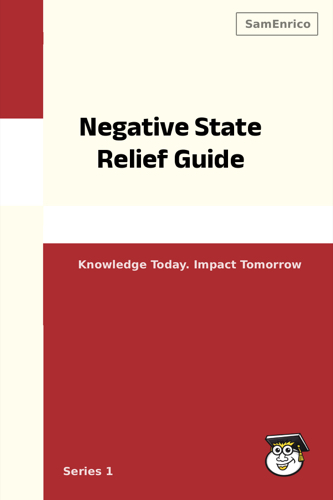
Negative State Relief Guide eBook
Offer solution to sadness for compliance.
Offer solution to sadness for compliance.
Formats
Free sample
Chapter 1: The Open Loop--The email arrived at 11:47 on a Tuesday. It was short, professional, and devastating. Three sentences informing him that the project he had spent eight months building was being shut down. Not because it failed. Because priorities had changed.
His cursor hovered over the reply button for a long time. He wanted to type something angry, something true. Instead, he closed his laptop, walked to his closet, and bought a four-hundred-dollar jacket he did not need and could not comfortably afford.He is not weak. He is not impulsive. He is not stupid.He is human.
And he was in an open loop.That jacket was not about warmth or style. It was about closing a gap. The gap between how he felt in that moment—small, erased, powerless—and how he wanted to feel. Something. Anything other than this.
The purchase did not solve the problem. It did not bring his project back. But for forty-five seconds, while he clicked "confirm order," the open loop closed. The gap disappeared. He felt relief.Then the confirmation email arrived, and the loop snapped open again.This is not a book about manipulation.
It is not a book about taking advantage of sad people or guilting strangers into doing what you want. This is a book about understanding the most basic, powerful, and overlooked driver of human behavior: the desperate, neurobiological need to close an open loop. Once you understand this mechanism, two things become possible. First, you can stop being manipulated by it yourself. Second, you can become the person who provides genuine relief to others—and earn their trust, their compliance, and their loyalty in return.Let us begin at the beginning.
Not with a theory. With a question.What is an open loop?The Neuroscience of a Gap Every moment of every day, your brain is comparing two things: where you are and where you expect to be. This is not a metaphor. It is a literal, measurable neural process. Your brain constructs a model of the world based on past experience, social norms, and personal goals.
That model generates predictions. When reality matches the prediction, your brain experiences a state of equilibrium. You do not notice it because nothing is wrong. That is the point.When reality does not match the prediction, your brain detects a discrepancy. A gap.
That gap is not neutral. It is experienced as negative affect—a range of unpleasant feelings that includes frustration, confusion, disappointment, sadness, and guilt. The size of the gap determines the intensity of the feeling. The closer you were to a desired outcome, the larger the gap feels. The more unexpected the discrepancy, the sharper the pain.This gap is an open loop.The term comes from cognitive psychology and was popularized in the world of narrative theory.
A story creates an open loop when it raises a question that it has not yet answered. Who killed the butler? Will the hero survive? What is in the safe? Your brain hates these open questions.
It craves closure. That is why you stay up too late finishing a thriller. That is why you click on clickbait headlines. That is why, when someone says "I have something to tell you" and then pauses, you feel a physical twinge of discomfort.Your brain treats unresolved emotional discrepancies the same way. The difference is that real-life open loops do not come with a final chapter.
The butler stays alive. The hero dies. The safe is empty. And your brain, which evolved to survive on the savanna, not to process corporate restructuring or romantic rejection, has only one primitive instruction: close the loop. Find relief.
Now.This is not a bug. It is a feature. The open loop mechanism evolved to keep you alive. If you did not feel the gap between safety and danger, you would walk off cliffs. If you did not feel the gap between belonging and rejection, you would be exiled from your tribe.
The mechanism is ancient, automatic, and ruthless. It does not care whether the loop closes through a wise decision or a stupid one. It does not care whether the relief lasts five minutes or five years. It only cares that the gap closes.This is the single most important fact in this book: a person in a negative state does not primarily want to be happy. They want the gap to close.
Happiness is a bonus. Relief is a requirement.The famous marshmallow experiments taught us that children who can delay gratification achieve better outcomes. What those experiments do not tell you is that the children who ate the marshmallow immediately were not weak. They were experiencing an open loop that they lacked the tools to close any other way. The marshmallow was not a treat.
It was relief.The Four Open Loops Not all negative states are the same. The gap feels different depending on what caused it. And the kind of relief a person seeks depends entirely on which loop is open. Through decades of research synthesizing social psychology, behavioral economics, and neuroscience, four distinct types of open loops have been identified. They are not merely academic categories.
They are four different locks. And you will need four different keys.Type One: Perceived Powerlessness The first open loop is the gap between the desire to act and the belief that action will make a difference. This is the loop of "I can't change this." It is not true powerlessness—most people who feel this way still have options. It is perceived powerlessness. And perception is reality when it comes to the brain.A person in a perceived powerlessness loop feels trapped.
They have tried something. It did not work. They have tried again. It still did not work. They have generated a list of possible solutions, and every item on that list comes with an internal objection: that will not work, that is too expensive, that will make it worse, I tried that already, no one will listen.
The loop is not the problem. The loop is the feeling that there is no solution.This is why people in perceived powerlessness often do nothing. Not because they are lazy. Because their brain has classified action as futile. Doing nothing is, paradoxically, a form of relief.
It closes the loop of effort by removing the expectation that effort should produce results.The influencer who understands perceived powerlessness does not offer more options. Options are the enemy. They offer one small, concrete action that is guaranteed to produce a specific, visible outcome. Not a solution to the whole problem. Just proof that action still works.Type Two: Loss The second open loop is the gap between having and not having.
Something valuable is gone. A relationship. A job. A possession. A status.
A future that you had imagined and counted on. Loss is unique among the four types because it cannot be reversed. You cannot un-lose something. The gap, in a literal sense, cannot be closed.But the brain does not accept this. It keeps searching.
It runs simulations: what if I had said something different? What if I had arrived earlier? What if I had…
This is the end of the free sample. Get the eBook to keep going. Buy now
About this book
Details
- Author
- Albert Kanisha
- Publisher
- SamEnrico
- Language
- English
- Genre
- Non-Fiction, Self-Help, Mood
- Released
- 2026-06-11
- Pages (approx.)
- 135
- Available as
- eBook, Audiobook

Read better in the ZLOADR app
Your eBooks on your phone or tablet. Sign in with your SamEnrico account and start reading.
More by Albert Kanisha
 Breaking the Casino Loyalty ProgramAlbert Kanisha$11.99
 Energy Sector Transaction AnalysisAlbert Kanisha$11.99
 Ayurvedic Heart HealthAlbert Kanisha$11.99
 The Neighbor TraffickerAlbert Kanisha$11.99
 Birthday Spending AddictionAlbert Kanisha$11.99
 Riptide Escape SkillsAlbert Kanisha$11.99
 Cannabis BipolarAlbert Kanisha$11.99
 The Last Stand of the Ball Boys: The Untold Story of the 1972 ABA FinalsAlbert Kanisha$11.99
 The Clockmaker of Leiden: Huygens and the Birth of PrecisionAlbert Kanisha$11.99
 How to Produce Horse and Livestock TrailersAlbert Kanisha$11.99
 Service Providers Guide to Fireplace Installation & RepairAlbert Kanisha$11.99
 NVIDIA Remote Internship GuideAlbert Kanisha$12.99
You may also like
 Hong Kong Handover 1997Dunn Johnnie$11.99
 Zumba For Postnatal Recovery CourseNeal Christian$11.99
 Zumba for BeginnersLadner Nikia$11.99
 YouTube Comment Mining GuideHumes Pandora$12.99
 Worry Box MeditationCarlin Rudy$11.99
 Workplace Stress MeditationNguyen Lynn$11.99
 Workplace Stress and Sleep RepairHawley Ivory$11.99
 Workplace Perfectionism CureDelaney Jeffry$11.99
 Workplace Injustice Anger GuideWallen Isabelle$11.99
 Work Addiction and Burnout LinkGreenwood Ester$11.99
 Women in Yoga and WellnessBeattie Galina$11.99
 Women in Stand Up ComedyChun Evangeline$11.99