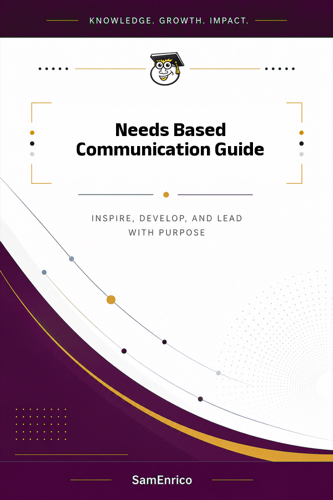
Needs Based Communication Guide eBook
Identify universal human needs underneath every co
Identify universal human needs underneath every conflict or request.
Formats
Free sample
Chapter 1: Beneath The Blame--Every conflict arrives wrapped in a story about who is wrong. Your partner left the dishes out. Your coworker undermined you in a meeting. Your teenager slammed the door. Your neighbor's dog barked for three hours.
The story feels true. It feels like a complete explanation. And it is almost never the real problem.You have been in this moment hundreds of times. Someone says something sharp. Your chest tightens.
Your jaw clenches. Before you can think, you are defending, explaining, or counterattacking. Ten minutes later, you are both exhausted, nothing is resolved, and you cannot even remember how it started. The argument felt logical in the moment. You were right.
They were wrong. But somehow being right did not fix anything.This book is built on a single radical claim: No one is irrational from the inside. What looks like irrationality, stubbornness, or deliberate difficulty is always a rational response to a threatened universal human need. When you understand that claim, everything about conflict changes. The question stops being "How do I win?" and becomes "What unmet need is driving this behavior?" That shift turns conflict from a battle into a diagnosis.This chapter introduces the foundational distinction that will guide every tool, technique, and practice in this book: the difference between needs and strategies.
Needs are universal, non-negotiable, and few in number. Strategies are specific, flexible, and infinite. Almost every conflict that seems unsolvable is actually a collision of strategies trying to meet the same or compatible needs. Once you see the need underneath the strategy, the conflict becomes solvable.The Case of the Seventy-Five Cents Let us begin with a true story. A factory worker named Miguel had been with his company for eleven years.
He was reliable, skilled, and never caused trouble. When the union negotiated a new contract, management offered a seventy-five cent raise across the board. It was a reasonable offer. It matched industry standards. Most workers were ready to accept.Miguel said no.
He would not sign. He organized a small group of holdouts. He risked his reputation, his relationships, and his steady paycheck over twenty-five cents. Management was baffled. The union was frustrated.
Everyone asked the same question: why would a reasonable person blow up a good deal over a quarter?The answer, when someone finally asked the right question, was not about money at all. A new employee, hired six months ago, was making the same hourly wage as Miguel. That new employee had less experience, less skill, and had not yet proven himself. Miguel did not need the twenty-five cents for survival. He needed it for distributive justice—the need for fairness, equality, and reciprocity.
He needed to know that his eleven years of loyalty meant something compared to a newcomer. The twenty-five cents was not a strategy for wealth. It was a strategy for recognition.Once management understood the need, they solved the problem in ten minutes. They kept the seventy-five cent raise for everyone and added a small longevity bonus for employees with more than ten years of service. The bonus cost the company almost nothing.
Miguel signed. The conflict ended. No one had to call Miguel irrational, stubborn, or greedy. He was acting rationally to protect a universal need that management had not bothered to diagnose.This is what needs-based communication looks like. Not compromise.
Not winning. Diagnosis.What Is a Need?In the academic literature on conflict resolution, the concept of a need has a very specific meaning. Drawing on the work of scholar John Burton and expanded by Paul Sites, Christopher Mitchell, and others, a need is not simply something you want or prefer. A need is an ontological requirement—something that must be met for human survival, development, and dignity.Burton argued that certain needs are universal across all cultures, all time periods, and all stages of life. They cannot be traded away, postponed indefinitely, or replaced with substitutes.
When a need is threatened, the human organism mobilizes for defense. That mobilization looks like anger, withdrawal, blame, rigidity, or what we call irrationality. But it is not irrational. It is the body and brain's way of saying: this matters. Do not ignore it.The most common mistake in conflict resolution is confusing needs with interests.
An interest is a desire or preference that can be negotiated. You want a window seat on the plane. I want an aisle seat. We can trade. No one's survival or dignity is at stake.
But a need is different. You need to be recognized as worthy. You need to feel safe. You need a sense of control over your own life. These cannot be traded.Here is the critical clarification that will save you years of confusion: when we say needs are non-negotiable, we mean the need itself cannot be suppressed without harm.
But the strategies we use to meet that need are entirely negotiable. Miguel needed distributive justice. That need was non-negotiable. But his strategy—a twenty-five cent raise—was completely negotiable. Once management offered a different strategy that also met the need, he accepted immediately.This distinction between need and strategy is the single most important concept in this book.
Master it, and you master everything that follows.The Strategy Trap Most people spend their entire conflict lives trapped at the level of strategies. They argue about bedtimes, salaries, chores, text message response times, and who said what at dinner. These arguments feel urgent. They feel like matters of principle. But they are almost always arguments about strategies.Here is how the trap works.
You have a need. That need could be met by a hundred different strategies. But you have gotten used to one particular strategy. Maybe it worked in the past. Maybe your parents used it.
Maybe you have never even considered alternatives. When that strategy is threatened or blocked, you experience it as a threat to the need itself. You forget that the need could be met another way.A parent and a teenager argue about a 10 PM curfew. The parent says: "You need to be home by 10." The teenager says: "That's not fair." They argue for an hour. Both are locked into a single strategy.
But the parent's need is not actually 10 PM. The parent's need is security (knowing the teenager is safe) and consistency in response (predictability in the household). The teenager's need is autonomy (control over their own life) and recognition (being trusted as responsible).Once you separate the needs from the strategies, the range of possible solutions expands dramatically. The parent and teenager could agree to a check-in text at 10 PM instead of a curfew. They could use a phone location sharing app.
They could agree that the teenager calls at 9:30 PM to give a status update. They could set a later curfew on weekends and an earlier curfew on school nights. The 10 PM curfew was one strategy among hundreds. But because neither party diagnosed the needs underneath, they treated a single strategy as if it were a sacred truth.This is the strategy trap. Escape it by asking one question: What need is this strategy trying to meet?Why "Irrational" People Are Making Perfect Sense…
This is the end of the free sample. Get the eBook to keep going. Buy now
About this book
Details
- Author
- Stapleton Estefana
- Publisher
- SamEnrico
- Language
- English
- Genre
- Non-Fiction, Self-Help, Needs Analysis
- Released
- 2026-06-08
- Pages (approx.)
- 148
- Available as
- eBook, Audiobook

Read better in the ZLOADR app
Your eBooks on your phone or tablet. Sign in with your SamEnrico account and start reading.
More by Stapleton Estefana
 Adoption After LossStapleton Estefana$11.99
 Franchising Your Local Brand Across Borders Weekend ObservancesStapleton Estefana$11.99
 Small Talk for Leaders and ManagersStapleton Estefana$11.99
 Crystal Meth AnonymousStapleton Estefana$11.99
 Exercise For Sperm QualityStapleton Estefana$11.99
 Assertiveness Body LanguageStapleton Estefana$11.99
 Loci Method Exam PrepStapleton Estefana$11.99
 The Velvet Revolution: How a Handbag Brought Down a DictatorStapleton Estefana$11.99
 The Ivory Hound: How a Bloodhound Exposed a Colonial Tax Evasion RingStapleton Estefana$11.99
 Mastering The Art of BokatorStapleton Estefana$11.99
 How to Produce Aquatic Grass and Weed Control ProductsStapleton Estefana$11.99
 A Collector's Handbook to the Datsun 180b, Type 610Stapleton Estefana$11.99